


When Israeli President Isaac Herzog first read the names of the 150 people selected last year to lead his new Jewish leadership initiative, he barely recognized any.
To Herzog, a former chairman of the Jewish Agency for Israel, this was a sign that his initiative, called Voice of the People, was on track, he told those inaugural leaders in Budapest last month.
That’s because he intended Voice of the People, which was established last year, to engage new Jewish audiences outside the affiliated circles with which Herzog is so intimately familiar, he explained during a Q&A session with Voice of the People CEO Shirel Dagan-Levy, a former high-tech executive.
The Q&A was the second gathering of Voice of the People, following the inaugural one in Haifa last year. At the heart of the organization is its council, which began with 150 inaugural members and grows as new members join its ranks.
Many of the members are entrepreneurs whose initiatives were selected for promotion or support by Voice of the People. In Budapest, entrepreneurs from the first cohort presented their work and the progress they have made since joining the organization.
One of those projects is Tiny Tribe, a line of Jewish educational toys for infants and toddlers developed by Erin Schrode, a California-based single mother who struggled to find toys that would help develop Jewish identity.
Schrode developed Montessori-inspired toys for children aged 0 to 3, including a soft challah, a wooden tzedakah charity box and toys with Hebrew letters.
The project has yielded a physical product that is already raising interest in U.S. synagogues, Dagan-Levy told JNS in an interview following the Budapest gathering.
This project illustrates how Voice of the People helps turn ideas into tangible initiatives, said Dagan-Levy.
Another presenter, Raphael Bijaoui Harel, is a Singapore-born artificial intelligence engineer who presented an AI solution that he said was designed to de-escalate polarization in online interactions, typically in WhatsApp groups.
The technology allows users who encounter polarization or confrontational rhetoric in such groups to chat with an AI engine on the same platform to understand the confrontation and de-escalate it, said Bijaoui Harel, whose parents are French Jews working in finance in Singapore.
A third initiative was OneBayit, a nonprofit founded by Joshua Buchalter, a recent immigrant from South Africa to Israel, which connects Jewish travelers with Jewish families abroad for Shabbat and holiday meals.
“Presenting OneBayit to President Herzog was one of the coolest experiences of my life,” Buchalter said of the conference in Budapest, which Herzog attended. “Last year, OneBayit was just an idea. This year, I got to present what we’ve built.”
Voice of the People is preparing to select its second cohort of 150 participants from approximately 2,500 applicants—more than double the number who applied to the first cohort—with the successful candidates expected to be announced in December.
Voice of the People developed an algorithm incorporating more than 100 criteria, including gender, Jewish affiliation, profession, geographic representation and the relative sizes of Jewish communities worldwide, to ensure diversity among selected applicants.
The first cohort had members aged 19 to 82, including seculars and ultra-Orthodox, technology entrepreneurs, venture capitalists, Jewish federation executives and educators. “If we will be only with people who look like us and think like us and work like us, that’s not how you lead a change,” Dagan-Levy said.
The algorithm narrows the field to 400 candidates, who undergo interviews by Voice of the People staff and members of the inaugural council. They select 250 applicants, who undergo individual interviews and background checks before the final 150 are selected.
Voice of the People has seen significant interest from people whose Jewish identity became more important to them following the Hamas-led massacres in Israel on Oct. 7, 2023, Dagan-Levy said.
“There were a lot of people in the application process who wrote, ‘I’ve never dealt with my Jewish identity. It wasn’t even on the table,’” she said, describing such people as “Oct. 8 Jews.”
Her organization provides seed funding for initiatives developed by participants, with grants of up to $20,000 to help participants establish proof of concept. Support extends beyond financial assistance, Dagan-Levy said. Voice of the People had an initial budget of about $10 million when it was launched last year.
She cited Schrode’s Tiny Tribe project as an example for the Voice of the People support net. Although Schrode is leading the initiative independently, she can turn to other council members for assistance. “So you’re never alone,” Dagan-Levy said.
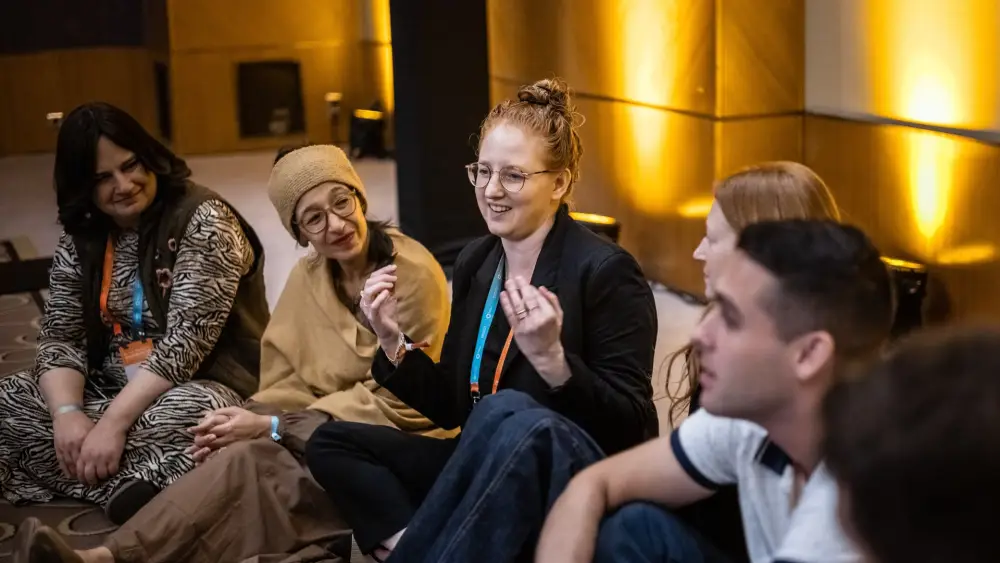
The physical gatherings are crucial to Voice of the People’s mission, she added, because it “allows you to come and meet people face to face, to have tough conversations, to be vulnerable and to look in the eyes of someone and to understand their pain or to disagree.”
The Budapest event marked the transition of the inaugural cohort from participants in a training program to permanent members of the global council, Dagan-Levy noted.
Unlike organizations whose governing bodies rotate periodically, Voice of the People intends to expand its council with each successive cohort, retaining members after they complete their training. “It’s for life,” Dagan-Levy said.
The second cohort is expected to begin its 16-month program in January 2027, with an in-person gathering planned for Israel in March.
Dagan-Levy said the organization also hopes to involve people who are not selected for the council. In addition to the applicants, approximately 9,000 people have expressed interest in participating in its broader activities.
“We see this as building an ecosystem at Voice of the People,” she said. “Even if we’re not in the council, we want people to be involved with our initiatives.”


