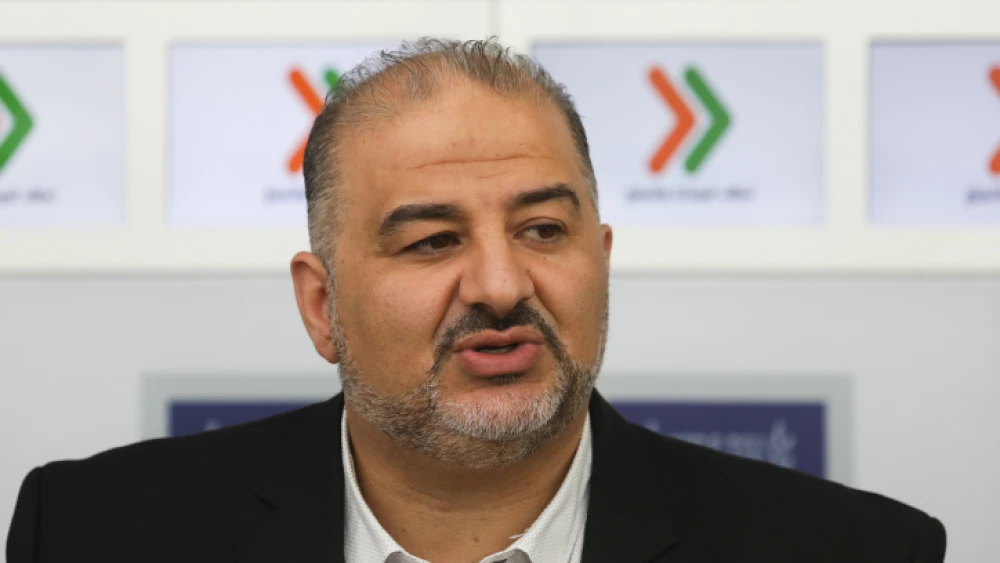
Deputy Knesset Speaker and Ra’am Party leader Mansour Abbas was the target of outrage within his own Joint Arab List faction after he told the right-leaning Israeli Channel 20 on Tuesday that “the Arab parties are not in the pocket of the left.”
Mansour’s faction mate, Balad Party chairman Mtanes Shihadeh, responded by calling for his dismissal.
“He proved he is not worthy of leadership,” said Shihadeh.
Abbas’s comments were part of an interview that he was giving about the crisis within Israeli-Arab society and the sector’s relationship with Prime Minister Benjamin Netanyahu.
“He’s the prime minister; he is responsible, and he is supposed to provide the solutions and decisions,” said Abbas. “I addressed him in a speech that was publicized; there’s nothing under the table; everything is above board. I made a few requests, mainly regarding cardinal problems in Arab society. [Israeli Prime Minister Benjamin Netanyahu] heard it, and we are moving forward.”
He added: “We crossed a certain line that has always pushed the Arab parties into a corner—specifically, they are in the pocket of someone, particularly the side of the left. I said enough of this approach; we are not left or right. We are representatives of the Arab public that is undergoing a severe crisis—a crisis of crime and violence that is spilling over in Arab society. It stands to reason that an Arab or non-Arab elected official would tend first and foremost to his constituency, and therefore I placed Ra’am in a more convenient position for contending with the range of opinions, parties and views across the political spectrum in Israel.”
According to Abbas, left- and right-wing theories cannot be applied to Arab society.
“On social issues and matters of religion and state, I am on the right, for example. Therefore the correct position is that we are committed to serving the public that elected us. The political echelon was elected by Israeli society, and we accept that, just as we demand that society and the political echelon accept us in return as elected by our constituents,” he said.
In response, Shihadeh told Israel Hayom: “It’s not surprising that [Abbas] chose a mouthpiece for Netanyahu and the far-right to announce his resignation from the Joint Arab List. This is an authentic way to serve [Netanyahu]. Knesset member Abbas is not worthy of leadership.”
This article first appeared in Israel Hayom.