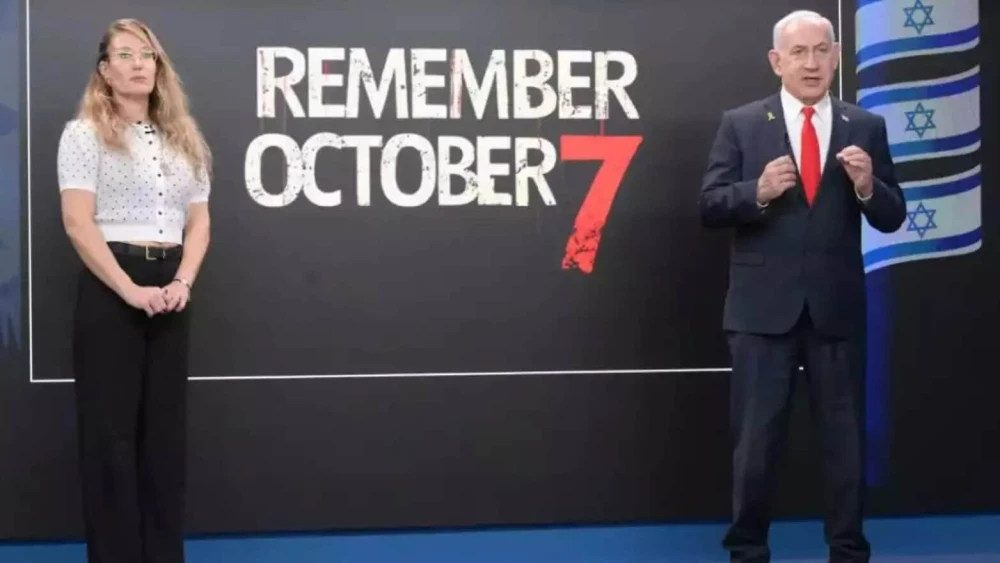

It is no small question: Ten days before Oct. 7, did Israeli Prime Minister Benjamin Netanyahu receive a 45-minute phone call from United Arab Emirates President Mohammed bin Zayed Al Nahyan warning him that Hamas leader Yahya Sinwar had decided to launch a devastating attack against Israel?
And had then-CIA Director William Burns also been warned? Did Netanyahu simply put the warning in a drawer and ignore it?
The prime minister categorically denies it, but the issue is forcing its way into Israel’s great pre-election battle.
There is little time left. Israelis go to the polls on Oct. 27, and in the remaining weeks, a head-on confrontation will unfold between those who want Netanyahu to remain prime minister and those determined to prevent that from happening.
The two camps are almost evenly matched, with much depending on the small parties hovering around the 3.25% electoral threshold, equivalent to four of the Knesset’s 120 seats.
This is no longer simply a question of right and left. After Oct. 7, few Israelis still believe there is a Palestinian counterpart with whom peace can be achieved in exchange for territory.
But Netanyahu’s opponents are attacking him relentlessly. The opposition has made the question of his responsibility for Oct. 7 a weapon it hopes will prove fatal to his political future. In recent days, since the prime minister’s wife, Sara Netanyahu, suggested in an interview that Yair Golan, a leader of the Israeli left, had advance knowledge of the Oct. 7 attack, the subject has exploded once again.
Who bears responsibility for Oct. 7—for the 1,200 people murdered and the 251 people abducted in the greatest disaster in Israel’s history?
How much responsibility rests with Netanyahu? How much with the Israel Security Agency (Shin Bet) and the Israel Defense Forces, which failed to prevent and then contain the monstrous attack?
Netanyahu has argued that he was not warned. He rejected the establishment of a state commission of inquiry on the grounds that it would be biased and instead proposed a commission with equal representation from the political camps.
He has repeatedly made the same essential argument: “If they had woken me up and warned me in time, things would not have turned out this way.”
That has been followed by a bitter dispute over the timeline. Netanyahu was awakened only at around 6:30 a.m., and his opponents argue that it then took him hours to become fully operational. His supporters, in turn, direct the accusation back at the military and intelligence establishment.
Now the battle has been inflamed by a Haaretz report claiming that Netanyahu learned directly from Mohammed bin Zayed, about 10 days before Oct. 7, that Sinwar was preparing “something big” from Gaza. If true, it would be an earthquake.
It would certainly be grave if the Israeli prime minister received such a warning and failed to alert the defense minister and the military—just as Prime Minister Golda Meir was warned by Jordan’s King Hussein ahead of the 1973 Yom Kippur War.
But Netanyahu’s office denies the report. There has been no confirmation from Mohammed bin Zayed, while silence has prevailed even at the Qatar-based news network, Al Jazeera. Evidently, the Arab world has little desire to be drawn into Israel’s election campaign.
Opposition figures, among them former Israeli prime minister Naftali Bennett, now once again very much in the race, insist that the story is true.
The affair is becoming a trial not only over responsibility for the past, but over Netanyahu’s ability to confront the dangers ahead—dangers that even now are appearing on Israel’s horizon.
Netanyahu has built his case to the Israeli public around the argument that since Oct. 7, his leadership rescued Israel from catastrophe and restored the country to a position of strength, even daring to attack Iran when he believed the nuclear threat was drawing dangerously close.
His opponents are asking a different question: What happened before Oct. 7, and what did Netanyahu know?
The latest accusation is almost certainly only one of the surprises that will punctuate what promises to be a fiery election campaign.