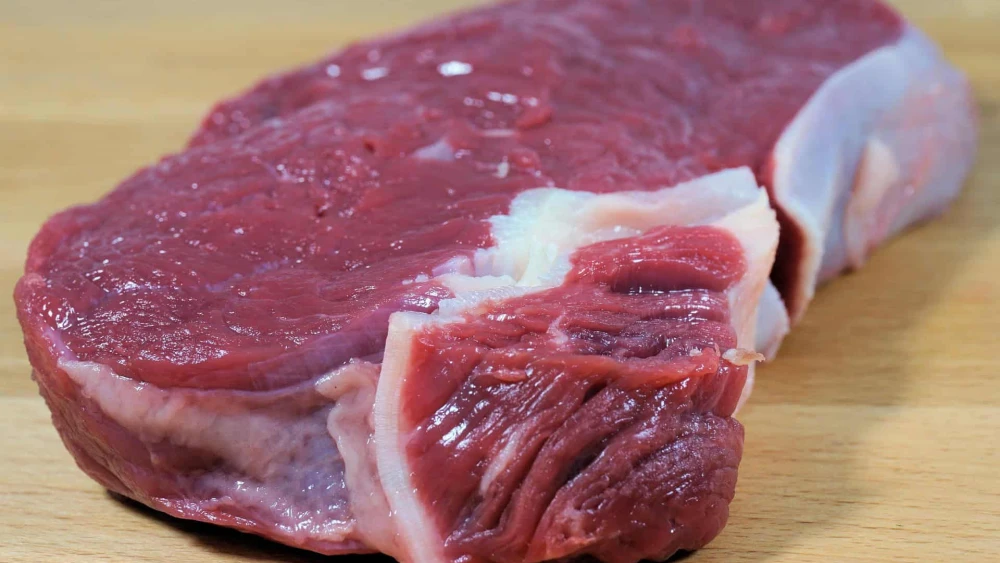
A bill that would make it mandatory to apply special labeling to kosher and halal meat passed its first reading in the British House of Commons on Tuesday, raising concerns that it will stigmatize and limit consumption.
The House accepted the bill, submitted by Parliament member Esther McVey of the Conservative Party, through the Ten Minute Rule Bill procedure, according to the protocol of the vote. It did not include a vote breakdown, which is not recorded under the procedure.
“This bill will give all consumers assurance that they know how their meat was produced,” McVey, who represents Tatton in Cheshire, said in a speech introducing the bill. She said that the production methods of kosher and halal meat, shechita and dhabihah, respectively, cause “the animal to experience severe pain” because they preclude stunning.
In an op-ed in the Daily Express on Feb. 23, she seemed to discuss approvingly how “a ban on non-stun slaughter is being introduced in some regions of Belgium, which paved the way for bans in Norway, Sweden, Slovenia, Iceland, Switzerland and Denmark.”
But in presenting the bill in Parliament, she said it “does not seek to ban halal or kosher meat. It seeks to ensure that it is clearly labeled.”
Slaughter without stunning takes place in the United Kingdom through an exemption for religious communities, but McVey said the exemption was being abused by abattoirs that export kosher and halal meat.
The British Labour Party, which has many Muslim voters and currently rules with a majority in the House of Commons, has not supported initiatives to limit the slaughter of animals without stunning. A plenum vote on McVey’s bill, which is set to take place on July 10, would likely encounter opposition from many lawmakers from both major parties.

‘Seeks to single out methods’
Shimon Cohen, campaign director for Shechita UK, a Jewish community organization devoted to protecting Jewish religious freedoms, wrote a letter to McVey after the vote that he shared with JNS, in which he disputed some of her assertions and lamented her unavailability to speak to him before the vote.
Cohen wrote to McVey that her proposal “seeks to single out just two methods of slaughter.
“If consumers have the right to know whether the meat they eat has been slaughtered by the Jewish or Muslim method, surely they should too have the right to know whether that meat had been slaughtered by the other methods too, including captive bolt or free shot, head-only by tongs electrocution, immersion in electrified water baths, LAPS [Low Atmospheric Pressure Stunning] or CO2 gas asphyxiation.”
Cohen added that under the existing laws, kosher meat is already clearly labeled as such.
Fully transparent labeling, he stated, “must be the way to go, lest consumers are fed the false binary believing that ‘stunned’ is good and or ‘non-stunned’ is bad.”
Shechita is a form of stunning in itself, Cohen argued, relying on studies that show that rapid blood loss desensitizes animals quickly. The choice, he wrote, “is between mechanical stunning methods and non-mechanical stunning methods.”
Across Western Europe, modern interpretations of animal and children’s welfare, as well as surging Muslim immigration, have complicated Jewish efforts to preserve shechita and brit milah, the Jewish custom of circumcising 8-day-old infant boys.
Activists opposed to Jewish and Muslim presence in Europe have pushed such bans, often joined by advocates for the perceived rights of animals and children, respectively. In Belgium, shechita and dhabihah are already banned in two of the country’s three regions, Flanders and Wallonia, while still legal in the Brussels-Capital Region.
Three mohels, Jews who perform brit milah, are under a criminal investigation in Belgium for allegedly practicing without a permit. The criminal investigation has resulted in a diplomatic row with the United States after Bill White, its ambassador to Belgium, demanded last week that the investigation be closed.
Brit milah is either legal or tolerated across Europe, with the possible exception of Belgium. In 2012, a court in Germany briefly ruled the practice a sort of child abuse, but legislation passed thereafter nullified the verdict and protected the practice.
Last month, British media reported that a draft document being prepared by the Crown Prosecution Service classified milah as a potential form of child abuse, alongside virginity testing and exorcisms.
Shechita in the United Kingdom “remains a tightly regulated community service, not a commercial industry,” Cohen wrote.
Cohen called McVey’s apparent endorsement of bans in Europe her “most harrowing claim,” noting that the earliest bans were “introduced explicitly to deter” Jews.
Denmark, Estonia, Finland, Norway, Slovenia and Sweden are among the European countries where shechita and dhabihah are illegal.
Poland’s parliament passed a ban in 2013, but scrapped it a year later. In 2011, the Dutch lower house of parliament voted to ban slaughter without prior stunning. However, the upper house did not pass the ban, which was not implemented. A compromise later reached between authorities and Dutch Jewish community officials imposed strict limitations on shechita in the Netherlands.