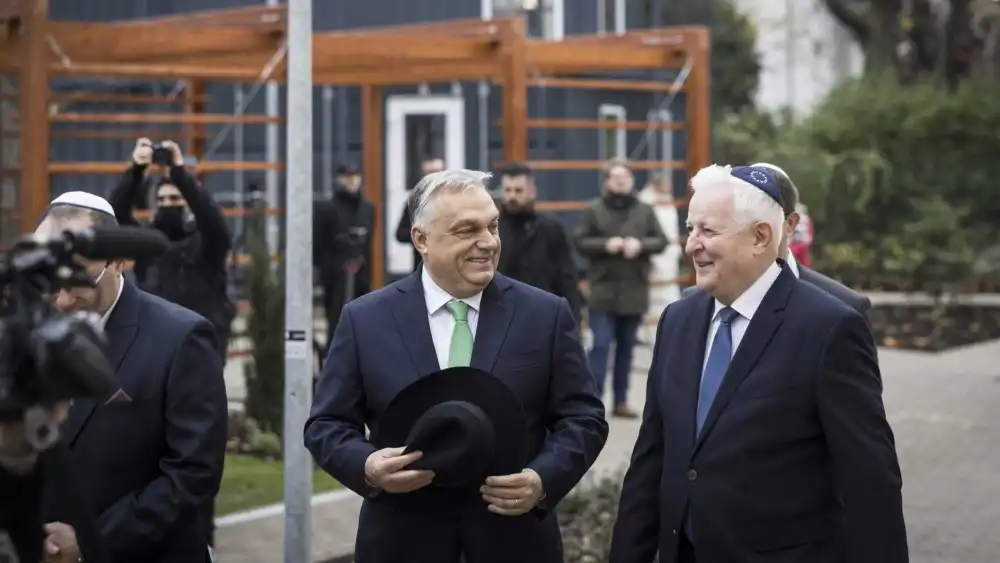
Hungary’s Jewish community last week reinaugurated its only hospital following a $26 million renovation made possible by funding from the government of Prime Minister Viktor Orbán.
Orbán spoke at the Dec. 3 reinauguration ceremony of the Jewish Charity Hospital in Budapest, recalling how Fascists closed down all of Budapest’s Jewish hospitals, destroying one of them, during the Holocaust, the news site Index.hu reported. The renovated hospital was returned to the community after World War II.
“The Jewish hospital is particularly close to my heart because I see that where patients are cared for in faith-affiliated institutions, something special happens,” Orbán said during the ceremony.
The hospital in Budapest’s Zugló neighborhood was founded in 1914, according to Mazsihisz, the Jewish umbrella group that owns it. It initially served as shelter for Jewish refugees, but “soon it was expanded to a hospital that included a number of buildings,” according to Mazsihisz.
It was nationalized toward the end of World War I under the Austro-Hungarian Empire, returned to the Jewish community, and by the end of the 1930s was among the country’s best medical centers. Persecution of Jews re-emerged under the pro-Fascist regime of Miklos Horthy. It served as a German Nazi headquarters after they invaded in 1944 and installed Ferenc Szálasi as ruler.
The hospital has more than 200 beds and its services are “available to all, with a priority to our community members and a special priority to Holocaust survivors and second generation of survivors,” Mazsihisz has said. The food served is kosher, and the hospital has an active synagogue. It also has a hospice department. Shabbat and Jewish holidays are observed at the hospital “as much as possible,” according to the group.
The reinauguration is part of an agreement between Orbán’s government and Andor Grósz, who became president of Mazsihisz in 2023. The renovation of the National Rabbinical Seminary of Hungary is also part of the agreement, and will happen in the coming years, Orbán said during the ceremony.
In the years leading up to the election of Grósz, a former army physician, Mazsihisz had had a tense and at times discordant relationship with the government headed by Orbán, who has been in power since 2010.
In 2014, under Andras Heisler, Mazsihisz announced a boycott of government-led Holocaust commemorations over the unveiling of a statue commemorating the genocide that depicted an angel being attacked by an eagle. Mazsihisz said the statue whitewashes Hungary’s Holocaust-era record by presenting it as the victim, though Orbán disputed this interpretation.
In 2021, Mazshihsz publicly condemned a law that forbade sharing homosexual content with minors. The Hungarian government provided funding to Mazshihisz throughout the dispute, including a $14 million subsidy for the construction of a new wing at the Jewish Charity Hospital.
“Over the last few years, there were differences with the government between the Mazshihsz,” Grósz acknowledged in 2021. But the group’s news leadership, he said, “believes that even if there are differences, they should be resolved in a respectful and mature, correct way.”