Newsletter
Newsletter Support JNS

JNS poll: Most Israelis think early elections would hurt deterrence

Some 60% are unhappy with the government’s handling of the war.

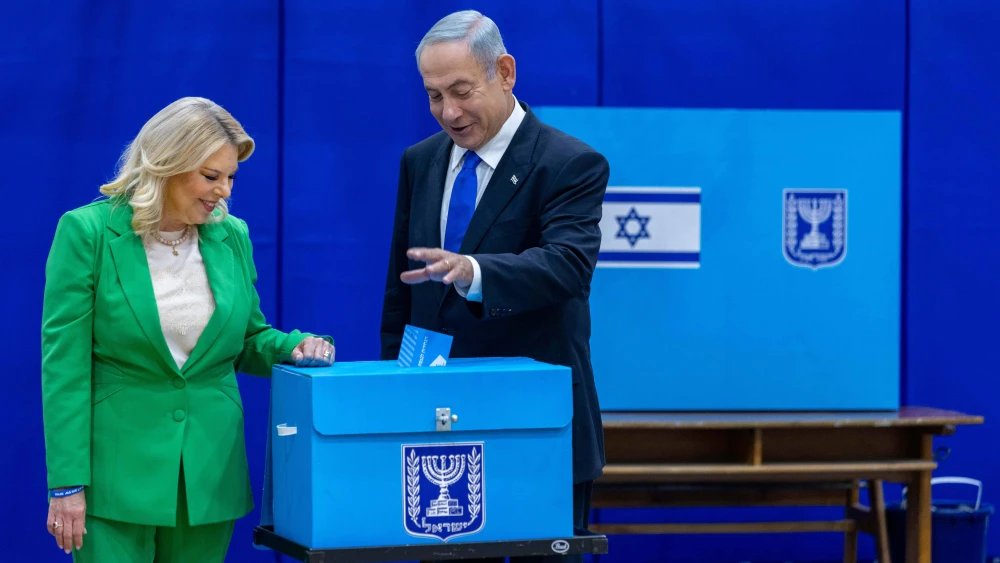
Prime Minister Benjamin Netanyahu votes in the Israeli general election as his wife, Sara look on, Nov. 1, 2022. Photo by Olivier FitoussiFlash90.

While 60% of Israelis are dissatisfied with the government’s handling of the conflicts on the country’s southern and northern borders, the majority believes that early elections would hurt the war effort, according to a poll conducted for JNS.

The Direct Polls Institute, which correctly predicted the results of Israel’s most recent election in November 2022, surveyed a representative sample of 685 Israeli adults on June 27, 2024. (The margin of error is plus or minus 4.3 percentage points at a confidence level of 95%, according to Direct Polls.)

Fifty-four percent of the respondents said a national vote before the end of the wars with Hamas and Hezbollah would “hurt” (9%) or be “very harmful” (45%) to Israel’s deterrence in the face of ongoing threats.

However, only just under two-fifths of those surveyed assessed the performance of Prime Minister Benjamin Netanyahu’s ruling coalition during the war as “good” (23%) or “very good” (15%), Direct Polls found.

Voters of Netanyahu’s coalition of right-wing parties were among those most likely to support its accomplishments and oppose early elections.

Asked when the next vote should be held, a quarter of the premier’s supporters said elections should be scheduled after the war ends.

Among the broader public, the opinion was split, with 42% saying the Jewish state should go to the ballot box “immediately” and 38% stating that elections should be held near their scheduled date, in October 2026.

A Direct Polls survey released by Channel 14 last month showed that Netanyahu’s Likud Party gained a slight tailwind following National Unity Party leader Benny Gantz’s decision to quit the wartime coalition.

Likud and its constellation parties would win 58 Knesset seats against a center-left coalition (52) and Arab parties (10), according to the poll.

Akiva Van Koningsveld is a news desk editor for JNS.org. Originally from The Hague, he made the big move from the Netherlands to Israel in 2020. Before joining JNS, he worked as a policy officer at the Center for Information and Documentation Israel, a Dutch organization dedicated to fighting antisemitism and spreading awareness about the Arab-Israel conflict. With a passion for storytelling and justice, he studied journalism at the University of Applied Sciences Utrecht and later earned a law degree from Utrecht University, focusing on human rights and civil liability.
Kenneth Marcus, founder and chairman of the Brandeis Center, told JNS that “we understand that those who characterize us that way, rather than as the civil rights organization we are, generally aim to marginalize us or undermine our efforts.”
Michael Specht, Ramapo Town Council supervisor, called the incident “very disturbing.”
The head of the Iranian parliament spoke after U.S. President Donald Trump warned he will destroy the Islamic Republic’s energy sites if it doesn’t open the Strait of Hormuz within 48 hours.
“It requires one clear choice: full decommissioning by Hamas and every armed group, with no exceptions and no carve-outs,” said Nickolay Mladenov stated.
“All the casualties from Iranian attacks, without an exception, are civilians,” Israel’s foreign minister adds.
At the site of a missile impact in southern Israel, the premier accused Tehran of targeting civilians and holy sites, and urged global action to stop Iranian aggression.