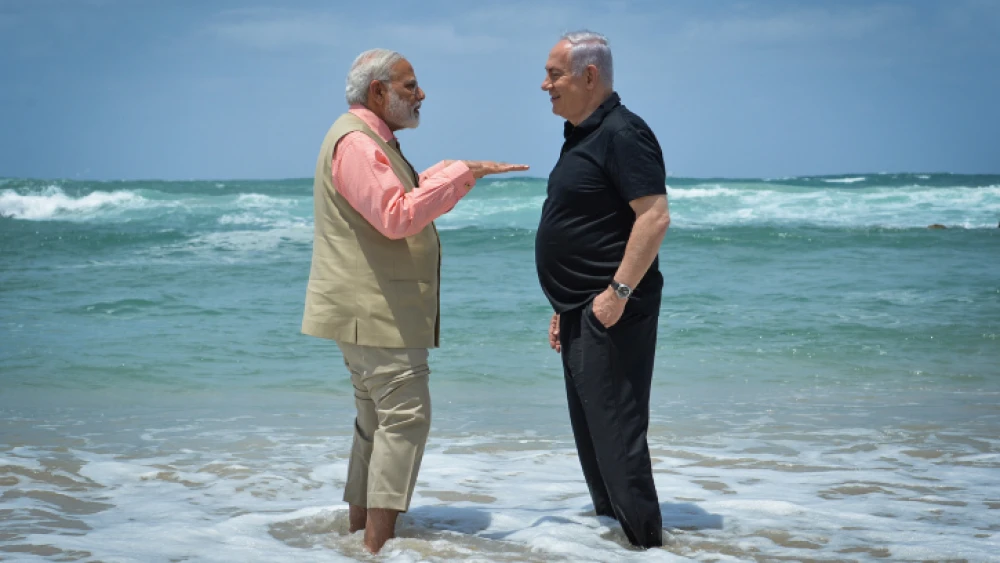
Israeli Prime Minister Benjamin Netanyahu spoke by phone on Wednesday with his Indian counterpart Narendra Modi, who vowed to advance bilateral ties between the Jewish state and the world’s most populous democracy.
“Was a pleasure to speak with my good friend, @netanyahu. Congratulated him for his impressive election win and for becoming Prime Minister for a record sixth time. Delighted that we will have another chance to advance the India-Israel Strategic Partnership together. @IsraeliPM,” wrote Modi in a post on Twitter.
Was a pleasure to speak with my good friend, @netanyahu. Congratulated him for his impressive election win and for becoming Prime Minister for a record sixth time. Delighted that we will have another chance to advance the India-Israel Strategic Partnership together. @IsraeliPM
— Narendra Modi (@narendramodi) January 11, 2023
The two leaders agreed to meet soon, according to a statement from the Israeli Prime Minister’s Office.
Last week, Indian Foreign Minister Dr. S. Jaishankar phoned his Israeli counterpart Eli Cohen to congratulate him on assuming his post.
“Look forward to partnering [with Cohen] in taking our cooperation forward. Value his many insights, including on economy and security,” Jaishankar wrote in a follow-up Twitter post.
Great to talk to the new foreign minister of Israel @elicoh1 .
— Dr. S. Jaishankar (@DrSJaishankar) January 5, 2023
Look forward to partnering him in taking our cooperation forward. Value his many insights, including on economy and security.
On Jan. 29, India and Israel celebrated 30 years of full diplomatic relations, kicking off a year of joint cultural and educational events.
Earlier Wednesday, Dutch Prime Minister Mark Rutte called Netanyahu to congratulate him on the formation of the new Israeli government.
“We discussed our renewed cooperation, and I underlined the Netherlands’ continuing support for a two-state solution, and its opposition to any steps that put this in jeopardy,” Rutte wrote in a post to Twitter following the conversation.
Rutte visited Israel in October, at which time he discussed with then-Prime Minister Yair Lapid the U.S.-mediated maritime border agreement with Lebanon and the likelihood of Jerusalem becoming an energy exporter.
They also discussed bilateral relations in fields ranging from climate change to artificial intelligence to Iran’s nuclear program.