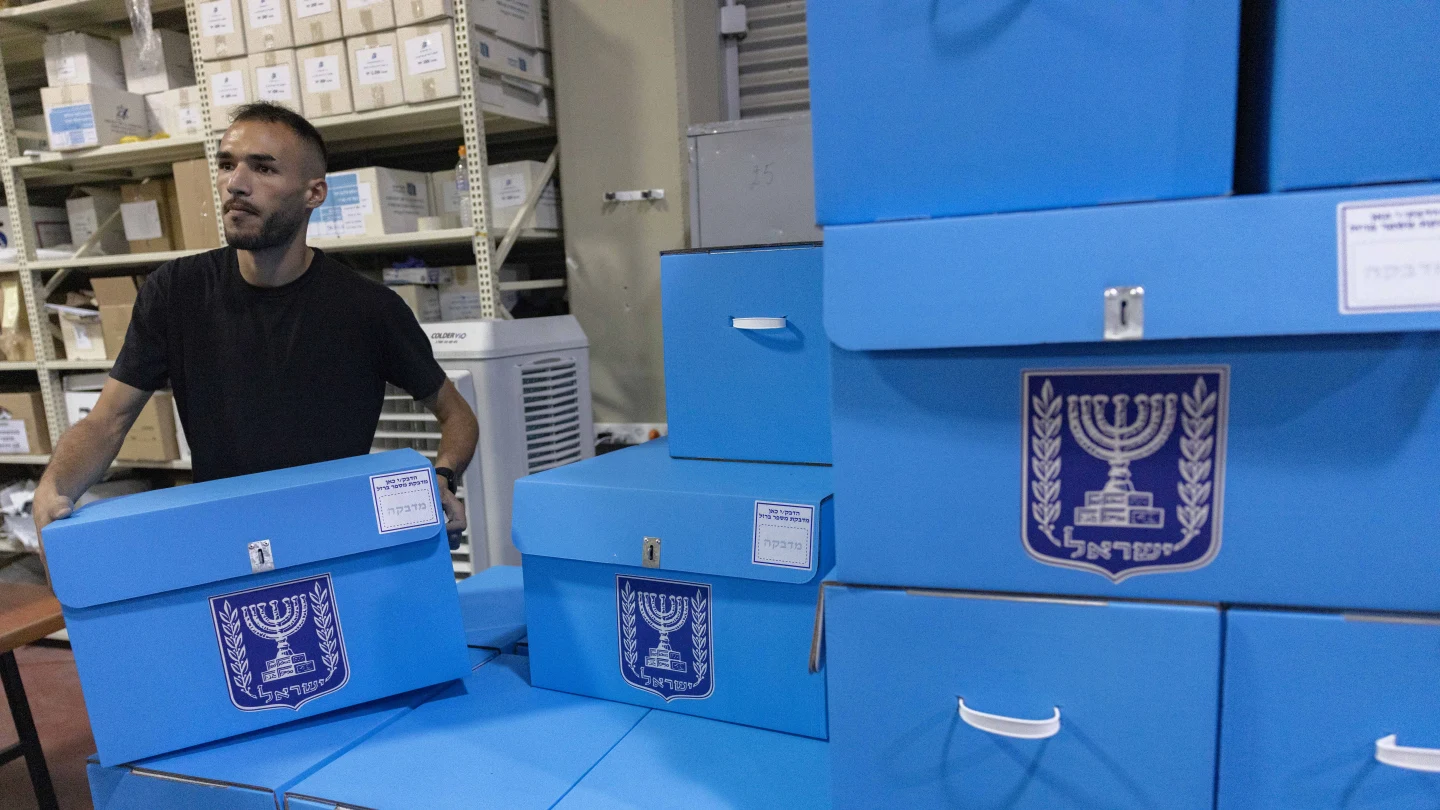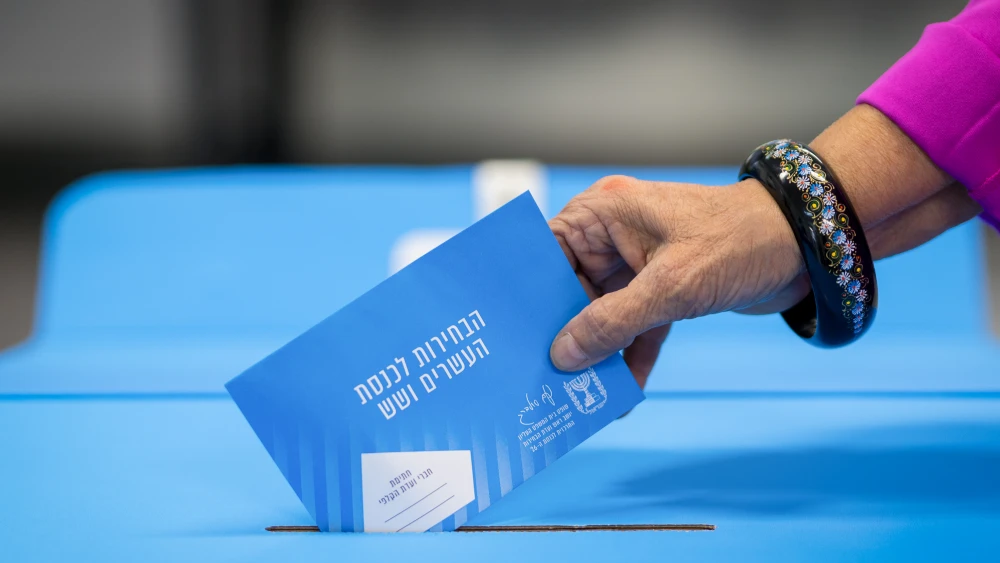
Ahead of the opening of polling stations nationwide on Tuesday for Israel’s 26th Knesset election, parties made their final pitches to voters on issues ranging from security and diplomacy to the economy.
“The Likud has the largest membership of any party in Israel. We are mobilizing our activists in every town, village and city to bring friends, family and neighbors to vote,” Avi Hyman, director of English-language outreach for the party, told JNS on Tuesday.
Likud Knesset candidate Almog Cohen told JNS that the party represents “people of all kinds and backgrounds. We are a right-wing faction whose leader is one of the most prominent figures in Jewish history,” he said, referring to Israeli Prime Minister Benjamin Netanyahu. “When the world, including U.S. President Joe Biden, told him to stop [the war against Hamas], imposed an arms embargo, urged him not to enter Rafah [in southern Gaza], said he would not bring back the hostages and told him not to strike Iran, he persevered.”
Cohen, who hails from southern Israel, expressed a commitment to strengthening Israel’s presence in the Negev and Galilee. His vision includes building an international airport in the Negev to serve Israeli travelers, supported by a unique ecosystem that could generate 14,000 high-quality jobs.
“I am deeply driven to focus on the front lines of the fight against crime and terrorism—a mission to which I have devoted my entire life. With God’s help, I wish to continue serving the nation with dedication and integrity,” he said.
The Otzma Yehudit Party campaign told JNS on Monday that the Knesset needs a strong right-wing bloc to keep Netanyahu true to his declared principles.
The campaign stressed the need for a Netanyahu “backed by partners who hold him to his principles, not one boxed into a weak unity government.”
Such governments “water down every commitment, deliver nothing on security, and fall apart within months,” the campaign warned.
The party said it is drawing voters who “don’t feel they have a home anymore,” including disappointed Likud and Shas voters, haredim, Russian-speaking Israelis and “Anglos,” that is, native English speakers.
“Voting in a Jewish democracy is something our grandparents could only dream of,” the campaign said. It called on every citizen to vote on Tuesday “with positivity and conviction.”
Otzma Yehudit Party candidate Tally Gotliv told JNS on Tuesday that the Knesset elections concern “the very character of the state of the Jewish people in the Land of Israel.”
“We live in a state that grants equal rights to all its citizens—a magnificent equality of rights. Yet, we are the State of the Jewish people,” said Gotliv, who previously served as a Knesset member for Netanyahu’s Likud Party.
“In the face of those who seek to destroy and extinguish our existence as Jews in the Land of Israel, we shall stand firm in our identity as a strong, empowered Jewish people,” she added.
Former prime minister Naftali Bennett’s B’Yachad party told JNS on Sunday that it is optimistic about Tuesday’s Knesset election, “in part because we know the people of Israel are the best in the world.”
The campaign said the Jewish state needs “better leadership that will put the needs of the public first.”
“We are offering the unity the country wants and needs not as a slogan—we’re doing it. It’s in our very name,” it said. (B’Yachad is Hebrew for “Together.”)
It pledged to put “the people who have carried the burden of defending this country first.”
Bennett and former prime minister and Yesh Atid Party leader Yair Lapid announced the merger of their factions on April 26.
Bennett heads the joint slate, while Lapid holds the No. 2 spot.
The party’s platform calls for a state commission of inquiry into the Hamas-led Oct. 7, 2023, attack. It also proposes an eight-year term limit for prime ministers and a universal conscription law.
“I’ve been through many elections, and so I know. It is clear the momentum is with us. After four years of chaos and destruction, what Israelis want and need is a government of proven professionals who will manage the country,” Lapid told JNS.
“Israelis hear this loud and clear, they want change—and on Tuesday, they’re going to bring it,” he said.
Gadi Eisenkot’s Yashar Party, which leads the opposition bloc in the polls, declined to comment to JNS.
Former Jerusalem Deputy Mayor Fleur Hassan-Nahoum, who is running for the Knesset with the People of Israel Party, told JNS on Monday that many Israelis are yearning for new leadership after the Oct. 7 massacre.
She described the party’s members as right-wing but “not tainted by the old politics of containment.”
On security, Hassan-Nahoum said the party seeks a decisive victory in Gaza. She said the current containment policy allows 600 trucks of food to enter the Strip every day, only for them to fall into the hands of the Hamas terrorist group.
“We’re going to win a decisive victory by separating the population from the terrorists, and encourage voluntary immigration from Gaza,” she said.
Hassan-Nahoum also serves as the Israeli Foreign Ministry’s special envoy for trade and innovation. She previously hosted “The Quad” on JNS TV, a panel show discussing Israel, the Middle East and the Jewish world.
The People of Israel Party, led by former Israel Defense Forces Brig. Gen. Ofer Winter, could provide additional seats for a government led by Netanyahu if it crosses the 3.25% electoral threshold, or cost the right-wing bloc votes if it should fail to pass.
Israel’s two political blocs are deadlocked and leading the Jewish state toward a second round of elections, Reservists-New Economic Party chairman Yoaz Hendel warned on Monday, less than 24 hours before voting opened.
“The only way out is to form a Zionist government,” he told JNS.
Such a coalition would exclude “anti-Zionist ultra-Orthodox parties” and Arab parties “that do not recognize Hamas as a terrorist organization,” Hendel said.
The Reservists-New Economic Party’s key objectives are universal military conscription and lowering the cost of living, he said. “We believe that those who serve should also be the ones leading the country.”
On Netanyahu, Hendel said the party has its “own position,” adding, “He is not the central issue—he is not what matters most.”
The Haredi Public Party told JNS on Monday that Israel faces an “existential problem” unless haredi children are taught core subjects and are inducted into national service.
Nearly 33% of the Jewish state’s first graders are in ultra-Orthodox school systems, the party noted.
Without core curriculum subjects “that can help them earn a viable living,” more than a third of the country will soon be “told what to do by extremists,” it warned.
The party said it is the only one able to bring the change needed to the haredi community, “to take more responsibility for their part in Israel’s future.”
“We aren’t promising to do the change after we get elected; we are the change,” said the party, adding that it represents “tens of thousands of haredim and other Israelis.”
The party held parlor meetings on Monday night, and its candidates will be out across the country on Tuesday urging people to vote, it said.
Free and fair democratic elections in Israel are more important today “than ever,” Maj. Gen. (res.) Yair Golan, leader of The Democrats (HaDemokratim) party, told JNS on Tuesday.
Golan lamented what he described as a “gap between the government’s decisions and public sentiment across a range of key issues.”
He said this gap underscores the need for citizens “to have their voices heard at the ballot box.”
“It is essential that the will of the people be accurately reflected in the composition of the Knesset,” he added.
Yisrael Beiteinu faction chairman Oded Forer told JNS on Monday that the Knesset elections are a chance to build a society that is “more united, just and resilient.”
The vote will decide whether the Jewish state becomes a nation where everyone shares the burden, he said, referring to the debate over military conscription of haredi men.
The alternative, he said, is a country where “those who serve, fight and make sacrifices continue to pay the price while draft evaders remain exempt from responsibility.”
Forer called the elections “an opportunity to restore trust between the people and their leaders,” including through a state commission of inquiry into the Oct. 7, 2023, terror attacks, leaders taking accountability and “the healing of national divisions.”