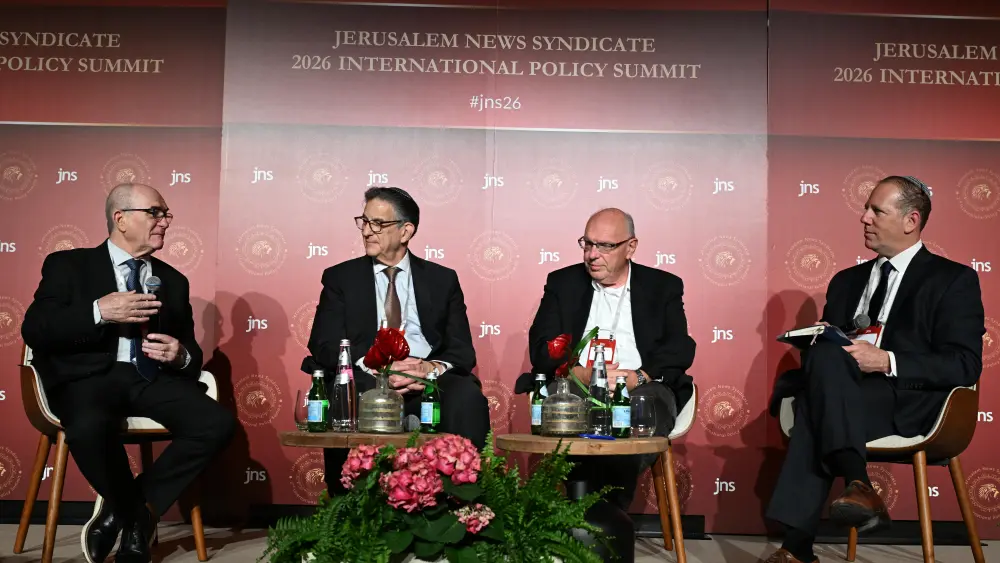
The message conveyed at a panel discussion on Tuesday at the JNS International Policy Summit in Jerusalem’s Waldorf Astoria Hotel, titled “Israel’s Military Systems and Weapons Independence,” was that the time has come for the Jewish state to rely less on foreign nations for its security needs.
The panelists also discussed Israel’s invaluable contribution to the U.S. in the fields of innovation and intelligence.
Moderator Doron Spielman, a major in the IDF Reserves, where he serves as an international Israeli military spokesman, noted at the start of the program that at the time of the founding of the Jewish state in 1948, Israel was under embargo by the U.S. and most other countries. It managed to obtain weapons from Czechoslovakia and other sources, and from the early 1950s until 1967, France was Israel’s primary arms supplier.
Brig. Gen. (res.) Yossi Kuperwasser, an Israeli intelligence and security expert and head of the Jerusalem Institute for Strategy and Security, recalled a time when the Israelis informed the Americans about the long-range missile threat emanating from Hezbollah in Lebanon, “and until those missiles fell over our heads, they didn’t believe us. It was frustrating.”
Although the goal of full military independence is the ideal, Kuperwasser conceded there are times when Israel must rely on the U.S. He gave the example of the U.S. airstrikes on Iran’s Fordow and Natanz nuclear sites. “We don’t have those kinds of weapons, and we don’t have the capability to deal with them,” he said.
“In the past,” he explained, “there was this idea that we share responsibilities with the Americans concerning the military. We were supposed to be in charge of the threats emanating from nearby areas—the Palestinians, Syrians, Jordan, Iraq and Iran were the Americans’ responsibility. In 1981, we realized this didn’t work. We went after the Iraqi reactor.
“Now, we’re at the point that we have to take care of Iran. It costs a fortune, but we have to make sure that we can deal with the Iranians on our own.”
At the same time, he stressed the value of maintaining a partnership with the United States, pointing to the negotiations between the two countries for a new security cooperation framework to replace the expiring 2016 Memorandum of Understanding.
An American view
Harold Luks, an export control and international trade adviser with Luks Cormaney LLP in Washington, D.C., stressed the importance of the private sector in enhancing the U.S.-Israel relationship.
What has changed over the decades, Luks said, is that the private sectors in Israel and the United States are learning to deal with each other in a way that does not require congressional intervention.
“I think, from my former congressional and private sector experience, that what is happening right now is that the initial dating period between the United States and Israel is over. They have now become engaged—no pun intended.”
“The private sector could accomplish a great amount of bilateral defense cooperation rather than the U.S. government having an advocate within the government to try to achieve that. I think we can rely on the private sector to do the job.”
‘Fundamental collapse of an icon of Israeli strategic doctrine’
According to David Wurmser, a fellow with the Jerusalem Center for Security and Foreign Affairs and a senior analyst for Middle East affairs at the Center for Security Policy, “what happened on Oct. 7 was the fundamental collapse of an icon of Israeli strategic doctrine.”
For the past several decades, “there was a fundamental trading of strategic autonomy in exchange for qualitative superiority that would be provided by the United States.”
“People talk about ‘America First’ as opposed to ‘America Alone.’ Israel has to do the same thing,” Luks said. “From the Zionist point of view, it’s very important that Israel maintain its autonomy and stop thinking of itself as dependent on the grace of the outside world...
“Israel has become one of the fundamental innovation centers in the world. Israel has to be included now as a critical node of American defense.”
Asked about the possibility of a hostile U.S. administration after the November 2028 election, Kuperwasser said he recognized the “problematic trends.”
“We need to be prepared for a rainy day,” he said. That’s why Israel decided to spend 350 billion shekels on domestic production of necessary ammunition. That doesn’t mean we shouldn’t continue to maintain a special relationship with the United States. But we should remember that the onus is on us to produce much of our own defense technology. Everybody agrees on that.”