


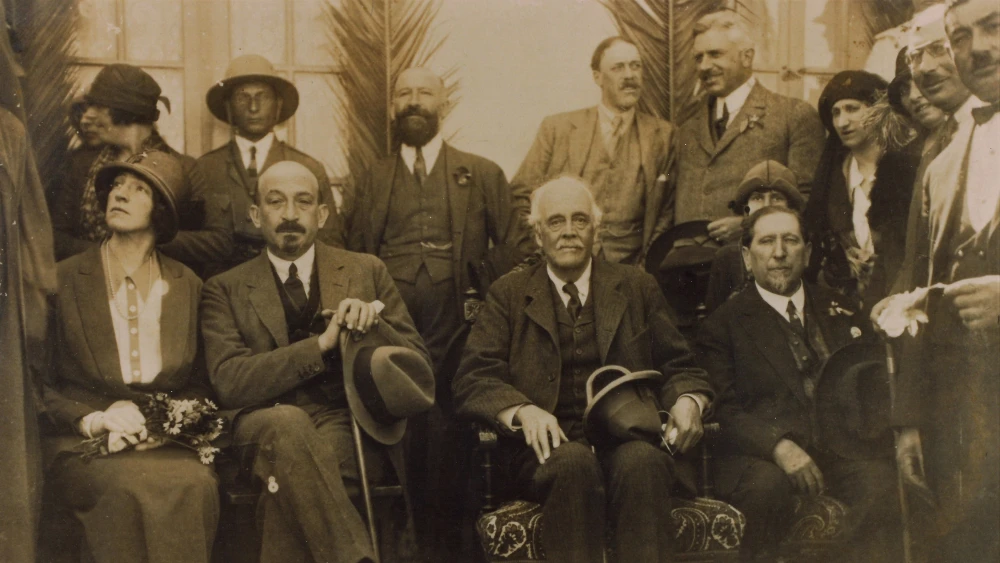

Today, Nov. 2, marks the 109th anniversary of the Balfour Declaration, one of the defining moments in the history of the Jewish people and their national revival.
On this day in 1917, in the midst of World War I, British Foreign Secretary Lord Arthur James Balfour signed a short letter addressed to Lord Rothschild. The letter contained a sentence that would change the course of Jewish history: “His Majesty’s Government view with favour the establishment in Palestine of a national home for the Jewish people.”
For the first time in the modern era, a world power recognized the Jewish people’s national aspiration to return and reestablish their home in their ancestral homeland. After nearly 2,000 years of exile, persecution, expulsions and pogroms, the ancient Jewish hope began to take the form of international policy.
But to understand the magnitude of this moment, we must understand what the Balfour Declaration was not. It was not the granting of a homeland to a people without roots. It was not the invention of a new nation. And it certainly was not the beginning of the Jewish people’s connection to the Land of Israel.
The Jewish people were not born in 1917. Jerusalem was their capital thousands of years before Balfour was born. Hebron, Bethlehem, Shiloh and the Galilee were part of Jewish history long before the British Empire existed. For generations, Jews prayed three times a day for the return to Zion, mourned the destruction of Jerusalem and concluded the Passover Seder with the words “Next year in Jerusalem.”
Balfour did not grant the Jewish people their right to the Land of Israel. He recognized a right that had existed long before him.
And this is the decisive difference between a people seeking the world’s favor and a people demanding recognition of the justice of their cause.
From Herzl to Weizmann
The Balfour Declaration did not emerge in a vacuum. It was the product of a prolonged diplomatic effort that began with the vision of Theodor Herzl and achieved a significant breakthrough through the diplomatic work of Chaim Weizmann.
Herzl understood a fundamental truth: The Jewish people needed not only pioneers, settlement and cultural revival, but also political legitimacy that would make it possible to transform their national revival into sovereignty recognized by the great powers.
Weizmann understood how to translate that vision into the language of the great powers’ interests. In the midst of a world war, as Britain sought ways to shape the political order of the Middle East after the Ottoman Empire, the Zionist movement succeeded in placing the Jewish question on the agenda of decision-makers in London.
Yet the Balfour Declaration taught us a far more painful lesson.
The limits of international promises
Three years after the declaration, at the San Remo Conference in April 1920, its principles were incorporated into international decisions concerning the future of the region. In 1922, the commitment was also reflected in the League of Nations Mandate.
It seemed that history was moving in the right direction.
However, as Arab opposition grew and British interests shifted, Britain gradually began retreating from its commitment to the Zionist project. Restrictions on Jewish immigration continued to expand, and in 1939, as the clouds of war were already gathering over Europe, the British government published the White Paper, which severely restricted Jewish immigration to the Land of Israel. Precisely when European Jews needed a national refuge more than ever, the gates of the land were gradually closing before them.
This was a catastrophe in Jewish history.
The gap between the declaration in 1917 and independence in 1948 represented 31 lost years between a diplomatic promise and the Jewish people’s ability to defend their lives against the Nazi machinery of extermination.
This is one of the most important lessons of modern Jewish history. International recognition can be obtained. The goodwill of governments can be won. Historic decisions can be secured in the corridors of diplomacy. But when the moment of truth arrives, if the Jewish people lack sovereignty, an army and the independent ability to act, their fate remains in the hands of others.
Sovereignty and survival
The Holocaust demonstrated the meaning of Jewish powerlessness in the most horrific way. The State of Israel would not necessarily have been able to prevent the entire catastrophe, but Jewish sovereignty established earlier could have provided many Jews with opportunities for rescue that were unavailable to them.
Therefore, the profound lesson of the Balfour Declaration is not only the importance of international recognition, but also its limitations. The world can recognize our right to live. Only we can ensure that we are able to exercise it.
Even 109 years after the Balfour Declaration, Israel must remember that diplomatic alliances are no substitute for military power, that international promises are no substitute for defensible borders and that even our greatest friend cannot shoulder responsibility for the future of our people in our place.
From Balfour to Iran
This lesson is also relevant to Iran and Hamas. Israel must make the most of its diplomatic alliances and international support, but it must never rely solely on diplomatic promises. An agreement with Iran that does not prevent the rebuilding of its nuclear and ballistic capabilities, or an arrangement in Gaza that leaves Hamas armed and capable of rebuilding its strength, could provide temporary calm at the cost of a future threat. The State of Israel must ensure that its security and future always remain in its own hands.
On this day 109 years ago, the Jewish people succeeded in persuading a world power to recognize their national vision.
Today, with the State of Israel sovereign, strong and capable of defending itself, our duty is not merely to remember the declaration, but also to understand the responsibility it placed upon future generations.
To be a people who do not apologize for their past. A state that does not hesitate to defend its future. And a nation that carries with it the responsibility never to lose what it has been given.
This is the profound meaning of the Balfour Declaration. And this is the great triumph of Jewish memory.
The author is Shimon Refaeli, deputy head of the Institute for Security Policy at the Israel Defense and Security Forum (IDSF).


