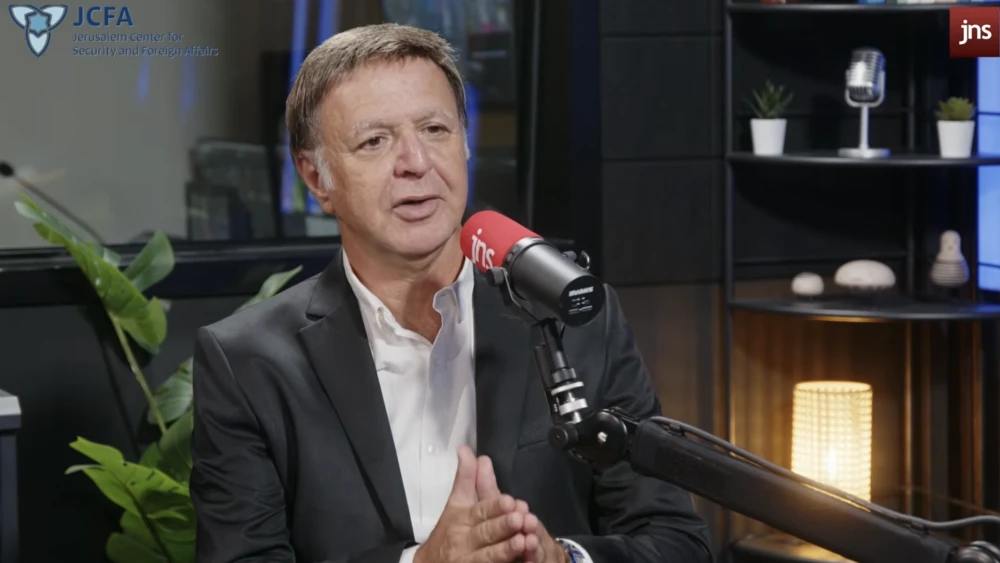

Khaled Abu Toameh is afraid of nothing—neither of thinking nor of speaking his mind. A Jerusalem Arab journalist and author with a doctorate in English literature, he has spent decades venturing into the complexities of the Israeli-Palestinian conflict, reporting what he sees rather than what others expect him to see.
We have traveled together into that complicated world many times.
Now, in the aftermath of Israel’s election, Abu Toameh offers an interpretation of one of its most striking results: the extraordinary turnout among Israeli Arab voters and the 19 Knesset seats won by the Arab parties.
His conclusion challenges the conventional political explanation.
The Arab vote, he believes, should not simply be read as a rebellion against Prime Minister Benjamin Netanyahu or his political partners. Beneath the rhetoric of the Arab political leadership, something deeper is happening: A significant part of Arab society wants greater integration into Israel.
In Umm al-Fahm, for example, turnout soared from 38.3% in 2022 to 75.7% in this election.
How does he explain such a dramatic change?
“There are two answers,” Abu Toameh told me.
“On the one hand, there is anxiety and fear, and the rallying cry urging people to vote against the Israeli government, in which [Otzma Yehudit party leader Itamar] Ben-Gvir and [Religious Zionist party head Bezalel] Smotrich are portrayed as a mortal threat. A sense of outright panic raised the specter of expulsion, destruction and marginalization.
“On the other hand, there is the desire for integration. Working among Israelis and enjoying a free and democratic society, students, workers, judges and doctors in hospitals want to have a greater say. It is the only country in which Arabs can organize, demonstrate and vote freely.”
Yes, I told him, but this freedom exists within the society of the Jewish people.
“Of course,” he replied. “In Italian society, too, minorities live protected by Italian law. Many appreciate this. Others less so. Minorities need to expand their opportunities and improve their situation, and despite the problems, this has also happened among the Arabs.
“Many of the people I speak with have a sincere desire to share in society—not with this or that political camp, Netanyahu or Eisenkot, but with Israeli society as a whole.”
That distinction is essential.
Much of the political interpretation of the Arab vote assumes that a large turnout must necessarily represent opposition to Netanyahu. Abu Toameh sees something more complicated and potentially more important.
It is a desire to participate.
Yet there is an obvious contradiction. The rhetoric of Arab political leaders frequently appears much more radical than the attitudes Abu Toameh describes among ordinary Arab citizens. Some Arab politicians have refused to describe Hamas as a terrorist organization and have accused Israel of colonialism and genocide.
Could Israel’s democracy itself become an instrument for radical Islamist forces that ultimately reject the Jewish state?
Abu Toameh is unconvinced.
“The leaders of the Arab parties are highly rhetorical and sometimes stupid,” he said. “They do not express the expectations and desires of a large part of Arab society.
“Moreover, neither the Israeli right nor the left appears to understand its problems: the future of young people, the devastating crime.
“If the current Arab leadership says a lot of foolish things, that is wrong. They should stop seeking support by attacking Israel. Many Arabs want greater integration. It has nothing to do either with rejecting Bibi or, on the other hand, with the jihadist advance you described.
“Many believe that the Oct. 7 disaster was monstrous, and they have no problem saying that Hamas is a terrorist organization. It is so obvious.”
But the Islamist appeal remains. The ideological claims of Islamic supremacy, exclusive possession of the land and the depiction of Israel as a colonialist enterprise have not disappeared.
Abu Toameh argues that these ideas should not be confused with Israeli Arab society as a whole.
“You will have noticed that very little of this was heard during the election campaign,” he said. “The Israeli Arab community has lived in close proximity to Israeli society for years; the two are intertwined. Radical Islamists are not the protagonists of this story, and there are many secular people among us as well.”
I also asked him about allegations that envelopes containing money from Qatar and other foreign sources had been distributed, particularly in the Negev.
“I know nothing about that,” he replied. “But I would say that if there was corruption, it is a stain, but it is not the central story.”
For him, the central story is elsewhere.
“The real story, if anything, is a social rapprochement that has not yet been matched by either an Arab or an Israeli political leadership capable of fully understanding it.
“For too many years, even when Arab parties entered governments in a highly instrumental way, Arab society itself was not really looked at.
“Today’s leaders must stop using aggressive slogans against Israel. The Arab component of Israeli society today could very well fit within the framework of a coalition government. That would be promising for everyone.”
Perhaps this is the most unexpected message of the election.
The extraordinary Arab turnout does not necessarily mean that Israeli Arabs have mobilized against Netanyahu, or that they have embraced the ideological rhetoric of their political leaders. It may mean that they increasingly want a stake in the country in which they live.
Israel’s political arithmetic remains difficult. The Zionist opposition won 48 seats, Netanyahu’s bloc 53 and the Arab parties 19. No side can simply ignore the others.
Perhaps, then, the numbers are pointing toward something Israeli politics has resisted for too long: not another government built around hatred of Netanyahu or fear of the left, and not one dependent on anti-Israel rhetoric, but a broad coalition bringing together the right, the left and those Arab Israelis who want to participate fully in the future of the country.
Such a government would demand difficult compromises from everyone. It would also require Arab political leaders to bring their rhetoric closer to the aspirations Abu Toameh sees in their own communities.
But if Abu Toameh is right, Israeli Arabs increasingly want to be fully integrated into Israeli society.
Perhaps Israeli politics should finally move toward them.
His conclusion offers something that all of us need today: hope.