


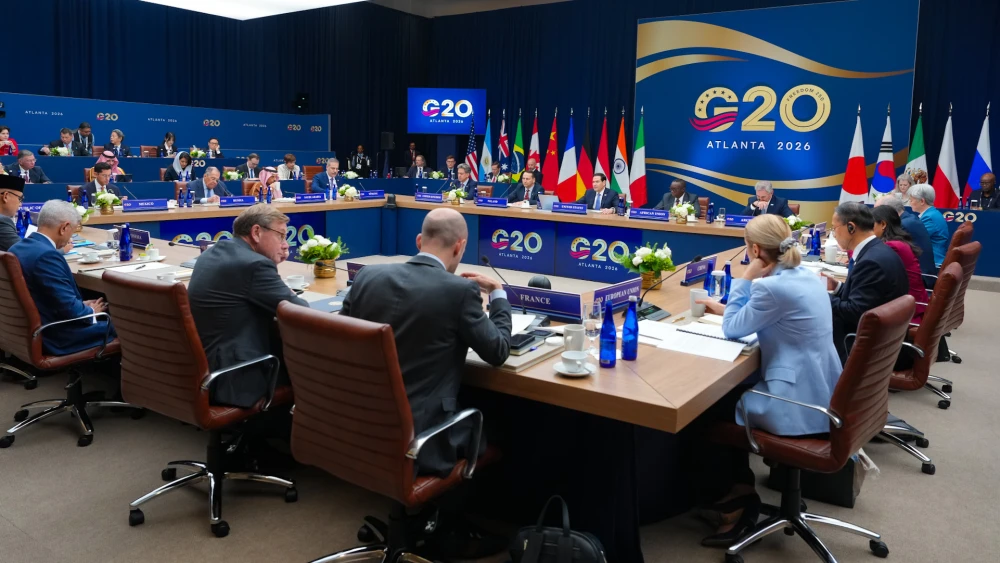
U.S. President Donald Trump “hasn’t made a decision” whether to resume strikes on Iran, Secretary of State Marco Rubio said on Saturday at the G20 Foreign Ministers’ Meeting in Atlanta.
Trump still prefers a diplomatic solution, according to Rubio.
“This is a regime that has massacred its own people,” the top U.S. diplomat said. “You could only imagine what it would do to others if it possessed weapons of mass destruction, which will never be allowed to happen as long as President Trump is in the White House.”
The Iranian regime, which backs militias in Lebanon and Iraq and supports the Houthi terrorists in Yemen that are attacking Saudi Arabia, “is at the center of all the instability in the Middle East,” according to Rubio.
“That is a fundamental threat that we have to confront, on top of the fact that they want nuclear weapons,” the U.S. secretary of state said.
Delegates from the 20 largest world economies could not reach a consensus in Atlanta about several key global security issues, particularly the Russian war against Ukraine.
Rubio still said that there had been “productive” discussions about threats to freedom of navigation, energy and food security.
The main challengers of freedom of navigation are Iran in the Strait of Hormuz and the Houthis in the Red Sea and Bab al-Mandab Strait.
JNS asked Rubio at a press briefing if other countries are offering their own solutions or if the United States is doing so and asking others to follow its lead.
“In the case of the straits, it’s more challenging, of course, because many countries around the world don’t have the ability to project power,” Rubio told JNS.
The U.S. secretary of state noted Trump’s requests, and sometimes demands, that allies join with Washington to protect global shipping interests there.
“So far, we have limited cooperation,” Rubio told JNS.
U.S. administration officials have cited greater levels of cooperation in implementing and enforcing secondary sanctions against Iran rather than direct military contributions.
If the United States strikes Iran after the U.S. midterm elections this week, the Iranian regime could retaliate with major consequences for the Gulf. Multiple media outlets have reported that the White House warned Gulf allies to prepare for a short but intense campaign. No parties have confirmed that.
Rubio said on Saturday that Washington is already living up to its security guarantees to its Gulf allies.
“We are doing it now. I mean, it’s not our oil and natural gas that’s flowing through the Strait of Hormuz,” Rubio said. “It’s theirs, and it’s the lifeblood of their economy.”
The United States is shooting down a drone aimed at an allied cargo ship “virtually every day, every other day,” Rubio said. “The United States also has an extensive presence in air defense, and we provide that and have done so in the past, along with their own capacities.”
“They’re using American equipment to do much of that, so you know we fully recognize the threat that’s posed,” he said.
Sergey Lavrov, Russian foreign minister, took part in the G20. Many counterparts declined to be seen with him, so a group photo was canceled.
Poland was a guest at the G20. South Africa, a G20 member, wasn’t invited, in part due to its harsh criticism of Israel and prosecution of the Jewish state in international court.


