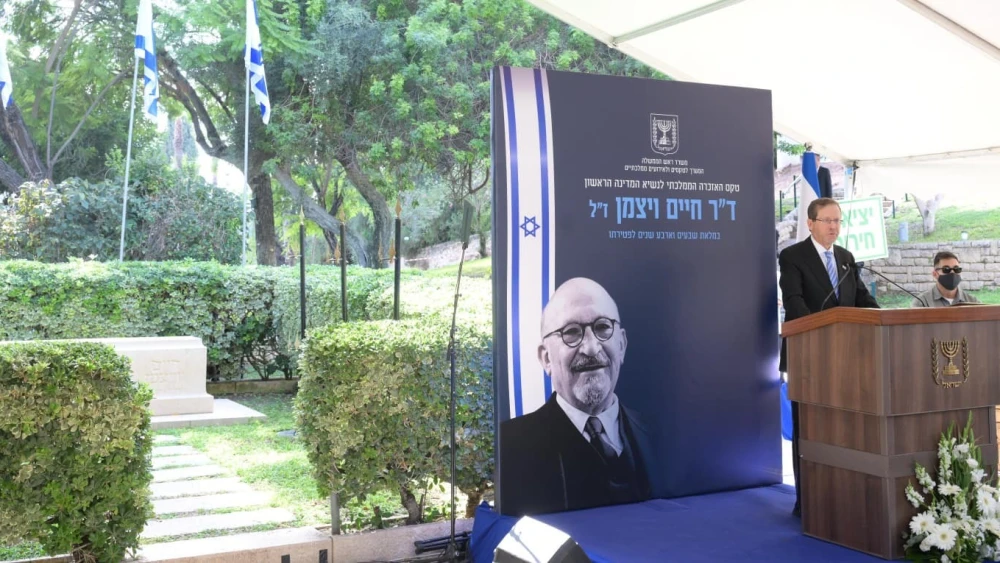
Israeli President Isaac Herzog on Sunday urged political leaders to seek compromises to avoid another election, speaking at a memorial ceremony in Rehovot for Israel’s first president, Chaim Weizmann.
Herzog said he would receive the official results of the Oct. 27 election on Wednesday before beginning consultations with Knesset factions at the President’s Residence in Jerusalem.
He called on leaders to approach the talks with “an open mind” and “an open heart.”
“As we all know, during an election campaign, candidates naturally and predictably climb to lofty positions. But the elections are over. The election results are a fact. They are a reality,” Herzog said.
He urged leaders to move beyond their campaign positions. “This week at the President’s Residence, we will try to put up ladders so that our leaders can come down and face this reality in a measured and careful way,” he said.
Neither Zionist bloc secured a Knesset majority
The opening session of the 26th Knesset is scheduled to be held on Nov. 10, the 14th day after the election, when the newly elected MKs make their declarations of allegiance and are sworn in.
After consulting with all party leaders, Herzog will task the lawmaker he believes is best positioned to form a government with doing so, according to the lawful procedures of Israel’s coalition building.
The leader granted the task to form the next government need not be the leader of the largest party; meaning that Israeli Prime Minister Benjamin Netanyahu is not guaranteed the opportunity, despite his Likud party emerging with the largest number of Knesset seats.
Likud secured 27 seats, followed by Yashar with 21 and B’Yachad with 12. The Joint List won 11 seats, The Democrats and Ra’am eight each, Yisrael Beiteinu, United Torah Judaism and Otzma Yehudit seven each, and Shas and the Religious Zionist Party six each.
The two Arab parties, Joint List alliance and Ra’am, together won 19 seats, leaving neither of the Zionist blocs with a majority and setting the stage for tough coalition negotiations.
Although no Israeli government has ever been formed by a minority coalition immediately after an election, Gadi Eisenkot, the chairman of Yashar, told Ynet on Oct. 10 that he would seek to lead one if he fell short of a parliamentary majority, necessarily relying on the tacit outside support of Arab parties.
The government-formation process follows a timetable set by law. The first candidate Herzog designates receives 28 days, with a possible 14-day extension, to form a coalition. If he or she is unsuccessful, the president can assign another candidate 28 days. If that attempt also fails—or the president determines there is no possibility of forming a government—a coalition of at least 61 MKs have 21 days to request that the president designate an alternative candidate. That candidate then has 14 days to form a government.
Failure to establish a government would trigger another election approximately 90 days later. Herzog has pledged to try to avoid that outcome, declaring: “I really, truly will do all I can so there won’t be repeat elections.”