


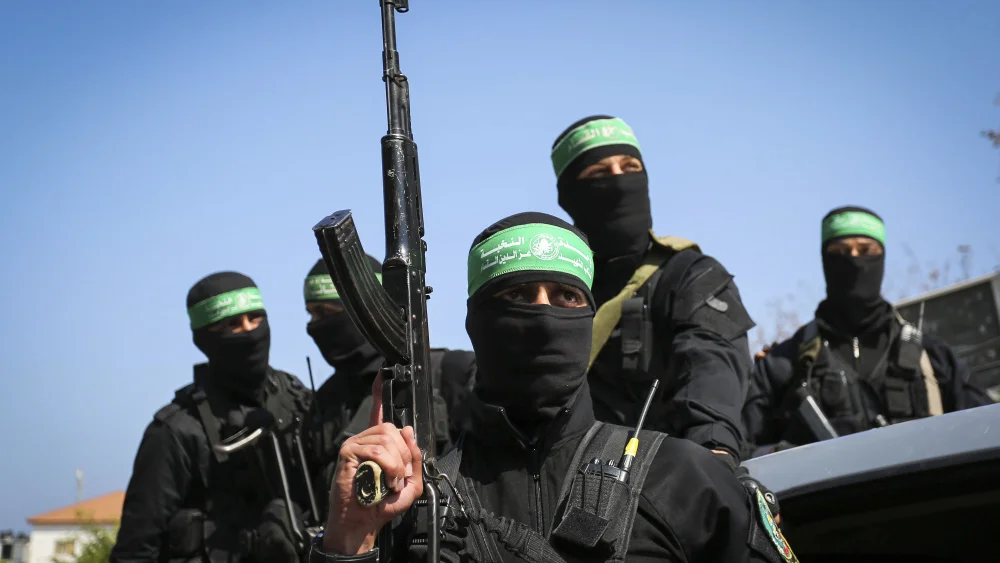
A diplomatic source familiar with the U.S.-led Board of Peace dismissed on Monday Hamas’ announcement that it intends to dissolve its governing role in Gaza after 19 years, saying the move “means nothing.”
“It shows that Hamas is under pressure; they’re cornered,” the source told JNS. “So what they’re trying to say is, ‘Look, we’re not the problem, we’re not the one saying no. The technocratic committee can come in, take over our bankrupt economy, our broken services, our mountains of debt and all of our problems, and we’ll just keep our weapons and keep power.’”
Hamas’s Government Media Office said the designated terrorist organization is prepared to hand over administrative control of Gaza to a Palestinian technocratic body under the Board of Peace framework, known as the National Committee for the Administration of Gaza, intended to serve as a transitional governing authority.
However, the statement made no mention of Hamas’s disarmament, a central condition of the U.S.-brokered Israel-Hamas ceasefire agreement that took effect in January.
According to the source, Hamas is attempting to shift responsibility onto the international community while avoiding the core requirements of the agreement, which include a sequenced process of disarmament, deployment of an international security force, installation of the NCAG and a formal transfer of authority.
“What they’re trying to do is more of a sham,” the source told JNS, accusing Hamas of wanting “to shovel off the sh*t, which is taking care of people and actually providing electricity and water. They want to hand over that and keep power and money.”
The source also said Hamas is struggling to pay the government employee salaries, adding, “We can do it, but we’re not paying the salaries of a Hamas state. We’ll pay the salaries when they hand over authority and transfer to the NCAG.”
If it’s not a game that Hamas is playing, and they are serious about a governing transition, “they can prove it by signing the sequencing agreement,” the source told JNS.
“If they come around next week, sign the agreement on how to disarm and give up their tunnels and give up their light and heavy weapons and hand over authority properly, then great,” the source said. “But what we’re seeing is instead they’re trying to position themselves through the media and through announcements that they’re doing these wonderful steps that in practice don’t mean anything.”
The Board of Peace aims to “move fast on some things,” including pilot projects to construct shelters outside Hamas control, to be gradually expanded under the protection of a multinational security force that would replace the Israel Defense Forces in those areas.
The NCAG, based in Cairo while awaiting deployment, is prepared to assume administrative responsibilities in Gaza. However, officials acknowledge the scale of the challenge after more than two years of war.
“Are they ready to take over all of Gaza on day one? No, but nobody is,” the source said of the NCAG. “It’s a colossal undertaking, but I think they’d be ready to start taking over services and start taking over some of the supply chain and making things hygienic pretty quickly if Hamas disarmed and was not actively trying to undermine them from doing that.”


