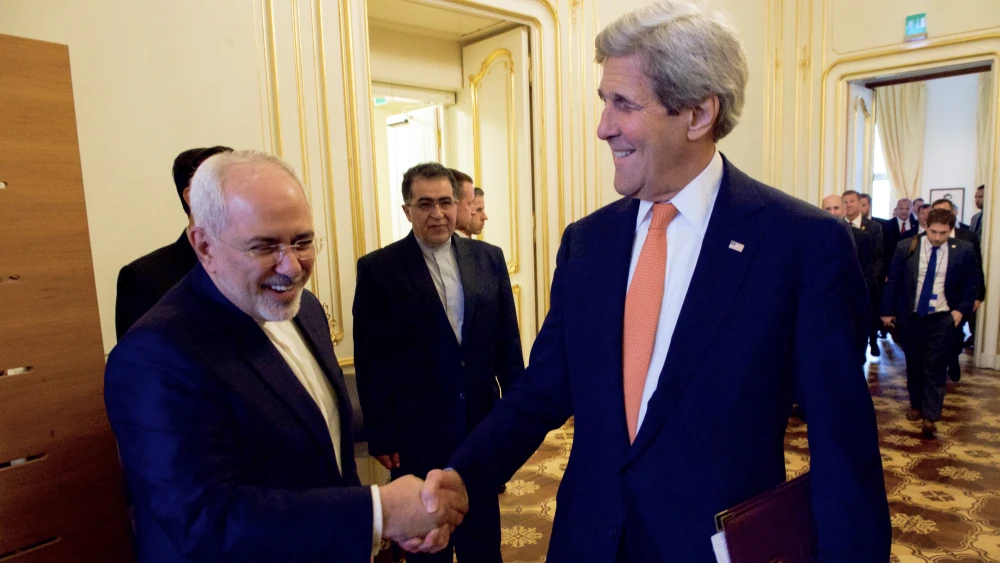
Iran is said to outlast its foes at the negotiating table with its “bazaar style,” which Persians honed over thousands of years, and its “shrewd” and “meticulous” approach.
“Iran never won a war but never lost a negotiation,” U.S. President Donald Trump stated on Jan. 3, 2020.
But experts told JNS that the Iran regime’s reputation as a master negotiator, which it is said to have displayed during the 1979 hostage crisis, the 2015 nuclear agreement and the most recent round of U.S.-Iranian negotiations surrounding a memorandum of understanding, is over-hyped.
Jason Brodsky, policy director at United Against Nuclear Iran, told JNS he would give the regime a C-plus on its abilities at the negotiating table.
“The Iranian regime is only as strong a negotiator as we allow them to be,” he said. “It takes very disciplined negotiations from the U.S. side to be able to counteract their demands.”

The Islamic Republic can be too confident in its abilities as well, according to Brodsky.
“Iran has the tendency to overplay its hand,” he told JNS. “They feel so emboldened that it is very likely they are going to overplay their hand.”
Iran has also suffered “massive damage” from which it will take years to recover and which limits its negotiating position going forward, but it can still be misunderstood if American negotiators aren’t cautious, according to Brodsky.
“The Iranian regime does not enter negotiations trying to solve problems with the United States,” he said. “It uses negotiations as an extension of its conflict with America, not a substitute for that conflict.”
Jonathan Harounoff, author of a book on protest movements for women’s rights in Iran, told JNS that depending on what exactly is being evaluated, Tehran would get mixed marks at the negotiating table.
Harounoff, who recently stepped down as international spokesman for the Israeli mission to the United Nations, gave the regime an A for its negotiation skills and ability to leverage its diplomacy to advance its interests.

“Islamic Republic negotiators are very shrewd, very skilled and they typically adopt a long-term strategy instead of a short-term one,” he told JNS.
He gave the Islamic Republic an F for what he said was its “sincerity for wanting to reach a deal that delivers actual regional peace.”
That distinction helps explain why public perceptions often differ from those of experts, and those who assess Iran primarily through its public messaging may be more inclined to give it an A, according to Harounoff.
“But those who were cognizant of the vast gulf between what the regime says and what it does in practice will likely be closer to the F grade,” he told JNS.
Stalling tactic
Annika Hernroth-Rothstein, a Jewish political adviser, writer and activist who has reported in Iran, told JNS that Western policymakers often misinterpret the regime by treating it as a conventional negotiating partner rather than a state shaped by a distinct historical and strategic worldview.
“They fail to understand what Iran is, and they also have very little insight into Persian history and culture,” she said.

The Iranian regime benefits from thinking in decades rather than election cycles, allowing it to outlast shifting Western administrations. “They understand their opponent very well,” she told JNS. “They are also good when it comes to exhaustion.”
Asked to describe Iran’s negotiating posture in a single word, she said “patient.”
“They have nothing to lose,” she told JNS. “If all you have to do is survive, Trump has to do a whole lot more than that to call this a win.”
Brodsky and Harounoff agreed.
“The Iranians prefer long drawn-out negotiations that gradually try to exhaust the other party in diplomacy in order to extract the concessions that the Islamic Republic wants,” Brodsky told JNS.

Iran’s negotiators also benefit from decades of institutional experience across multiple U.S. administrations, he said.
Electoral cycles and administrative changes don’t constrain Iran’s leaders, so the latter can afford to delay and recalibrate their approach over time, according to Harounoff.
“They have the luxury of stalling, kicking the can down the road and hoping that a future administration might view the Islamic Republic more palatably,” he told JNS.
Harounoff said that the Iranian regime must not be conflated with the people and that the “greatest misconception” about the Islamic Republic is that it in any way resembles the 93 million Iranians.

“The vast majority of Iranians want peace with the outside world,” he told JNS.
Hernroth-Rothstein echoed Brodsky’s view that the Iranian regime’s confidence could backfire for it.
“They are very proud people,” she told JNS. “I think they might overplay their hand, because they are very cocky.”
A Quinnipiac University poll released last month suggests that 59% of voters aren’t confident that the Iran deal will work, with 19% not being very confident and 40% not at all confident. Some 37% were confident that it would work—11% very confident and 26% somewhat confident.
Iran is either very likely (21%) or somewhat likely (40%) to develop nuclear weapons, 61% of the voters surveyed told pollsters, with 33% thought the opposite—21% that its not so likely and 12% not at all likely.