KRAKOW, Poland—It is not the profile one might expect of a volunteer at one of Europe’s largest Jewish cultural events.
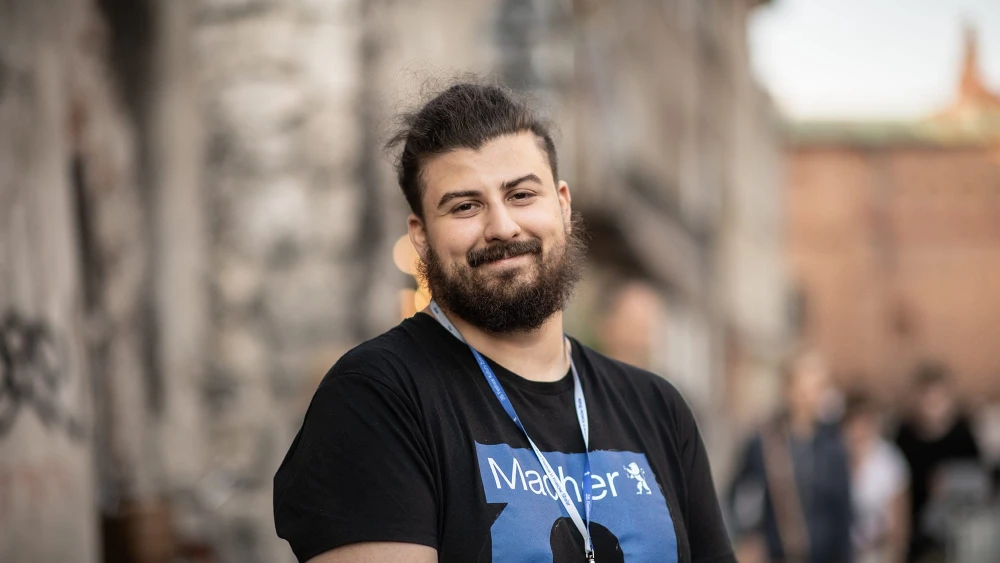
At 23, Adam Dabedoub is an Icelander from a country often known for its frosty relations with Israel. His father is Muslim and originally from Egypt, while his mother is Christian and Icelandic.
“I knew almost nothing about Jewish culture or heritage,” Dabedoub told JNS while volunteering at the 35th Krakow Jewish Festival alongside more than three dozen young adults from Israel, the United States and across Europe.
His path to the weeklong festival that concluded on July 5 began with a Polish woman he met in Iceland. She had previously volunteered at the annual event and encouraged him to apply.
“I wanted to start a new life and go somewhere to define who I am,” he said.
After moving to Poland with his girlfriend, Dabedoub walked into the festival’s offices for an interview and was immediately accepted for a five-month volunteer position.
“A lot of happenstance led me here,” he said.
Founded nearly four decades ago as a tribute to the lost Jewish culture of Polish Jewry, which was decimated in the Holocaust, the Krakow Jewish Festival has grown into the largest Jewish festival in Europe.
Festival director Robert Gadek said previous editions have also included a small number of Muslim volunteers from Jordan, Pakistan and Azerbaijan.
Dabedoub, who trained as a chef, said working alongside volunteers from different backgrounds has broadened his understanding of Jewish life, including Shabbat and Jewish traditions.
“My dad taught me that if you want to get to know people forget where they come and try to give a person a clean slate to avoid biases,” he said.
He said volunteering at a Jewish festival during a period of rising global antisemitism aligns with both his desire to explore the world and the example set by his parents, who both worked in the tourism industry.
“I’m doing what my parents did just with a big safety net,” he said.
Looking back, Dabedoub acknowledged that his journey has been unusual.
“I never thought how eccentric my story is, but I would never trade anything for it,” he said.