“I stand with Israel because it’s real simple when you believe the Book, and I do,” U.S. Ambassador to Israel Mike Huckabee declared at a StandWithUs gala in Jerusalem on Thursday night. “I’ve been visiting for 53-and-a-half years, and it’s not hard for me to say I stand with Israel and I hope you stand with us.”
The Nov. 12 event at the YMCA Theater celebrated the 25th anniversary of StandWithUs, the international Israel education organization, bringing together American supporters of Israel, former hostages, military figures and young advocates for the Jewish state.
Opening the evening, Michael Dickson, executive director of StandWithUs Israel, welcomed a solidarity mission of pro-Israel leaders from across the United States, led by the organization’s co-founders, Roz and Jerry Rothstein.
Dickson said the delegation had traveled across Israel, hosted an event for soldiers and participated in a ceremony marking the organization’s anniversary at the Tel Aviv Stock Exchange.
“Tonight we will hear from ambassadors, we’ll hear from students, we’ll hear from amazing individuals who’ve chosen to speak out against antisemitism and speak up for Israel and the Jewish people,” he said.
“We’ll also hear powerful personal testimonies that remind us that behind every headline is a human story.”
‘Let’s call it what it is’
Huckabee grounded his commitment to the Jewish state in his Christian faith and the biblical promise made to Abraham.
“Because whether we who are not Jewish like it or not, it was here in this land that God said to Abraham, ‘I will make you a great nation, and those who bless you will be blessed, and those who curse you will be cursed,’” he said.
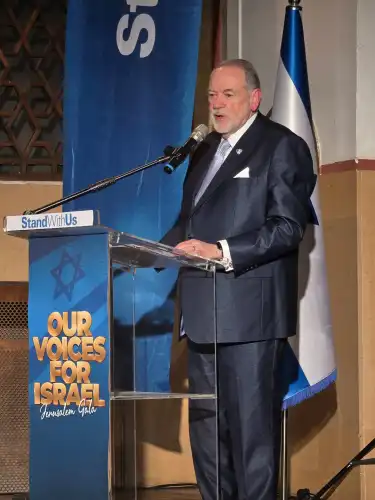
“Folks, I’m not the smartest guy in the world, but I got good enough sense to understand what that means. I’d rather be blessed than cursed.”
Huckabee warned of growing hostility toward Jews from extremists on both ends of the political spectrum.
“Some call it antisemitism. I don’t even use that term much anymore because I find that for some people they’re becoming numb to it,” he said. “Let’s call it what it is. It’s Jew-hatred, and it’s irrational.”
The ambassador linked rising Jew hatred to what he described as a broader rejection of biblical values and moral absolutes. He pledged that Christian supporters of Israel would never abandon the Jewish people.
“We really do stand with you, and we will never see you standing alone and not come to join you shoulder to shoulder and say you’ll never be alone in this world because if we abandon you, then we have abandoned the God who chose you, and we are not about to do that,” he said. “Be bold. Be strong. Be unflinching in your defense of who you are, why you’re here,” he urged the Jewish audience.
‘An unsinkable aircraft carrier’
British Col. Richard Kemp, a former commander of British forces in Afghanistan, told StandWithUs co-founder and CEO Roz Rothstein in an onstage interview that defending Israel was both a moral obligation and a matter of Western strategic interest.
“I was taught by my mother to know right from wrong,” he said, recalling his upbringing and his conviction that people had a duty to confront injustice.
Kemp said he regarded supporting Israel as an act of British patriotism, despite criticism from some in his home country.
Asked why Israel was so important to the United States, Kemp described the Jewish state as a vital military and intelligence asset. “Israel is a battlefield laboratory for U.S. weapons,” he said, arguing that Israel’s battlefield experience saved Washington billions of dollars in weapons development costs.
He also likened Israel to a permanent American aircraft carrier in the Middle East. “Essentially, we’re sitting now on board an aircraft carrier. This is an unsinkable aircraft carrier,” he said.
Without Israel’s military capabilities, Kemp argued, the United States would have to deploy tens of thousands, if not hundreds of thousands, of additional troops to the region.
Kemp recalled traveling to Israel immediately after the Hamas massacre of Oct. 7, 2023, and spending approximately 80% of the first two years of the war in the country.
During his visits, he said he accompanied Israeli forces into Gaza, observed their operations and met Palestinian civilians.
Having served alongside troops from Britain, the United States, Australia and other countries, Kemp offered an unequivocal assessment of the IDF.
“There is no better army in the world than the Israeli Defense Forces,” he said.
“You can also be immensely proud of their extraordinary courage, fighting spirit, unity and loyalty to their country. I’m in awe of every IDF soldier.”
Asked about allegations that Israel had committed genocide in Gaza, Kemp rejected the accusations.
“Genocide is the most obscene accusation that anyone’s ever made about Israel,” he said, arguing that the allegations were intended to delegitimize the Jewish state.
‘You have friends’
Rev. Dumisani Washington, founder and CEO of the Institute for Black Solidarity with Israel, told the audience that black Christians in the United States and Africa remained committed to standing alongside the Jewish state.
Washington had just completed a pilgrimage to Israel with more than 500 black American and African pastors, reviving a vision of civil rights leader Martin Luther King Jr., who had planned to bring thousands of black Christians to the Holy Land in 1967.
King’s planned pilgrimage was postponed following the Six-Day War, and he was assassinated in April 1968 before it could take place.
Washington said the delegation, which included former NAACP president and CEO Rev. Benjamin Chavis, was intended to strengthen ties between black Christians and Israel.
“I want you to know that you have friends out of the African and African American community,” he said.
He praised StandWithUs, which has partnered with his organization since its founding in 2013, and announced plans to bring 5,000 Christian pilgrims to Israel next year.
“We stand in solidarity with Israel and the Jewish people,” he said.
Despite rising antisemitism, Washington expressed optimism about the future.
“The future doesn’t belong to haters. The future belongs to people who love light, who love love,” he said.
‘We are going to stand in light’
One of the evening’s most emotional moments came when Avi Rosenfeld, father of fallen IDF soldier Sgt. Natan Rosenfeld, spoke about his son’s sacrifice and his family’s determination to turn tragedy into hope.
Born in Sweden to Holocaust survivors from Poland and Hungary, Rosenfeld recalled growing up in a home shaped by the Holocaust. His father survived four concentration camps, while his mother survived Auschwitz.
Rosenfeld, who served as a lone soldier in the IDF’s Nahal Brigade in 1986, said his son followed the family’s tradition of military service, joining the Combat Engineering Corps.
Natan, 20, from Ra’anana, was killed while serving in Gaza, sacrificing his life to save 16 fellow soldiers, according to his father.
“He took the full impact himself,” Rosenfeld said.
He also revealed that his daughter, who was in the audience, had lost her boyfriend, an IDF soldier, on Oct. 7.
Despite the family’s losses, Rosenfeld said he and his wife had resolved to devote their lives to strengthening Israel and the Jewish people.
“We decided we are not going to be in the dark. We’re going to stand in light because we are Jews and we are proud,” he said. “We never ever give up. Nobody ever breaks our people. Nobody ever breaks this nation.”
Rosenfeld urged Jews around the world to continue celebrating life in honor of the soldiers who had sacrificed their lives to protect Israel.
‘We got a second chance’
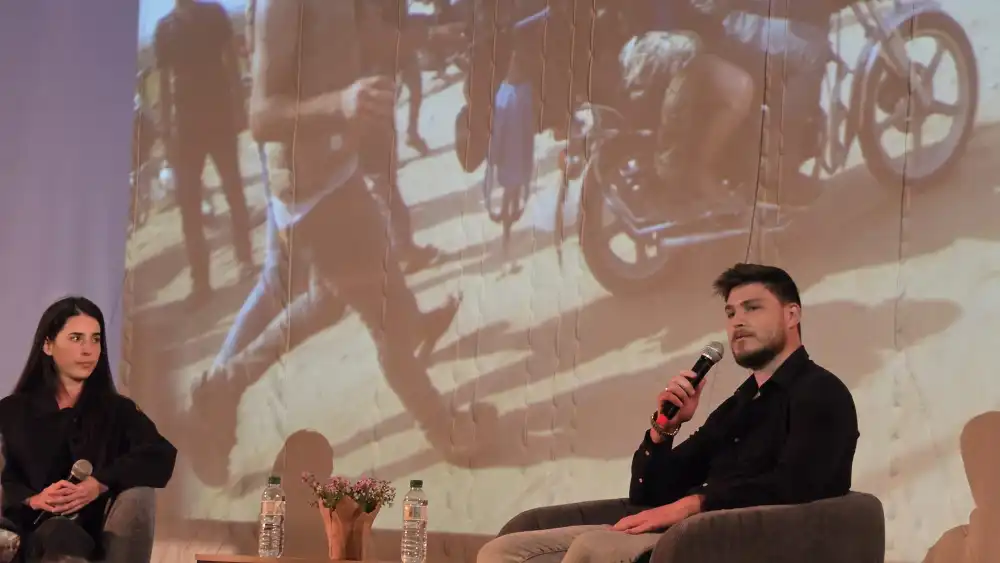
Former hostages Sasha Troufanov and Sapir Cohen, who recently married, shared harrowing accounts of their captivity and the long road to rebuilding their lives.
Troufanov, who was held by Palestinian Islamic Jihad for 498 days, described being forced to crawl through a narrow underground passage before reaching a makeshift prison cell approximately 30 meters below ground.
He recalled the overwhelming smell of mold, humidity and dirt, as well as insects crawling through the cramped space.
“You really feel that you are buried down in the ground while you are still alive,” he said.
Troufanov spent approximately eight and a half months in the tunnel, sometimes left completely alone for weeks, with his captors appearing only once a day to deliver a small amount of food.
“The darkness—you put your hand in front of your face, and you cannot see your hand,” he recalled.
The silence was equally unbearable.
“You can hear a cockroach walking on the floor,” he said, describing the psychological toll of prolonged isolation.
Troufanov was eventually released after 498 days and reunited with his mother, grandmother and Cohen. Only then did he learn that his father had been murdered on Oct. 7.
Cohen, who was released earlier, described how she had moved into the same hotel as Troufanov’s mother to support her during the agonizing uncertainty over her son’s fate.
She recalled struggling to comfort a woman who had lost her husband and did not know whether her only child was still alive.
The couple spoke about their recent marriage and their determination to build a future together after captivity. Cohen acknowledged the sacrifice of Natan Rosenfeld, whose father had spoken earlier in the evening.
“He gave his life for us and for many other Jews,” she said. “We got a second chance to build a Jewish home in Israel, to get married.”