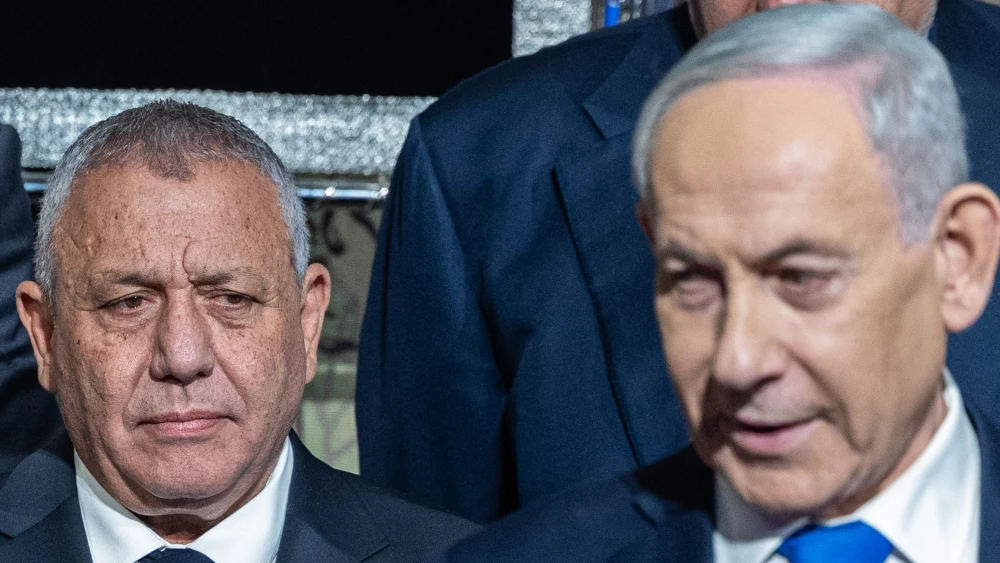

A meeting that lasts two hours must surely have covered a great deal of ground. The subject was Israel’s security—the country’s number one concern. Iran, Hamas and the timing of decisions that cannot be postponed could even lead Benjamin Netanyahu and Gadi Eisenkot to conclude that the country must come together.
It will not be easy.
Even this meeting began as a show of strength. Eisenkot sought it to assert his authority—a challenge to “Mr. Security.” And the meeting was effectively forced upon Netanyahu by Attorney General Gali Baharav-Miara, the prime minister’s perennial adversary.
Guy Markizeno, the military secretary, was supposed to oversee the meeting, but Bibi insisted that it take place in his own office, where he remains as caretaker prime minister while Eisenkot, leader of the “change bloc,” attempts to form a government within the allotted four weeks.
Israel faces threats on every front. Every decision could be both urgent and fateful.
But who should be making those decisions?
The impossible coalition
Speaking in the Knesset, Netanyahu linked the security emergency to the need for a coalition government.
Yet Eisenkot’s bloc wants him out, even though the only alliances available to it appear impossible—with Arab parties that do not recognize Israel, or with religious parties that refuse military conscription.
Eisenkot has repeatedly warned: “Netanyahu must not use security for political purposes.”
He went to meet Netanyahu to demonstrate that he was keeping him in check.
But what if the reality he has now encountered exceeds his expectations? What if the dangers facing Israel are even greater than he imagined?
Just how serious is the threat?
Iran’s growing menace
Iran is displaying its renewed arsenal of ballistic missiles. Its enriched uranium remains in its possession. Tehran threatens Israel, the United States and European countries.
It sends bomb threats to aircraft and perhaps now even schools. It threatens Jews around the world and pays professional assassins to target the U.S. treasury secretary.
Bibi could also prove to be a valuable source of reassurance for Eisenkot.
Following the tragedy of Oct. 7, Netanyahu led an extraordinary comeback on seven fronts, most notably the two major operations against Iran, carried out alongside the United States.
An unexpected opening?
A joint statement issued after the meeting said that Netanyahu and his military secretary, Maj. Gen. Guy Markizeno, had briefed Eisenkot on “the security and diplomatic challenges presently faced by the State of Israel.”
The statement added that the two sides had agreed to “proceed with mutual updates as the need arises.”
No political discussions were mentioned.
But in Israel, security and politics are inseparable. And a great many facts can emerge over the course of two hours, especially when Iran is on the agenda.
Who knows? Perhaps yesterday marked the first serious attempt to discuss a coalition government, beyond the empty talk and impossible alliances.
But let’s not tell anyone.
Eisenkot’s camp cannot yet abandon its defining commitment to rejecting Netanyahu.
Still, there is time.