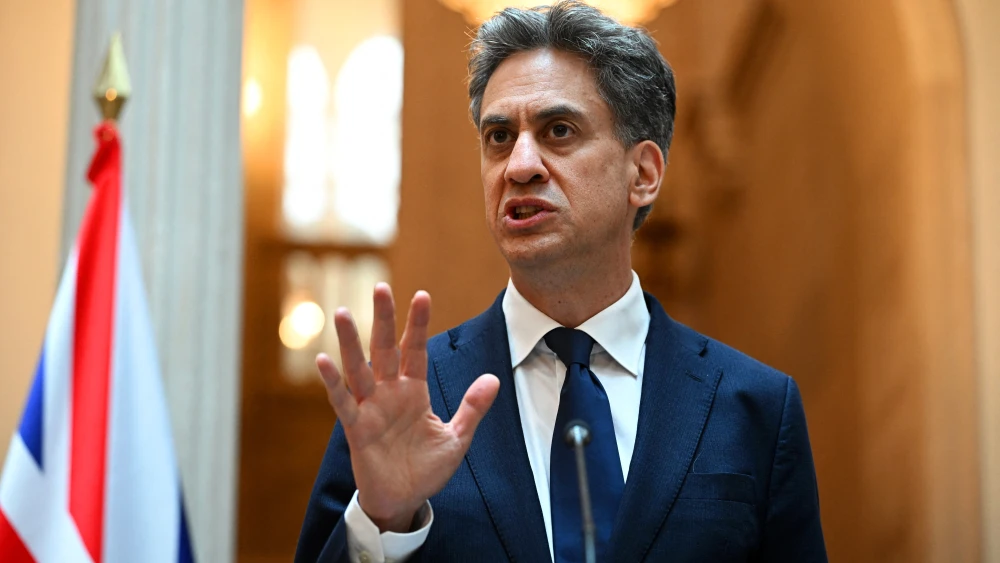
British Foreign Minister Ed Miliband on Friday posted a video message about “stories” he’d heard about living conditions in Gaza, prompting the Israeli Foreign Ministry and U.S. Ambassador to Israel Mike Huckabee to chide him for ignoring relevant facts.
“I just came out of this meeting talking about Gaza to people who’ve been there and are there on the ground. And frankly, it was horrific what is unfolding. You know, the stories that people were telling me of medicines being blocked, children dying while waiting for vital life-saving treatment,” said Miliband, a Labour politician who is Jewish.
Miliband has often criticized Israel, but has also defended its right to exist as a Jewish state. He is widely seen as a moderate within his party.
“When you hear that account of what is happening, you know that we as a U.K. government, as the prime minister has said, have got to act and act more decisively than we have,” added Miliband in the 32-second phone video posted Friday.
Huckabee wrote about the video: “The Brits have lost it. The Jew-hate of their government knows no boundaries and knows no facts.”
The British Foreign Secretary @Ed_Miliband posts a video recounting “stories” he was told about Gaza.
— Israel Foreign Ministry (@IsraelMFA) September 5, 2026
If the Foreign Secretary were interested in facts rather than stories, he would know that there are no restrictions whatsoever on the entry of medicines into the Gaza Strip, and… https://t.co/JuPUpyhPLM
A spokesperson for Israel’s Foreign Ministry wrote on X: If Miliband “were interested in facts rather than stories, he would know that there are no restrictions whatsoever on the entry of medicines into the Gaza Strip, and that no medicines are being blocked; that 22,500 tons of medical supplies have entered Gaza since the ceasefire began; and that Gazans exit the Strip for medical treatment, including 200 who did so in just the last two weeks.”
Miliband “is well aware of all this, as the U.K. is a member of the International Gaza Support Center, which facilitates the delivery of medical aid to the Gaza Strip. But apparently, facts matter less (when making a video for a political audience),” the spokesperson added.
Israel’s relationship with the U.K. has soured under Labour, which won the 2024 elections and replaced the Conservative Party as the ruling party.
Labour has pressed Israel over Gaza, suspending about 30 arms licenses, recognizing a Palestinian state while Israeli hostages were still held in Gaza, sanctioning Israel’s Finance Minster Bezalel Smotrich and National Security Minister Itamar Ben-Gvir, and threatening sanctions over Israeli construction east of Jerusalem. This has happened against a backdrop of mass protests against Israel, a spike in antisemitic incidents, and an increase in British Jews leaving for Israel.
On Friday, a delegation from the Board of Deputies of British Jews met with Prime Minister Andy Burnham to express “concern” about antisemitism and the prospect of fresh sanctions on Israel. Miliband said last week that such sanctions would target Israelis living in Judea and Samaria.
While the participants expressed support for all efforts to promote peace between Israelis and Palestinians, and their opposition to extremism on all sides, they conveyed significant concerns about the unintended consequences of policies the government is considering in relation to Jewish communities in Judea and Samaria.
The board delegation members “pressed the Prime Minister to avoid steps that may cause harm to the Jewish community, including measures that would place a profound strain on the Jewish people’s deep connection to places of great religious and cultural significance, including the Western Wall, Judaism’s holiest site,” the board said.
“Broad, untargeted measures may also give legitimacy to a wider boycott movement that marginalises and stigmatises British Jews,” the board wrote, adding that delegates “asked the Prime Minister to carefully consider the potentially perverse consequences of announcing such measures during an already heated Israeli election, and the need for both the U.K. and Israeli governments to ensure that domestic political considerations do not stand in the way of the positive policy outcomes that the Middle East so desperately needs.”