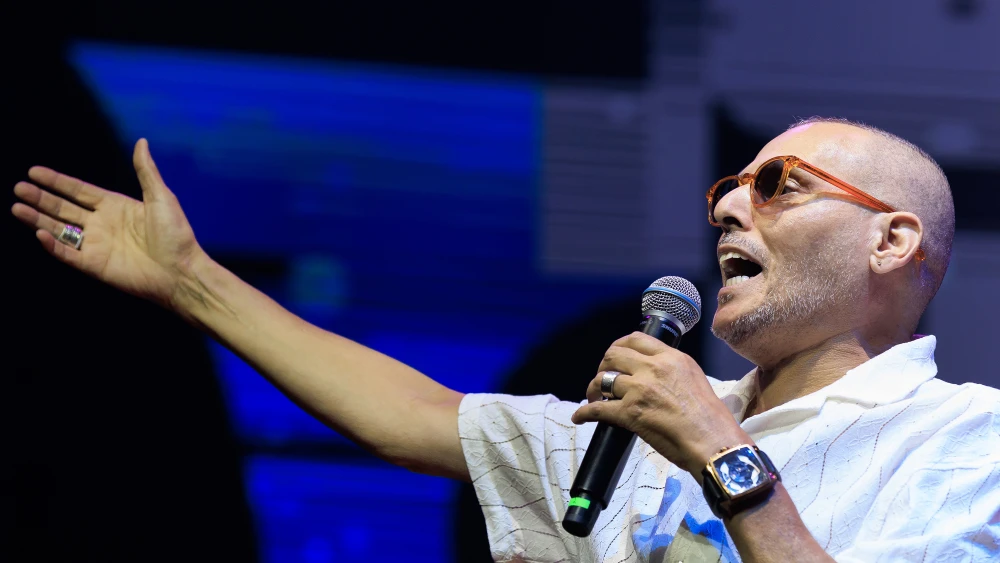
Israeli singer Yishai Levi, one of the most influential voices in Mizrahi music, died overnight Saturday at the age of 63 after being hospitalized in serious condition at Wolfson Medical Center in Holon.
“With unimaginable pain, we announce the passing of Yishai Levi last night. There are no words right now,” his family said in a statement.
His brother, Nati Levy, revealed that he had suffered from COPD (chronic obstructive pulmonary disease), a serious lung disease, that eventually led to a stroke. Survived by his wife, Iris, five children and several grandchildren, he was buried on Sunday in Rosh HaAyin, the city where he was born and raised.
Prime Minister Benjamin Netanyahu paid tribute to the singer on Sunday.
“My wife, Sara, and I convey our sorrow over the passing of the beloved artist Yishai Levi; may his memory be a blessing,” Netanyahu wrote. “Yishai was a unique voice in Israeli music—a voice of soul, joy, pain and love for humanity.
“Yishai touched the hearts of millions of Israelis with his songs. He crossed generations, communities and sectors, becoming an inseparable part of the soundtrack of our lives.”
Culture and Sports Minister Miki Zohar described Levi as “one of the pioneers of Mizrahi music in Israel and one of the greatest and most moving voices in Israeli music.”
Zohar eulogized Levi as “an artist who managed to touch the hearts of entire generations and become an inseparable part of the soundtrack of the State of Israel,” adding, “I extend my heartfelt condolences to his family, friends and many fans.”
Yemenite-born Mizrahi singer Margalit Tzanani, who was a close friend, paid tribute to Levi by praising his musical talent. “Everyone who met him understood that he was a master. He knew how to love a song and perform it in the best possible way,” she said.
From Rosh HaAyin to the top of the charts
Born on Jan. 20, 1963, in Rosh HaAyin in central Israel to a Yemenite Jewish family, Levi began performing as a teenager at clubs and family celebrations.
He emerged during the 1980s as one of the leading figures in Israel’s Mizrahi music scene, a genre rooted in the musical traditions of Jews from the Middle East and North Africa.
His professional career began with guitarist and producer Moshe Ben-Moshe, and his debut album, “Hafla Im Ben-Mosh,” (“Party with Ben-Moshe”) helped establish him as a rising star. His breakthrough came with the album “Hineh Ba Hayom” (“Here Comes the Day”), which featured enduring hits such as “Ra’aya,” “Halom,” “Ahat VeYehida” and “Tzlil Anbalim.”
Over a career spanning more than four decades, Levi recorded dozens of albums and became known for romantic classics such as “Rikdi” (“Dance”), “Rikud Romanti” (“Romantic Dance”), “Ha’achat Sheli” (“My One”) and “Od Hayom” (“Still Today”).
He remained a popular performer well into the 2020s and appeared in the fourth season of the Israeli TV show, “The Masked Singer,” in 2025.
Alongside his musical success, Levi’s life was marked by personal struggles, including battles with drug addiction that interrupted his career. He spoke openly about those challenges and became known as a symbol of resilience for repeatedly rebuilding his life and returning to the stage.
His comeback albums and performances earned him renewed popularity, while songs such as “Taltalim Shehorim” (“Black Curls”) and “Rikud Romanti” introduced his music to new generations of music lovers.
‘Don’t cast us aside in old age’
Three years before his death, Levi reflected publicly on his legacy in a social media post that resurfaced following news of his passing.
“I am 60 years old, and for the first time in my life I wonder what people will say after I’m gone,” he wrote. “I know how to sing. That’s what I have to give and that’s what I will leave behind.”
Writing after the death of fellow Israeli singer Yitzhak Klepter on Dec. 8, 2022, aged 72, Levi reflected on the fleeting nature of fame and issued a plea to honor veteran artists during their lifetimes.
“Don’t cast us aside in old age,” he wrote, echoing a verse from the Book of Psalms. “If you grew up with us, embrace us while we are still alive. Otherwise, we become walking dead—shadows of extinguished fame. I hope no artist who helped pave the way for Israeli culture leaves us carrying sorrow.”
Many Israelis shared the message on social media following Levi’s death, describing it as a poignant farewell from an artist whose distinctive voice helped shape the sound of Israeli popular music for more than 40 years.