With more than 8,800 Scouts and approximately 2,500 adult Scouters and staffers, the recent 2026 National Jamboree, produced by Scouting America (formerly known as the Boy Scouts of America), was one of the smallest on record but, in terms of its Jewish aspects, loomed larger than ever.
The nine-day series of events in July regularly takes place every three or four years at Scouting America’s permanent high adventure site—the Summit Bechtel Family Scout Reserve—a sprawling 14,000-acre site that spans the area between Glen Jean and Mount Hope in the rugged, mountainous West Virginia hills near New River Gorge National Park.
The Jamboree was home to several expansive ziplines, sites for kayaking, white water rafting, scuba, fishing and a variety of range and target activities that included archery, rifles, shotguns and pistols.
Dozens of merit badges were offered to the Scouts to enable them to advance in rank and were taught by Scouters and older members of the Order of the Arrow who were also on staff. The Scouts and Scouters were entertained by huge outdoor shows emphasizing the 250th anniversary of the United States with impressive fireworks and choreographed drone displays.
As in the Mah Tovu (“How goodly are your tents, O Jacob.”), the thousands of attendees all slept in tents confined to three main camps—Camps C and D for the Scout contingents from councils across the country and Camp E for the staff, which consisted of adult volunteers and Order of the Arrow contingents.
To emphasize Scouting America’s commitment to the various faith and belief groups that charter partner with it and sponsor packs, troops, crews, ships and posts for youth from ages 5 to 21, the Duty to God and Country exhibit area was created. It fell under the Crossroads activities listed under Program, which had organized and planned the series of events in earnest over the past two years with Zoom sessions and in-person gatherings.
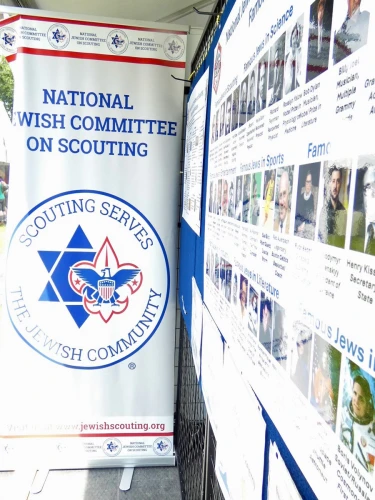
Founded in 1926 and thus celebrating its centennial, the National Jewish Committee on Scouting elected to go big at this year’s Jamboree.
To celebrate its 100th year, the NJCOS expanded its footprint at the Duty to God and Country exhibit area with a huge booth that showcased Judaism and highlighted famous Jews. Buffeted by pictures of famous celebrities, historic Jewish Scouting pictures and explanations of Jewish holidays and traditional Jewish foods, the volunteer workers at the booth gave away hundreds of Jewish Scouting patches and buttons and promoted their religious emblems program.
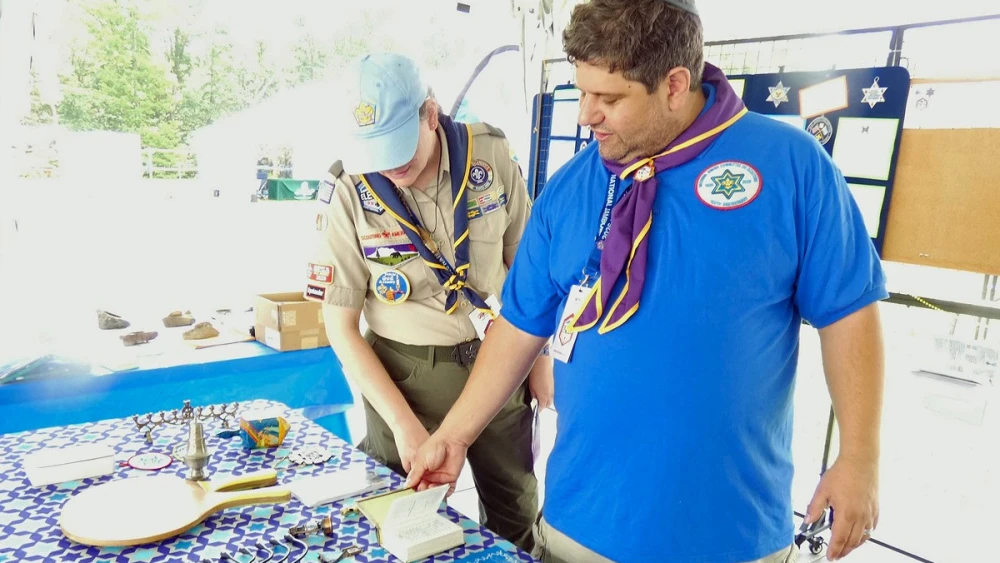
In addition, a large contingent of shomer Shabbat observant Scouts and Scouters, some from Israel, arrived early in order to prepare to observe Tisha B’Av, which began on July 22, the first day all the other Scouts were set to arrive. Their encampment was part of a sub-camp in Camp C that erected an eruv and held daily worship services of Shacharit, Mincha and Maariv in their own synagogue tent led by the Scouts themselves. Other than the day of fasting for Tisha B’Av, the shomer Shabbat contingent ate kosher meals for the duration of the Jamboree.
The Friday night egalitarian Conservative service was also held in Camp C, not far away from the Shabbat-observant contingent in the camp pavilion. That service was officiated by Cantor Neil Schwartz, a former Cubmaster and Scoutmaster, who has enjoyed a long Scouting and professional career as both a cantor and a Jewish educator. The cantor, who has been trained twice at the Philmont Training Center in Cimarron, N.M., was the Scoutmaster when both of his sons, David and Adam, attained the rarefied rank of Eagle Scout.
On Shabbat morning, July 25, while the observant contingent conducted religious services in the Synagogue Tent in Camp C, the NJCOS sponsored an alternative, egalitarian Conservative-based morning worship service for Jewish Scouts and Scouters at the shared Duty to God Worship Tent.
The start of a journey
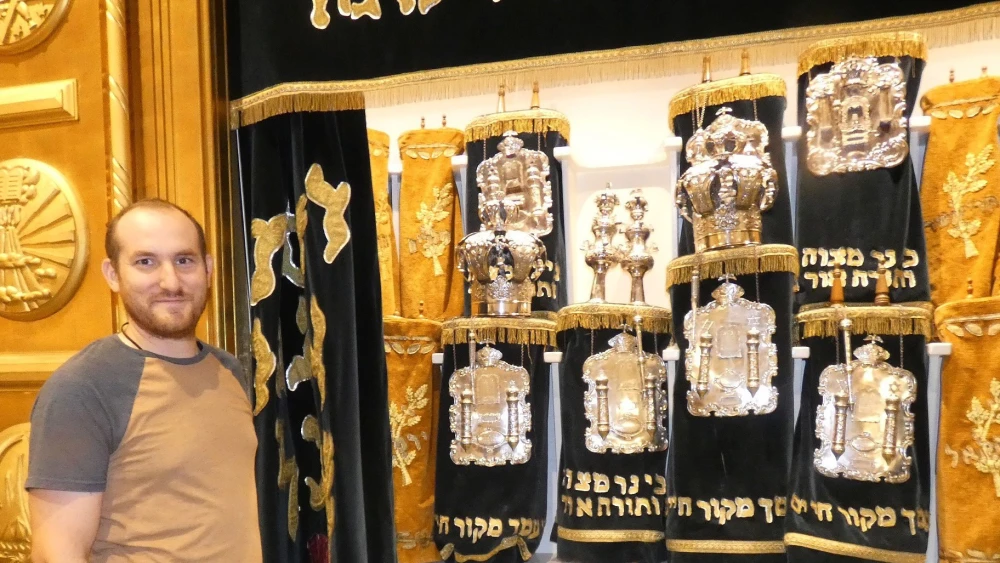
As a member of the NJCOS for nearly a quarter of its existence, I wanted to ensure we had a Torah scroll deemed kosher from which to read Parsha Va’Etnachan on that particular Shabbat morning.
Checking nearby Charleston, W.Va. congregations, I found an online number on the Congregation B’nai Jacob website. I cold-called Mark Slotnick, whose number was available online and, after making a cursory introduction, explained my intent to borrow a scroll. He contacted the synagogue’s religious leader, Rabbi Adam Berman, who called the president of his synagogue, an attorney named Michael Victorson. Victorson revealed to the rabbi that he was, in fact, a proud Eagle Scout who had attended the 1969 National Jamboree in Farragut State Park in Idaho. It was the first time the rabbi ever knew that Victorson had such a connection to Scouting.
The congregation’s president gladly offered a scroll to continue the cycle of religious practice at the 2026 National Jamboree that he had experienced himself as a youth, as in 1969.
When Berman called me back, I assured him I would have insurance coverage for the scroll and would arrange to house it safely on site at the Jamboree. Charleston is about an hour’s drive away from the summit.
On July 19, I arrived at the synagogue and was greeted by the young rabbi on the same date most of the Scouting staff was directed to arrive and check in.
The rabbi gave me a tour of the sanctuary and proudly displayed the many Torah scrolls housed there. He spoke later about why he chose the particular scroll that traveled to the Jamboree.
“I chose it because it was the smallest,” he said. “They’re all about the same size, but I figured it would be the easiest to schlep around at the Jamboree.” After a slight pause, he asked, “Do Boy Scouts use the term schlep?”
“Jewish ones do,” I assured him.
Unbeknown to me, Berman is the son of emeritus Rabbi Harold Berman, who was senior rabbi at Congregation Tifereth Israel in Columbus, Ohio, from 1979 to 2013. One of his early colleagues was the very same Cantor Neil Schwartz, who served as the congregation’s cantor when he was newly ordained by the Jewish Theological Seminary in 1980. Schwartz served as cantor there for two years before moving on to other posts in Reading, Pa., and Chattanooga, Tenn., as he also began his Scouting career.
Connecting generations
On July 25, I served as the gabbai during the Torah service while Schwartz served as the officiant, guiding us through the morning blessings, the Shacharit service, as well as the Torah service. As fortunate as we could be, one of the attendees was a Kohen or descendant of the House of Aaron.
After calling the Scouter up by his Hebrew name, the introductory parsha was read by Cantor Schwartz. That section of Va’Etnachan (“I pleaded”) deals with Moses unsuccessfully pleading with God to permit him to enter the Promised Land.
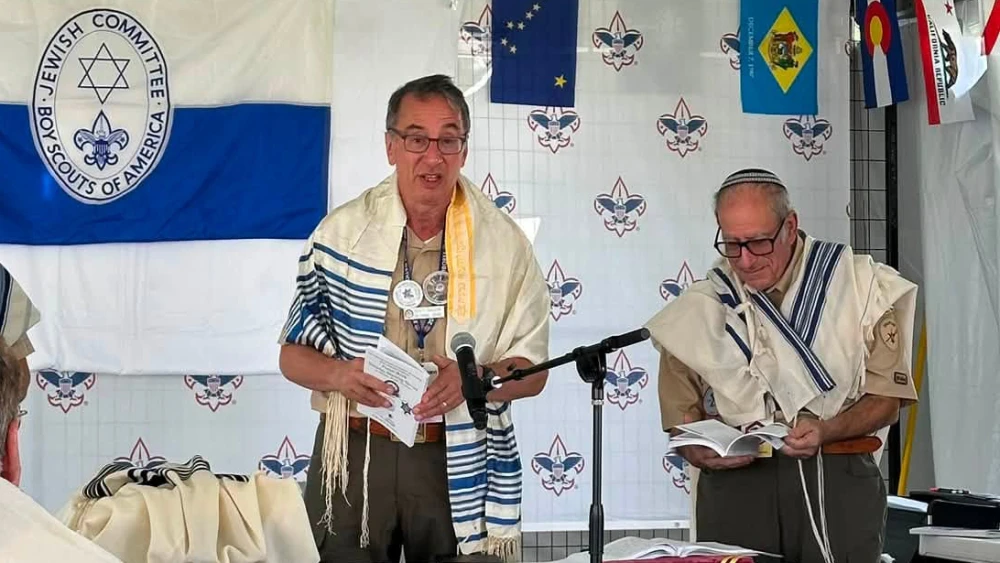
We advanced the Torah to the second aliyah, which was the section in Devarim (Deuteronomy) that pronounces the Ten Commandments. As it was explained, it is tradition that everyone stand during that portion of the reading, and a Levite member of the NJCOS was then called to the Torah. At the moment the cantor reached the Ten Commandments, I used three resonant poundings on the table to alert everyone to rise.
Once that section was finished and everyone was seated, we advanced the Torah scroll to the section that speaks of the Shema. For the third and final aliyah, I called Yisroel ben Yosef (the Hebrew name for Ricky Mason), the attorney who, in May, had ascended to the position of chairman of the board of Scouting America, one of the two top volunteers in the organization. He is only the third Jewish figure to occupy that position, which correlates to the older title of president of the Boy Scouts of America.
Two other Jewish presidents of the BSA preceded him. The first was Mortimer Schiff, who assumed the presidency in 1931, but tragically died within a month of his appointment. The second Jewish BSA president was Irving Feist, who served from 1968 to 1971.
There is no record of Feist participating in the Shabbat worship service at the 1969 National Jamboree, according to Victorson, who recalled it so vividly.
Mason thus became the first sitting Scouting America board chair to be given the honor of an aliyah at a National Jamboree.
At the conclusion of the Torah service, he spoke to his fellow worshippers, saying the moment was one of his most heartfelt and special moments in Scouting because it emphasized his dual commitment to Judaism and Scouting.
“I am honored to be the first Jewish national chair to attend synagogue services at a Jamboree,” he noted.
“Scouting is a faith-based organization. We provide a safe and welcoming space for worship and community for all religions, and that was clearly the case for the synagogue services here, which could be my favorite of all services that I have been privileged to attend around the world,” Mason emphasized.
Following services, Schwartz left the Jamboree by car to fly from Charleston, W.V., to Boston to attend the New Coalition for the Advancement of Jewish Education on the occasion of its 50th anniversary. Other than the three times the conference was held in Israel, the cantor had enjoyed perfect attendance and was cited for his 47th appearance there. He returned to West Virginia to retrieve his car on July 29 and spent the night with Berman and his family.
On July 30, at the suggestion of the younger Berman, the cantor had a phone conversation with Rabbi Berman in Columbus. It was the first time the two had spoken in four decades.
On the occasion of the return of the Torah scroll to the synagogue later that day, Berman expressed pride that his congregation had such a central part in the 2026 National Jamboree. “Judaism doesn’t just belong to New York and Los Angeles and whatever,” he pointed out. “Here we are, proud to be a pillar of Jewish life in Appalachia and to be able to facilitate Jewish experiences, even in the mountain states.”
Staying to take part in an afternoon/evening prayer service at Congregation B’nai Jacob, I made sure that both the rabbi and the congregation president received special Jewish Achievement Award triangular-shaped patches on behalf of the NJCOS before I left for my return trip home.
Once I was safely back home, I reflected on the two-week journey and the many instances where the confluence of Judaism and Scouting seemed to rise above mere coincidence.
The connection between that Torah scroll and the people who had a direct hand in bringing it from a remote Jewish outpost to prominence on a national stage suggested to me some kind of Divine intervention. It made it possible for me to tour a West Virginia synagogue for the first time and meet its rabbi, whose father had worked side by side with the cantor who led the very same religious service where the Torah was read. It also brought the two of them together for the first time in 40 years.
And it allowed the congregation’s president, himself an Eagle Scout, to help ensure that the experience he had as a Jewish youth at a National Jamboree might be repeated at this year’s event.
Such small miracles cannot always be explained or questioned. After all, it is a matter of faith. Like the many other miracles described within it, this, too, comes from a Torah scroll.
Originally published by Crescent City Jewish News.