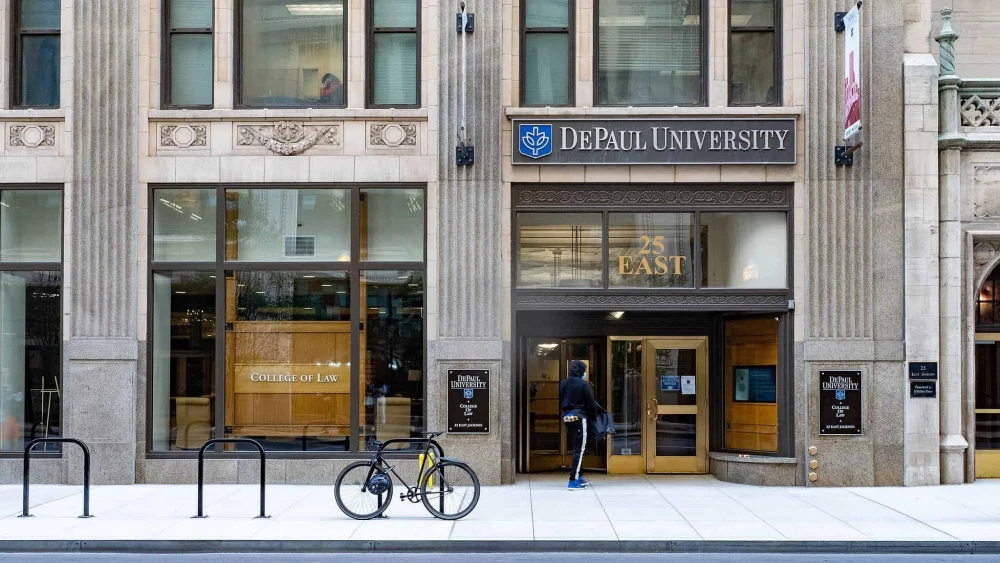
The sentence of 300 days in jail and two years of probation that Kasem Noubani received on Aug. 4 for attacking two Jewish students at DePaul University “raises serious questions about whether the punishment reflects the gravity of the crime,” according to Daniel Schwartz, president and co-founder of the Chicago Jewish Alliance.
“There is a growing perception in our community of a two-tiered standard, where violence directed at Jews is condemned rhetorically but treated differently when accountability is actually imposed,” he told JNS. “Whether that perception is intended or not, sentences like this reinforce it.”
DePaul is a private Catholic research university in Chicago. The attack occurred in November 2024. Norman Finkelstein, a longtime critic of Israel, used to teach at the school, which, earlier this year, suspended its Students for Justice in Palestine chapter.
“Jewish Chicagoans are not asking for special treatment,” Schwartz told JNS. “We are asking for equal treatment, equal protection and consequences proportionate to the seriousness of crimes committed against us. A hate-crime conviction should mean something.”
Jay Tcath, executive vice president of the Jewish United Fund, told JNS that “it is deeply disappointing that the sentence does not reflect the seriousness of this act of anti-Jewish violence.”
“Our community deserves to know that acts of hate and violence will be taken seriously and met with appropriate consequences,” he said. “We remain concerned that this outcome does not provide the accountability or deterrence our—or any—community deserves.”
Noubani pleaded guilty to two class three felony hate crime charges, according to the office of the Cook County state’s attorney. He also must complete 200 hours of community service, and a no-contact order prevents him from contacting the two victims or the university, the office told JNS.
Under the Illinois Hate Crimes Act, class three hate crime charges are used for first offenses that occur in certain locations like a religious facility or school, according to the Illinois attorney general’s office.
Two masked people attacked Michael Kaminsky and Max Long, leaving Kaminsky with a wrist injury that required surgery. Long suffered a severe concussion and other head injuries, he told JNS. Both sued DePaul in April 2025, alleging that its “public safety officers stood idly by and watched the assault unfold.”
Noubani is the second man to be sentenced over the attack. Adam Erkan, 20, got two years’ probation and 100 hours of community service in November 2025 after pleading guilty to battery and causing bodily harm in connection with the attack.
The state’s attorney’s office told JNS that it “evaluated the facts and evidence to determine an appropriate resolution and, in consultation with the victims, made an offer of three years in prison in exchange for the guilty plea on two felony hate crime counts.”
“The judge ultimately accepted a plea from the defendant and rendered the sentence of probation,” it said.
Gerard Filitti, senior counsel at the Lawfare Project, which is representing the two students, told JNS that “we are grateful to the detectives who worked this case and to the prosecutors who brought it.”
“They did their jobs. The problem sits above them,” he said. “In Chicago and across this country, the criminal justice system stops short of the sentence a hate crime deserves.”
“Illinois imposes a higher penalty when a hate crime is committed on a school or university campus, because the state judged that conduct uniquely repugnant,” he said. “That provision sat unused for 13 years.”
“Most Jews attacked in this country never see a felony conviction with the words ‘hate crime’ attached to it. Many never even see an arrest,” Filitti told JNS. “Measured against that record, this conviction is a good result. Measured against the violence it answers, it is not enough.”
“Cook County has now convicted under the campus provision, and I expect to see it charged again,” he added.