


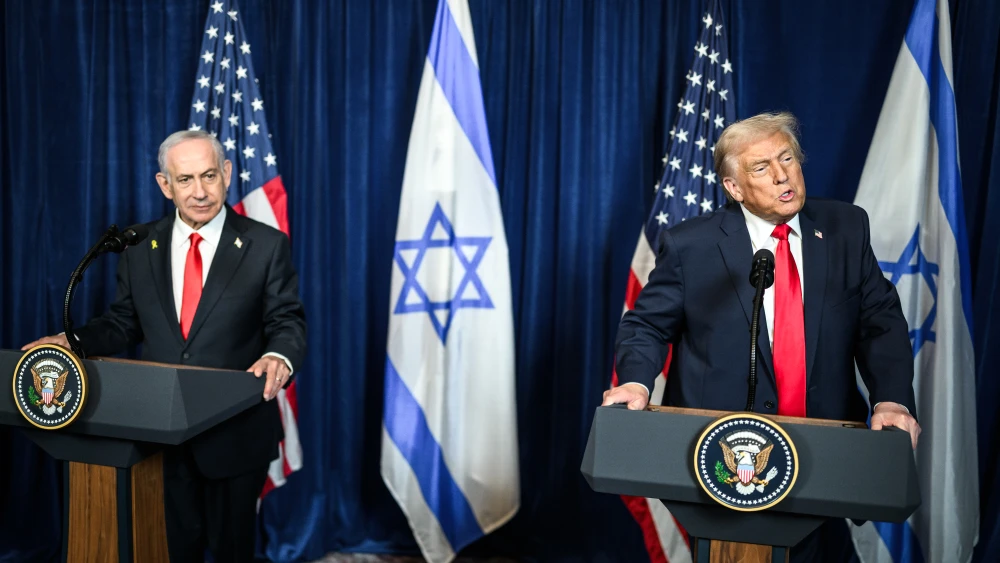
The American Israel Public Affairs Committee on Tuesday reaffirmed its support for the existing U.S.-Israel military aid agreement and backed negotiations on a new security pact, after U.S. President Donald Trump said in an interview that aired earlier in the day that assistance would end by year’s end.
The Jewish Institute for National Security of America questioned whether an agreement to end assistance this year had been reached, while the Zionist Organization of America expressed concern about an early cutoff.
The existing memorandum of understanding provides $38 billion in military assistance over 10 years, through fiscal year 2028.
AIPAC said a new agreement would further strengthen the partnership, adding that cooperation between the allies helps keep both countries secure, promotes regional stability and benefits their economies.
“President Trump’s statement today about foreign aid to Israel seemed to have caught everyone by surprise,” JINSA President and CEO Michael Makovsky wrote on X. “We’re not aware of any agreement to end the aid this year.”
Makovsky said both countries had been working on a new memorandum to replace or follow the existing agreement. He urged “one final MOU of equal dollar value to the existing one,” warning that an abrupt end to assistance “serves neither country’s economy nor security interests.”
JINSA ultimately favors replacing the aid framework with a strategic partnership centered on military, technological and intelligence cooperation, he added.
The Zionist Organization of America said it was “concerned” about Trump’s announcement. Its national president, Morton Klein, noted that ending assistance this year would be almost two years earlier than the current agreement provides.
“The ZOA is questioning why the U.S. isn’t also ending the more than $4 billion in annual U.S. aid to the Arab Muslim countries of Egypt, Jordan, Pakistan and Lebanon, and the Palestinian Authority entity, especially when those countries vote with the U.S. less than 10% of the time at the United Nations,” the ZOA said. “By contrast, Israel is a reliable ally that votes with the U.S. at the United Nations over 90% of the time—more than any other nation.”
Speaking on Fox News on Tuesday, Trump said he and Israeli Prime Minister Benjamin “Bibi” Netanyahu had agreed months earlier to end the payments.
“As far as paying Israel, Bibi Netanyahu and I have made a deal that we give Israel $4 billion a year, and we made a deal months ago that we’re stopping,” Trump said. “They’re fine with it, because they’ve become a very successful country. They don’t need it, and we won’t be paying any more.”
“By the end of this year we won’t be paying Israel,” he added. “We’ll help Israel if they need it.”
Brig. Gen. (res.) Amir Avivi, an Israeli security expert and founder of the Israel Defense and Security Forum, told JNS on Wednesday that Netanyahu had been pushing for an end to aid to reduce Israel’s dependence on foreign weapons supplies.
“Israel needs to be able to defend itself by itself,” Avivi said, calling for production of military capabilities and munitions to move to Israel and for strengthening the country’s defense industries.
“We also have to remember that in the past, three or four billion dollars was a big amount of money,” Avivi said. “Today with Israel’s economy, it’s a very small part of our overall budget.”
He argued that the assistance did not justify dependence or a lack of full sovereignty and control over Israel’s future.
Avivi noted that weapons had been withheld by the United States twice at defining moments during military operations, leading Israel to conclude that it could not remain dependent. He also cited growing opposition to assistance within the United States.
However, he said the timetable remained uncertain.
“As far as I know, it’s supposed to be a gradual process,” Avivi told JNS. He said it remained unclear whether assistance would end gradually or “stop at once.”
Netanyahu previously advocated a longer transition. “I want to taper off the military aid within the next 10 years,” he told The Economist in January.
Under the current agreement, reached during the Obama administration, Israel receives $3.8 billion annually, including $500 million for missile defense cooperation. The remainder is typically used to purchase American military equipment, including F-35 fighter jets. Israel also received billions of dollars in supplemental appropriations after the 2021 Gaza war and in 2024 following the Oct. 7, 2023, attack.
Trump said on Tuesday Israel would remain able to purchase American weapons. “They can buy whatever they want,” he said.
The Prime Minister’s Office declined to comment to JNS, and Netanyahu has not publicly addressed Trump’s statement.
How Trump would implement a cutoff remained unclear. The House included billions of dollars in assistance to Israel in its fiscal 2027 State Department appropriations bill and National Defense Authorization Act, neither of which had passed the Senate.


