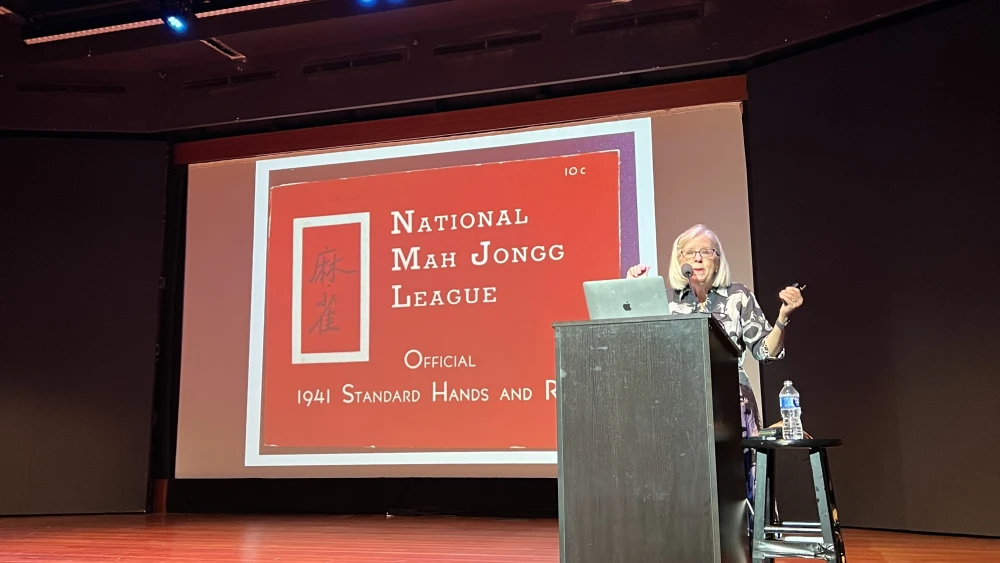
Some 500 people gathered on Sunday at the Museum of Jewish Heritage in lower Manhattan for lessons, lectures, social play and vendors at the New York Jewish Mah Jongg Festival.
“I think people really just want to connect,” mahjong historian Gregg Swain told JNS at the event, which also takes place on Monday. “Nowadays, it’s just so easy to spend time doing something mindless on the computer. Mahjong really allows people to connect in different ways.”
Swain told JNS that the game, which has Jewish roots, offers something increasingly rare in a digital world: face-to-face interactions across generations.
“The other day, I was playing a game, and I’m in my 70s,” she said. “There was somebody else in their 50s, and two people were in their 20s.”
“Only around the mahjong table would you find something like that,” she said.
In mahjong, players begin with 13 tiles on their racks and take turns drawing and discarding tiles to build a winning combination. Players aim to complete a specific pattern, known as a “hand,” from the annual National Mah Jongg League guide, known as the “card.”
The first player to complete a valid hand and declare “mahjong” wins the round.

Donna Kassman and Dara Collins, founders of Modern Mahjong, led instructional sessions at the festival, teaching newcomers the basics of the game, sharing strategies and explaining the 2026 National Mah Jongg League guide.
Kassman discouraged new players from feeling intimidated by experienced mahjong players and told attendees that the game can be learned with practice.
“Don’t be intimidated by people who play,” she told the crowd.
Kassman and Collins also reminded players to carefully study the annual National Mah Jongg League guide and understand the different tile combinations needed to win.
“I thought I could learn something new about Jewish mahjong, but also about Chinese mahjong, which I haven’t learned yet,” Daniela Taitel of Rye, N.Y., told JNS.
Taitel, who runs a company that organizes mahjong events and fundraisers, said that the game has created a strong community in Westchester County.
“Every Wednesday, we host mahjong events,” she told JNS. “We’re about 200 women strong, and half of them are here today.”
Mahjong’s appeal has expanded beyond its traditional audience, according to Taitel.
“Mahjong’s demographic has widened, so it’s not just your grandmother’s game anymore,” she told JNS. “It’s open to everybody.”
During her presentation at the museum, Swain traced the ways that the Chinese game became rooted deeply in American Jewish culture during the 1920s and 1930s.
She told attendees that as Jewish women organized social gatherings and charitable fundraisers, mahjong evolved from a pastime into a way to strengthen community ties.

The game was played everywhere from wealthy Manhattan homes to crowded Lower East Side tenements, providing friendship and relief during difficult periods, including the Great Depression, Swain told the crowd.
The creation of the National Mah Jongg League in 1937 helped standardize American rules and transformed the game into a uniquely American Jewish tradition, while supporting charitable causes through annual membership cards, she said.
Swain also challenged what she said is a common misconception about the game.
“Many people like to think that it really is thousands of years old,” she told attendees.
Earlier Chinese card games date back centuries, but the version recognizable today emerged only in the mid-19th century, with later marketing efforts emphasizing its ancient origins to make it appear more exotic, she said.
Hasia Diner, professor emerita of history at New York University, told JNS that mahjong’s popularity among Jewish women grew as their leisure time expanded in postwar America.
As household technology reduced the time that women spent on chores, the game offered women “a way to do something pleasurable, just for themselves,” Diner, who wasn’t involved in the event, told JNS.
Jewish Community Centers later hosted organized games, but mahjong first spread via informal family and friendship groups on a grassroots level, according to Diner.
The game also reflected the Americanization of Jewish life, according to the scholar.
Rather than replacing Jewish traditions, mahjong gave women “an avenue to a bigger, more fun world” while preserving strong family and community bonds, Diner told JNS. “Playing mahjong did not threaten Jewish solidarity and bonds” but became a meaningful social outlet instead, she said.
Beyond the history lessons, the festival centered on community.
Players gathered around tables throughout the museum, compared strategies and shared stories, reflecting what many attendees described as the game’s greatest appeal: bringing people together.
“It’s a wonderful escape and vacation from the trials of everyday life,” Swain told JNS. “When you’re sitting down at the mahjong table, all you’re really worried about is those little tiles in front of you and what you’re going to do to win.”