Eleven minutes after the State of Israel was declared on May 14, 1948, U.S. President Harry Truman became the first foreign leader to recognize the Jewish state. Visitors to the National Library of Israel can now see the pen he used to sign that declaration, along with a document attesting to its authenticity, as part of an exhibition marking the 250th anniversary of American independence.
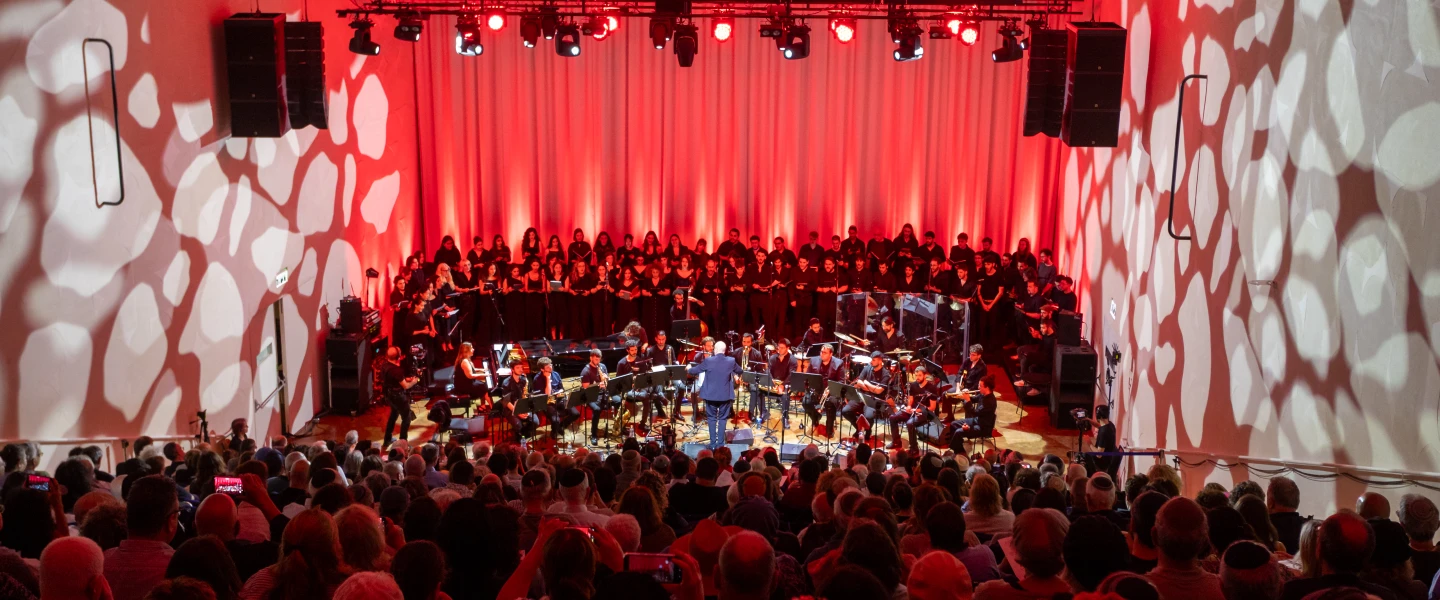
The events opened with a gala concert at the library titled “The Sounds of Freedom,” featuring works by two of America’s greatest Jewish composers, George Gershwin and Leonard Bernstein. The Student Choir of the Jerusalem Academy of Music and Dance performed alongside the academy’s Big Band Orchestra in a celebration of American Jewish music.
“America is often referred to as the land of endless possibilities, a place defined by its commitment to liberty, democracy and innovation,” David Brownstein, chargé d’affaires at the U.S. embassy in Jerusalem, said at the event. “Tonight, through the music of George Gershwin and Leonard Bernstein—two Jewish-American giants—we are reminded of the profound contributions that the Jewish community has made to the American tapestry and the enduring bond between our two nations.”
He emphasized the values shared by the United States and Israel.
“Think about the values we share: the belief in human dignity, the pursuit of justice and the constant striving for a more perfect union,” Brownstein said. “These are not just American or Israeli values; they are universal aspirations that unite us. As we celebrate this milestone, let us also celebrate the vibrant, multifaceted friendship that continues to grow and flourish between the United States and Israel.”
Because Independence Day falls on Shabbat this year, the National Library has extended the celebrations into next week.
On Sunday evening, the library will host three Hebrew-language lectures on American history and society. Dr. Ronny Regev of the Hebrew University of Jerusalem will speak on “Not Every Vote Counts: Voting Rights and American Democracy”; Nettanel Slyomovics of Tel Aviv University will discuss “American Assassins: When Violence, Politics and Culture Collide”; and Professor Gad Yair of the Hebrew University will present “Loneliness in America: A Contemporary Epidemic or a Deep-Seated Cultural Trait?”
Before and after the lectures, visitors will be able to join guided tours of a display featuring maps, books and historical American artifacts.
The library will also host an English-language panel on the American Jewish experience, examining the history of Jewish life in the United States, the issues shaping the community today and the challenges it may face in the future.
Panelists include Rabbi Abi Dauber Sterne, educator and author; Michael Oren, Israel’s former ambassador to the United States; and Felicia Sol, rosh kehillah (community leader) of B’nai Jeshurun in New York.

Chaim Meir Neria, curator of the library’s Haim and Hanna Solomon Judaica Collection, told JNS that Jewish life in North America predates American independence.
“For example, there is Haym Salomon, whose signature we have on a ketubah [Jewish marriage contract], who helped finance George Washington’s war against the British,” he said. “The big wave of Jewish immigration came much later, but Jews had an impact far beyond their numbers.”
At the time of American independence, Neria said, only a few thousand Jews lived in the United States, out of a population of about 2.5 million.
The National Library also houses a ledger documenting emissaries from the Land of Israel who traveled to the United States in the mid-19th century to raise funds for Jewish communities in Ottoman Palestine.