


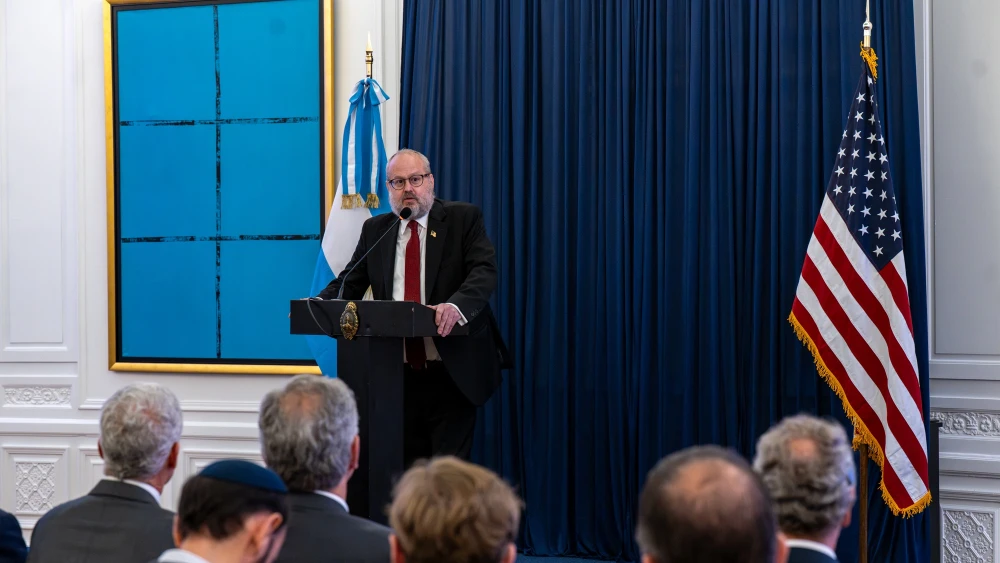
Yehuda Kaploun, a rabbi and special envoy to monitor and combat antisemitism at the U.S. State Department, decried leaders of the International Holocaust Remembrance Alliance for not inviting Saudi Arabia and the United Arab Emirates to its plenary preliminary conference in Buenos Aires this month.
“I find IHRA’s policy that it will ‘only accept U.N. member countries commonly seen as democracies’ deeply concerning,” the envoy wrote to Michaela Küchler, secretary-general of the alliance, in an Oct. 26 letter that JNS viewed.
The letter, which came days before the event, calls for an update to what it calls IHRA’s “archaic membership requirements” and urges the alliance to “instead admit any government that demonstrates a serious commitment to advancing its mission.”
IHRA is an intergovernmental organization that addresses “contemporary challenges related to the Holocaust and genocide of the Roma.” It is best known for its working definition of Jew-hatred, which the United States and many other countries use. Many states, cities and organizations have also adopted it.
Member governments “strengthen the historical record, so the world can better understand and remember what happened,” IHRA states. “We equip leaders with what they need to craft international policies that support democratic and inclusive societies, to help prevent genocide in the future.”
IHRA states that it will “only accept countries commonly seen as democracies,” meaning “not countries with authoritarian, dictatorial or totalitarian regimes,” as full members. Other countries may be encouraged to develop projects in cooperation with IHRA, or agree to projects with local nonprofits, according to the alliance.
Küchler, a former German diplomat, serves on IHRA’s executive board, which consists of the secretary general and two representatives appointed by the plenary, IHRA’s official decision-making body that oversees the executive board. The plenary consists of the heads of delegation from each of the alliance’s 35 member countries.
Shameful to shut out states ‘taking historic steps’
Kaploun has been working with Saudi Arabia and the United Arab Emirates to curb Jew-hatred, he has told JNS.
In August, the Institute for Monitoring Peace and Cultural Tolerance in School Education, or IMPACT-se, detailed antisemitic content that had been found in Saudi textbooks that, it said, has been removed.
This month, the United Arab Emirates sent a representative for the first time to the Special Envoys and Coordinators Combating Antisemitism forum in Dublin.
Kaploun wrote that it is “shameful that this body protects the membership of some European governments failing to honor their commitments yet shuts out states taking historic steps to strengthen Holocaust remembrance and promote peaceful coexistence in their regions.”
“Excluding states that may not be ‘commonly seen as democracies’ risks shutting IHRA out of the very places where its mission is most in demand,” he wrote.
IHRA was urged to invite Bahrain, Morocco, Oman, Saudi Arabia and the UAE to the pre-conference that Argentina, the current president of the alliance, held on Sunday, Kaploun said.
“I also expect to see this issue included on the agenda during the meeting of the heads of delegation” later this week, Kaploun wrote. “This issue is too important to gatekeep membership.”
An IHRA spokesman told JNS that “we welcome countries and governments’ interest in our work to strengthen Holocaust education, remembrance and research.”
The spokesman said that “our biannual plenary brings together delegations from our 35 member countries alongside representatives of observer and liaison countries.”
“Only countries with this status can attend the plenary, as established in the working rules confirmed by the member countries,” the spokesman said. “The fact that these decisions are made in consensus is part of their strength.”
Kaploun further criticized the alliance’s decision on Sunday in Buenos Aires.
“Too many of our European partners are failing to fulfill their commitments to protect Jewish communities,” he said. “It is shocking that they keep their seats at the table while many of the governments now leading the way remain outside it.”
“Any government that is serious about countering antisemitism, promoting Holocaust remembrance and education and standing with Jewish communities should have a seat at the table,” Kaploun said.
“Can any European government tell this body that they are fighting hatred better than the Emiratis?” he said. “Can any government say that Saudi Arabia improving its curricula is not a historic opportunity to expand our coalition against hatred?”


