



At the University of Michigan, where I’m a student, I watched as a woman was shoved to the ground, guilty of having a differing opinion. At a free-speech debate table, which was supposed to be a place for respectful discussion, words quickly escalated into violence when the debate topic—whether Islam is compatible with the West—challenged the political norms of a left-leaning campus.
At a campus like the University of Michigan, we were not surprised to discover that the victim of this attack was a Jewish woman attempting to express her opinion, and that her attacker objected to the fact that it did not align with the anti-West narrative so popular on campus.
On the eve of the U.S. midterms in a state as politically charged as Michigan, tensions are running high. What has felt like a divided campus since my freshman year has reached a level of political polarization that led to an incident like this. Unfortunately, such events have become par for the course during my time in Ann Arbor.
Oct. 7 changed everything
For me, it all began on Oct. 7, 2023. I was a freshman on that fateful Saturday morning. In a state of shock, I found my peers rallying in support of the perpetrators of the Hamas massacre that killed roughly 1,200 people and included the taking of 251 hostages. The campus I had just excitedly arrived at was suddenly a stage for those who wanted to delegitimize Israel and, more broadly, American and Western values.
Encampments appeared, and violent slogans were shouted across campus. I heard calls for the destruction of Israel, claims that America is an oppressor and accusations that the university was “complicit” in a conflict taking place thousands of miles away. People harassed Jews for wearing kippahs and Stars of David, and our parents begged us to hide them so we wouldn’t be targeted.
It didn’t end there. The post-Oct. 7 Palestinian protest movement had barely begun when it became intertwined with other progressive causes, such as queer liberation, anti-police and anti-ICE activism, and women’s liberation. Every cause was now interconnected in one big anti-West web, even if the connections were questionable at best.
Seeing this misguided movement for “collective liberation” unfold in Ann Arbor, across the United States and around the world further solidified my commitment to standing for my morals, values and the truth. For me, standing for Israel was the first step.
Standing up on campus
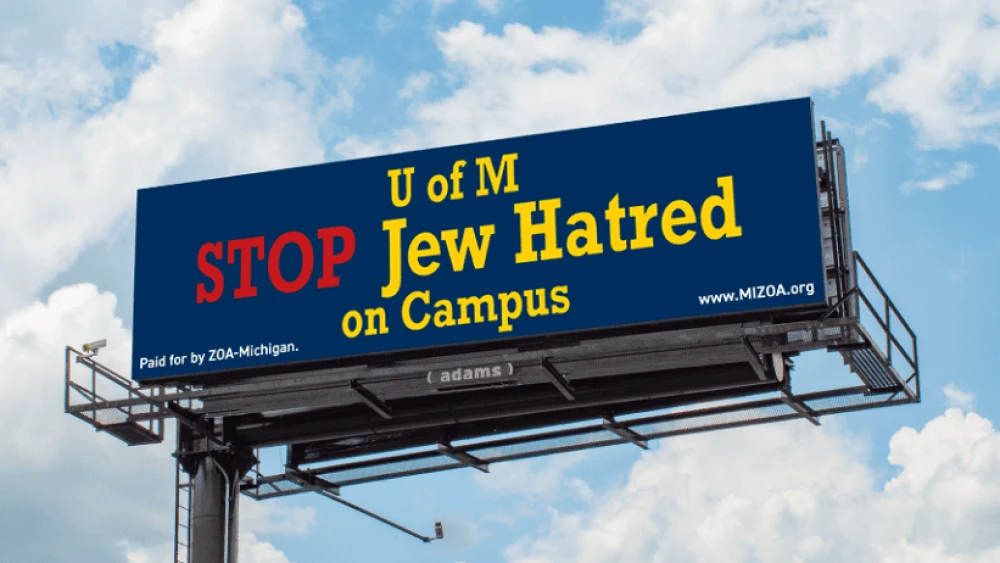
Students Supporting Israel at the University of Michigan was founded by my friend Dan Viderman in the months following the Oct. 7 attacks. It emerged not by desire, but out of necessity. Too many of us faced harassment from our own classmates and extreme anti-Israel bias at every level, from our graduate student instructors to professors. Our peers openly proclaimed their support for terrorism and disdain for those of us who believed in Western values. We felt afraid, alone and unsafe.
Among those in the Jewish community, we all know someone either directly or indirectly affected by antisemitic and anti-Israel terror attacks—from Bondi to Michigan. When an armed gunman drove into my friend Abigail’s synagogue and attacked its preschool, global events suddenly came very close to home. When the door of our Jewish Resource Center was kicked by a student yelling “F**k Israel, F**k the Jewish people,” the hatred’s presence on our own campus became abundantly clear.
Israel is simply the front-line battle in the war for the West. If we lose, we risk falling to the insidious forces that want to burn to the ground the free society people have fought and died for.
As Rabbi Jonathan Sacks famously observed, what starts with the Jews rarely ends with the Jews. The forces that scream “Death to Israel” often continue with “Death to America,” and we must take them at their word when they tell us what they intend to do.
They do not speak for all of us
Watching an assault on my way to dinner has a way of making the future of this country feel bleak. But there are moments that give us hope. When we marched with more than 250 people on Oct. 7 this year, all draped in American and Israeli flags, we were reminded that we are not alone.
The loudest voices on campus may dominate the headlines, but they do not speak for all of us. There are students who still believe in freedom of speech, in the values that built this country and in the civilization we have inherited.
We may not be the loudest or most forceful—occupying buildings, shouting down speakers or assaulting those who disagree with us. But we are here, studying, organizing and preparing to take our places in the world beyond Ann Arbor.
The radicals may have captured the campus microphone. But they do not speak for an entire generation.
When we leave these classrooms, we intend to prove it.