What does it mean to be a second-generation Holocaust survivor? For Lior Marom, it’s being raised by a father haunted by his earliest childhood memory: digging in the snow for frozen potatoes left behind by a farmer in eastern Russia. Because as early as he could remember, life meant simply fighting to stay alive.
And now, his father’s childhood spent on the run from the Nazis with his parents and sister, along with a grandfather’s words whispered in his ear from the grave, are guiding this man’s paintbrush and transforming his family’s nightmare into art that’s at once haunting and transcendent.

That art has been exhibited this year at Georgian Court University in Lakewood, N.J., and the Ghetto Fighters’ House Museum in the Western Galilee, where it took home this year’s Bella Zarchi Award for excellence in Holocaust remembrance.
And every year when Kristallnacht (Nov. 9-10, 1938) is remembered, Marom asks the same question: How much did his family and the other Jews living in their village near Warsaw know about what the Nazis and their collaborators did that terrible night: the 1,400 synagogues and yeshivahs throughout Germany, Austria and the Sudetenland destroyed (hence the “Night of Broken Glass”), the 2,000 Jews murdered, the 30,000 arrested and the 7,000 businesses demolished?
“In Pułtusk, the Jews lived alongside their Christian Polish neighbors in relative peace,” says Marom, sitting in his studio in Pardes Hanna, Israel, surrounded by his portraits of those family members still alive and those who are not. “It’s one of the most haunting questions of all: Could they have had any inkling of what awaited them if the Nazis invaded their country? Could they have guessed the catastrophe that was approaching?”
Because it was only 10 months later, on Sept. 7, 1939, that their village was filled with Nazi soldiers on their murderous march across Poland—a date that ended the life Jews had lived there for generations.

For Marom, now 53, 1990 was the year the Holocaust came into a sharp and deeply personal focus with a trip to the death camps. This rite of passage for Israeli high-schoolers shook him awake to his family’s tragic past, especially since his father had come along as a chaperone.
“The first time I ever saw him cry was at Treblinka,” says his son. “He told me that he and his parents and sister were supposed to be killed there, too, along with so many of his relatives and neighbors.”
The trip also opened a floodgate inside the teen at the time. “I came back and painted, painted and painted, everything I saw there, everything I felt. I literally couldn’t stop, like there was something inside of me that had to get out.”
When Marom entered his artworks in an exhibit at his school, the judge of that show—a survivor himself—came over and shouted at him: “You can’t stop here!”
“And I could see how proud my father was that I could find a way to express what he could not.”
After his father’s death in 2018, Marom discovered in the basement every painting, every sketch from that time, which, unknown to him, his father had stashed away for safekeeping.
And when it was Marom’s time to enlist in the army, “I had to go straight into a combat unit because, by then, I knew from my family what ‘Never Again’ means and I wanted to be a part of making sure nothing like this ever happens again.” He joined the paratroopers and later Israeli Prime Minister Rabin’s security staff. Eight years of military service were followed by six in Paris studying architecture, where he met the woman he would marry: Hamutal, an Israeli cellist.
By 2007, the couple returned to Israel. “We knew it was time to come home. We both had successful careers in Paris, but we wanted our children to be Israelis.”

‘Our own way of sorrow’
Fast-forward 11 years later. After his father’s passing, in addition to his early Holocaust art, something else surfaced when cleaning out his belongings: a pile of dust-covered copies of a memoir his paternal grandfather, Shlomo Aaron Blankitney, had written throughout the war, then in a Displaced Persons’ camp, and finally, in Israel after he moved there in 1949. In the introduction, he shared what drove him to write this book: the determination that his community would not be forgotten.
“I think I also paint for the same basic reason—myself and my grandfather both expressing in our own way the sorrow for this world that was destroyed and for all the Jews who lost their lives, so no one can forget.”
As soon as the book was translated from Yiddish into Hebrew, Marom says he was able to “hear” his grandfather’s voice, a voice that had long been silenced by Parkinson’s disease. “Reading his words, it’s like he came alive for me—everything he’d been thinking and feeling and experiencing.”
Through those pages, Marom was able to follow his grandfather from the fateful day—Sept. 7, 1939—when the German army entered Pułtusk, beating many of the Jews and shooting others in the street. Two weeks later, the Nazis broke into their home, taking everything of value and beating his pregnant wife. (The fetus, Marom’s future father, miraculously survived.)

His grandfather decided to run with his wife and 3-year-old daughter, passing bodies in the streets as they headed east toward the Russian section of Poland. It was a decision that would mean the difference between life and death for them, as most of the village’s Jews, including much of his family, would be burned alive in a local synagogue.
Others would eventually be shipped to the Warsaw Ghetto and then to their deaths in Treblinka, a fate that would have awaited them as well had they stayed.
Marom’s father, Gershon, was born four months later in Belarus on Jan. 25, 1940, his grandfather having been put to work after telling the Russians he was proficient at sewing boots. That skill saved their lives repeatedly over the next several years, even as they scrambled for food, shelter and heat, managing to dodge Nazi attacks. All the while, they continued to move eastward as far as Kazakhstan, where his tailoring skills were also in demand.
It was during these years that he began to write. “You can tell that was his way to protect his sanity,” says his grandson.
His grandfather titled the book Goral, meaning “fate” or “destiny,” a Yiddish word of Hebrew origin. “I feel that my grandfather’s art and my own are bound by that destiny.” Marom says more than 80 years later, “his writing and my art are also ways to know ourselves and our roots, to understand what kind of men we became and why.”
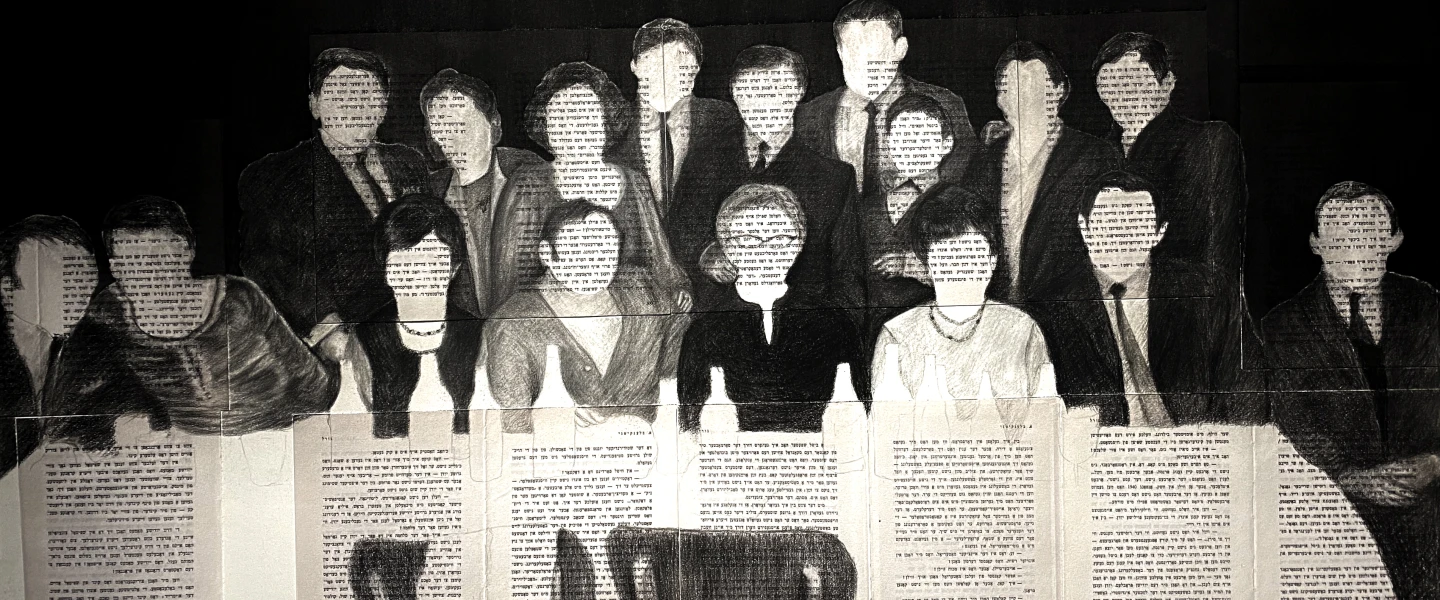
It was 2020 when the idea struck Marom to take apart one of his grandfather’s books and use the pages as backdrops for his paintings, “like a conversation he and I are having so many years after his death.” His grandfather died in 1986, shortly after his grandson’s bar mitzvah.
‘Revealing his story to the next generations’
Oddly, this series of portraits was an unexpected gift of the pandemic.
“When we were isolated during COVID, we let go of a lot of the things in life, like work and errands that usually keep us distracted,” he says. “So we were free to deal with things inside that needed to be expressed but were too emotional to be able to pierce through normal day-to-day life.”
Soon, he was envisioning the faces of his family literally set against the backdrop of his grandfather’s story of strength, survival—and destiny.
Working his way through his grandfather’s life story also gifted Marom with new compassion for his own father, who’d made aliyah at age 9 with his parents, brother and sister after four years in a Displaced Persons camp in Germany. He went on to a 20-year military career, fighting in the 1967 Six-Day War and the 1973 Yom Kippur War through the First Lebanon War in 1982 before retiring as a children’s photographer in the Tel Aviv area.

“A lot of survivors had problems with relationships, with showing affection and speaking of the terrible things they’d endured,” he says. “Learning what he’d been through, the childhood that was stolen from him, I began to better understand our family—my father’s hardness and my grandparents’ silence … ‘Shhh! The kinder.’”
In the end, it was these pages that Marom discovered what had happened to them when no one else could speak of it, and he, in turn, feels duty-bound to pass it on in his own way. “In my paintings,” he states, “it looks like I’m covering up his words. But I’m actually revealing his story to the next generations and to the world, instead of leaving his book unread on a dusty shelf.”
‘A reminder of the darkness’
These were the paintings that caught the eyes of the judges for an exhibit of Jewish artists dealing with the Holocaust at Georgian Court University, a Catholic college in Lakewood, as well as those at the Ghetto Fighters’ House Museum in the Galilee. Every year, this—one of the world’s oldest Holocaust museums, established in 1949 by survivors, including those of the Warsaw Ghetto Uprising—sponsors an award for the inspiring and innovative works that best convey the lessons of the Shoah.
Many of Marom’s works are created with a simple piece of charcoal. “Symbolically, since charcoal is born from fire, from what has been consumed and reduced to its darkest essence, it carries within it the memory of a tree that once lived and has reached its end,” the artist explains. “And yet, from this blackened remnant, I seek to breathe new life into the darkness.”

And the yellow detailing he employs in many of his works “is a subtle reminder—a beautiful luminous color that was imposed upon the Jewish people during the Holocaust as a mark of persecution and humiliation. I’m using it deliberately as a quiet warning, a reminder of the darkness that must never be allowed to return.”
“Lior was an easy choice this year,” says museum curator Liat Margalit. “Painting portraits of generations of his family embedded in his grandfather’s memories is very emotional and provides a testimony for both the past and the future.”
And, she adds, “with so few survivors still alive, Lior’s work speaks for them, fully engaging us without words.”

Six years ago, as the portraits began to emerge from his paintbrush atop his grandfather’s words, Marom says that “the whole time, I’m thinking: ‘This is how I’m telling this story to my children the third generation, so their children the fourth generation will also understand it.”
Now, busy with his residential architecture practice and a family complete with three teenagers, in Marom’s newest works he is exploring the question of home.
“The Jewish people around the world say to themselves, ‘Where I’m living is my home.’ But home is not just shelter. After the Holocaust, with the same poison of antisemitism now taking new forms, I ask myself: ‘If my grandfather could see it coming, why can’t we?’ This reminds us: Before we forget the past, that we can be marked again.
“The only difference? They had no real home to go to, but now, we have our own country. … I hope that somehow my grandfather knows, after everything he went through, that he has grandchildren and great-grandchildren at home here in the land that he dreamed of.”
Visit Marom’s website at: www.liormarom-art.com.