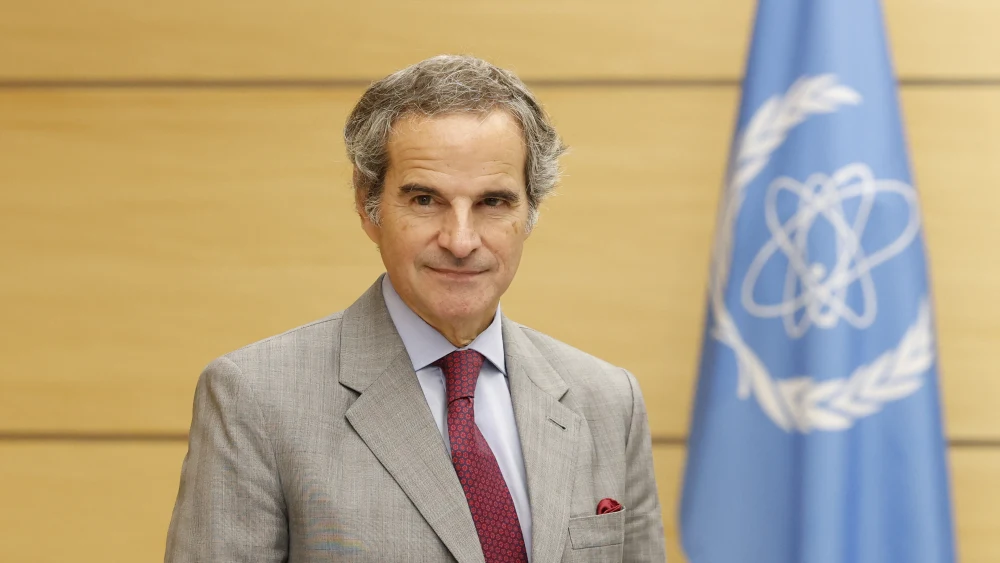
To ensure Iran does not develop nuclear weapons, a “very strong” inspection procedure will be required, U.N. nuclear watchdog chief Rafael Grossi said at a news conference in Japan on Friday, according to the AFP news agency.
Washington and Tehran signed a Memorandum of Understanding last week to end hostilities in the Middle East and engage in a 60-day negotiation period to address Iran’s nuclear project.
U.S. President Donald Trump told reporters on Tuesday in Pennsylvania that, despite denials made by Iranian officials, “We have it down: 100% inspection,” adding that if Tehran had not agreed to inspect its nuclear facilities, he would call off further talks “right now.”
Referring to the MoU, the head of the International Atomic Energy Agency said on Friday that its objective “is to ensure that there is no development of nuclear weapons in Iran. The government of Iran has declared quite clearly that this is not their intention.”
Grossi continued, “But of course, intentions are not enough. We have to have a very strong verification system in place ... as soon as is practicable.
“There is a bit of a war of statements here,” he went on to say, referring to the mismatch in remarks made by U.S. and Iranian officials, according to CNBC.
“What is undeniable is that we have an MoU. This MoU specifically indicates that the nuclear part of the memorandum will be supervised. This is the word, will be supervised by the IAEA. In order to supervise, we need to inspect. There is no other way,” said Grossi.
“The technical work has started, and we hope to be there soon,” he added.
The Islamic Republic of Iran is estimated to hold a stockpile of 440 kilograms of uranium enriched to 60%, a short technical step away from the weapons-grade enrichment of 90%.
This stockpile is believed to have been bombed by U.S. forces during “Operation Midnight Hammer” that took place in June, 2025, and is possibly buried deep beneath the ground.
The memorandum stipulates under clause number 8 that Tehran has agreed “to resolve the disposition of stockpiled enriched material pursuant to a mechanism that will be mutually agreed upon … with the minimum methodology to be down-blending on-site, under the supervision of the IAEA.”