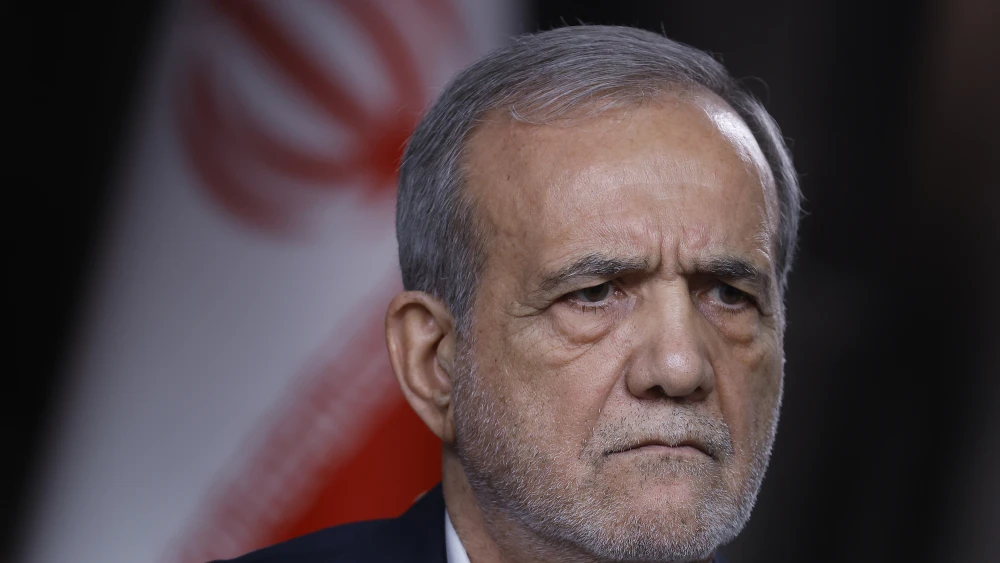
Iran will not give up “its right” to enrich uranium, President Masoud Pezeshkian said on Sunday, while also ruling out negotiations over its ballistic missile program.
“We will not relinquish our right to enrichment, and the other side will have no choice but to accept this right,” Pezeshkian told a monetary and foreign exchange policy conference in Tehran, according to a readout posted to the website of the Iranian Presidency.
“Previously, they said that Iran’s missiles must also be part of the negotiations. Now, however, they say that just as other countries possess missiles, Iran should also have ballistic missiles,” the Iranian leader said. “The rules of the game have changed.”
Pezeshkian spoke as U.S. and Iranian negotiation teams were arriving in Lucerne, Switzerland, to discuss a final agreement that would end the war and define restrictions on the Islamic Republic’s nuclear project.
“What the United States is demanding is that Iran not build a nuclear bomb,” he said in his remarks. “The supreme leader has previously stated that Iran is not seeking a bomb, and we have repeatedly said the same. This is nothing new, and we are prepared to put it in writing that we do not intend to build a nuclear weapon.”
U.S. President Donald Trump said after agreeing on the Memorandum of Understanding with Iran last week that any final agreement would allow Tehran to enrich uranium only at low levels that “could never be used for military purposes.”
Speaking alongside French President Emmanuel Macron on June 15, the American leader said that Tehran “fully agreed to that, with strong policing powers, and they won’t have a nuclear weapon, which is what it was all about—because they probably would have used it if they had it.”
Regarding Iran’s ballistic missiles, Trump pivoted on Wednesday, saying that the regime should be allowed to keep some as “other countries have them” and they “don’t blow up the planet like nuclear weapons do.”
Iran’s deputy parliament speaker, Ali Nikzad, warned on Sunday that the Islamic regime’s armed forces have “their finger on the trigger and are ready to act” despite the diplomatic talks.
“The country’s executive and administrative officials must also work around the clock, planning for the worst-case scenarios, without waiting for the outcome of the negotiations or to see whether our enemies will honor their commitments, and should instead continue working to build a strong Iran,” he said.