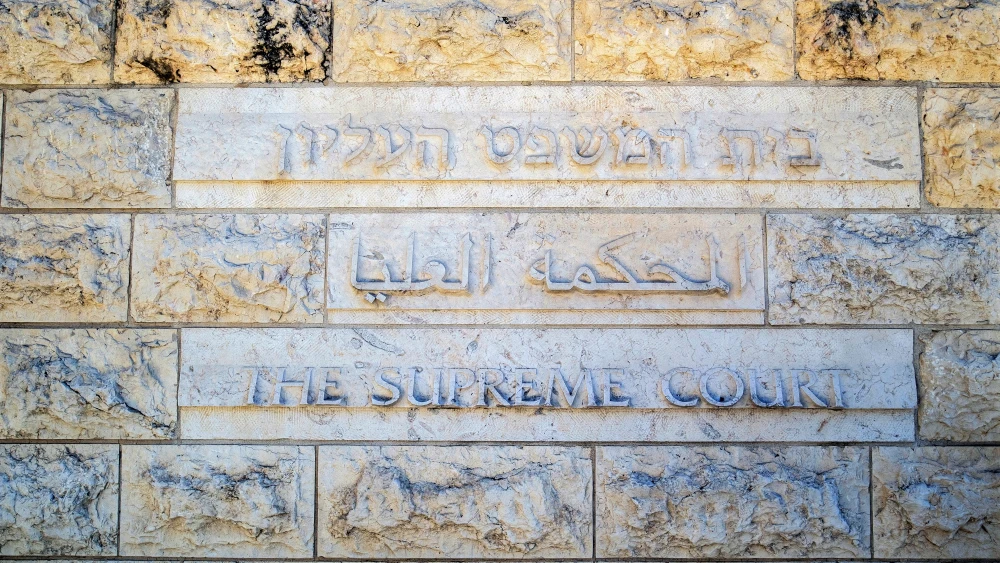

On the afternoon of March 31, the day before the eve of Passover this year, two urgent petitions were filed with Israel’s High Court for Justice against the Israel Police, and they were remarkably similar.
One was filed by the Association for Civil Rights (hereinafter: the “left-wing petition”), and the other was filed by the Headquarters for the Land of Israel (hereinafter: the “right-wing petition”), represented by me.
Both sought to order the Israel Police to rescind decisions regarding various activities at this time of war, which the police had prohibited based on Home Front Command guidelines set by the Israel Defense Forces.
The left-wing petition sought to order the Israel Police to permit demonstrations throughout the country without any restrictions on the number of participants, despite Home Front Command instructions limiting gatherings to only 50 participants.
The right-wing petition sought to order the police to allow Jewish visits to the Temple Mount in Jerusalem, especially on Passover and the days of the Holy Week, to allow Jews to fulfill the commandment of pilgrimage on Passover. It should be emphasized that the Home Front Command explicitly confirmed, at the petitioner’s request, that there was no restriction on its part on visits to the Temple Mount and that the restrictions related only to assemblies.
Both petitions reached the desk of the duty judge, Yechiel Kasher, on April 1, the eve of Passover.
In the left-wing petition, after consulting with Judge Yitzhak Amit, Kasher ruled that the petition would be heard on April 3 at 11:30 a.m., the first intermediate day of the holiday, before a panel of Amit, Kasher and Khaled Kabub, and that the prosecution must submit its response no later than one hour before the hearing.
In contrast, in the right-wing petition, Kasher made no decision. No hearing was scheduled, no response from the respondents was requested, and no substantive comment was given. There was total disregard, as if the petition had never been filed at all.
On April 2, the first day of the Passover holiday, Haaretz newspaper submitted a request to broadcast the hearing scheduled for the following day.
To our astonishment, on the evening after the holiday, at 8:42 p.m., a panel of three judges—Amit, Kasher and Kabub—rejected the right-wing petition.
It is important to understand the significance of this: The courts do not operate on Shabbats and holidays, except in extremely exceptional cases of life-threatening emergencies. In order to activate the court on such a date, it is necessary to contact the chief secretary of the Israeli Supreme Court at her home, who operates the entire system: secretariat, judges’ chambers, legal assistants and computer personnel. This entire mechanism was activated not to save lives, but to decide on the request of Haaretz to broadcast the hearing the next day.
On Friday, the hearing on the left-wing petition was held before the three judges. The Attorney General’s Office did not file a response. Apparently, it identified with the petitioners.
At the end of the hearing, the judges ordered the Home Front Command and the police to conduct a tour of four protest sites and submit an update by Saturday, the Shabbat, at 11 a.m. This means that the state authorities—the police, the Home Front Command and the prosecutor’s office—were required to work and violate Shabbat in order to hold demonstrations on Saturday night.
Amit also added at the end of the decision that “the doors of the court remain open as long as the need arises,” meaning that the court will also operate during Shabbat for left-wing demonstrations.
Indeed, on Saturday at 11 a.m., a notice was submitted by the Home Front Command and the police, stating that a deviation from the gathering guidelines for 150 participants could be approved at Habima Square in Tel Aviv. But no permission was given to deviate from standing instructions at other sites: at the Horev Center in Haifa, at Paris Square in Jerusalem and on Sokolov Street in Kfar Saba.
Following this, the court returned and activated its mechanisms once again on the Shabbat, ordering the Home Front Command to update its position by 6 p.m. (Shabbat concluded only after 7:30 p.m.) and even to consult with the “military justice authorities” (i.e., the MAG), thus obliging the authorities to continue to violate the Shabbat.
Since the Home Front Command did not change its professional position, the court issued another decision at 7 p.m., still during the Shabbat, according to which 600 demonstrators would be allowed to participate in the demonstration in Tel Aviv (four times the Home Front Command guidelines), and 150 participants would be allowed at other sites (three times the original limit).
It should be clarified that, at the time of this writing, events such as weddings, bar mitzvahs and funerals are limited to only 50 participants. The High Court has thus appointed itself as a substitute for the state authorities and the military, and exempted left-wing protesters from the restrictions.
On the other hand, in the right-wing petition, which concerned individual visits to the Temple Mount without any assemblies and which was supported by an explicit clarification from the Home Front Command that they are permitted, no decision was made in response, and no hearing was scheduled. The High Court completely ignored the right-wing petition.
In light of this disregard and the clear procedural discrimination, as the attorney who filed the right-wing petition, informed the High Court regarding the deletion of the petition: “In a case where the court does not exercise its authority and does not discuss the dispute brought before it, the foundations of trust in the legal system and the principle of equality between litigants are violated.”