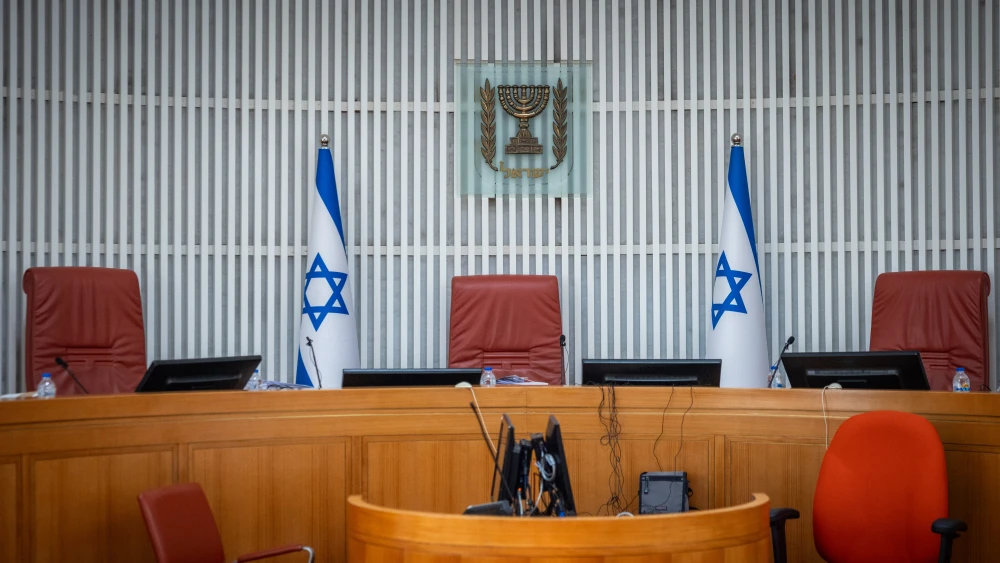

These days, with Israel fighting on multiple fronts, there is no dispute that national security is the No. 1 issue on the minds of the Israeli public. Yet long before the war with Iran—and certainly, during any moment when Israelis are not focused solely on the battlefield—one issue has consistently dominated public discourse: the regulation of the balance of power among Israel’s branches of government, particularly the relationship between the judiciary and the other branches.
Until Oct. 7, 2023, this issue shook the nation, sending hundreds of thousands into the streets. Even today, it remains a constant subject of public and political debate.
In simple terms, Israel is facing an ongoing dispute over the proper scope of judicial authority and the extent to which the courts may intervene in the decisions of the legislative branch (the Knesset) and the executive branch (the government). Over many years, the judiciary has steadily accumulated more and more power at the expense of the other branches, disrupting the institutional balance between them. It has asserted the authority to strike down Knesset legislation and has exercised that power repeatedly in recent years. It has granted significant authority to unelected legal officials vis-à-vis elected representatives without explicit legislative authorization.
More broadly, the judiciary has assumed a central role in shaping national policy, despite not being an elected body.
At the heart of the controversy lies a fundamental disagreement about democracy itself. One camp believes that decisions regarding Israel’s identity and governance must ultimately rest with elected representatives, who are accountable to voters. The other camp argues that robust judicial oversight is essential to restrain elected officials and prevent abuses of power, and views the courts as the primary mechanism for doing so.
After years of intense public struggle surrounding proposed judicial reforms and the trials of Israeli Prime Minister Benjamin Netanyahu, an overwhelming majority of Israelis recognize that serious problems exist within the judicial system. The central debate is no longer whether reform is necessary, but what kind of reform is required.
The answers, however, depend largely on one’s starting assumptions. On the Israeli right, which remains underrepresented within the judicial system, many believe that the judiciary has used its authority as a political instrument and therefore seek substantial changes to its powers. On the Israeli left, which holds considerable influence within the legal establishment, attention is focused mainly on internal organizational reforms.
Waiting for a decision
Consider the following story.
Attorney Roi Kahlon was appointed about two years ago as the acting civil-service commissioner. Shortly after his appointment, the attorney general, who had opposed the appointment from the outset, announced, somewhat “surprisingly,” that a disciplinary investigation had been opened against him for allegedly including inaccurate details in the résumé he submitted.
For nearly 14 months, Kahlon has been waiting for a decision in his case. Even a complaint he filed with the ombudsman regarding the delay was found to be justified. Yet the attorney general has apparently not found the time to make a simple decision on the matter—or even to respond to the ombudsman’s request for her position.
When news broke that the complaint against the attorney general had been accepted, journalists were quick to react. For example, Kan 11 news reporter Michael Shemesh wrote: “The first reform in the law-enforcement system should be to stop the terrible delays in the enforcement system at the expense of people’s lives.”
To the average citizen who does not closely follow the conduct of the legal system, such a reaction might sound reasonable. A system that delays decisions and fails to operate efficiently must be suffering from bureaucratic inertia.
But anyone who follows the system more closely sees that this is not mere delay. Rather, it appears to be a deliberate and effective method of operation—a political tool through which the legal system exercises control over individuals, appointments and policy.
Here is a brief and far from exhaustive review of several recent cases involving such “delays”:
- Two years and dozens of extension requests—some even submitted late without court approval—passed before the attorney general responded to the Israeli High Court regarding a petition against the spyware commission. During that time, the commission’s appointment remained frozen, preventing it from functioning or investigating one of the most serious allegations ever raised in Israel: potential criminal conduct within the justice system itself. After two years of being unable to operate, the commission ultimately resigned.
- It took six years for the attorney general to file an indictment against former Knesset member Michael Ben-Ari, after previously informing the High Court that Ben-Ari should be barred from running for the Knesset because an indictment was imminent. During those years, Ben-Ari was denied the basic democratic right to run for office like any other citizen. He repeatedly demanded: Put me on trial already and end this torment. After all, you told the High Court the indictment was just around the corner. Yet in the corridors of the prosecution—silence.
- The attorney general also apparently found no time, for many months, to provide an opinion on Netanyahu’s pardon request. Even when the pardons department at the Israeli Ministry of Justice contacted her repeatedly, there was no response, delaying the request and the process.
- It took 10 years to conclude the corruption trial of attorney Ronen Fischer, a case that shook the prosecution. Due to investigative failures and the prolonged proceedings, Fischer ultimately did not serve time in prison.
- More than a decade later, Ruth David, the former senior prosecutor suspected of corruption, has still not been convicted. According to legal commentators, the “failures” seen in the Fischer case may also prevent David from serving a prison sentence.
Enact legislation requiring time limits
What these cases and others have in common is the use of “delay” as a political instrument. By intentionally dragging proceedings out, prosecutors can effectively eliminate appointments, block political candidacies, torment suspects and shape policy.
They do so knowing that most individuals standing under this sword lack the resources or power to fight back. Eventually, many give up. And even when they do not, the damage is already done: Reputations are tarnished, public perception is shaped, and when cases ultimately close without charges, the stigma remains while the exoneration rarely receives attention.
One of the best ways to determine whether something results from inability or unwillingness is to examine consistency over time. If inefficiency were the true problem, delays would occur even in cases convenient to the attorney general. Yet no one was surprised by the sudden “efficiency” demonstrated recently in the High Court petition seeking to remove the interior minister, when the attorney general submitted her response ahead of schedule—a model of efficiency when politically advantageous.
But the attorney general and the prosecution are not the only ones who employ this method. The Supreme Court may be its most experienced practitioner.
It took the court three years to publish its ruling striking down the Regulation Law. During that time, a temporary injunction froze the law, harming thousands of families who would have benefited from the regulation. And when was the decision finally released? Coincidentally, the government that passed the law had already collapsed and was no longer in a position to respond.
By contrast, when the Supreme Court decided to carry out what many consider a second constitutional revolution by striking down a Basic Law concerning its own powers, the ruling was issued within just a few months—immediately after Oct. 7, when the country was in the midst of an existential war, and the last thing on the public’s mind was the judiciary. Suddenly, remarkable efficiency was shown.
This is a well-known practice within the court: tabling rulings until a politically convenient moment emerges. Decisions are postponed for months or years until the timing suits the justices, while groundbreaking rulings mysteriously appear when the legislative and executive branches are too occupied to respond. It is the deliberate use of judicial procrastination as a political tool.
The system can work very efficiently when it wants to. Yet some within it consciously choose to use prolonged proceedings to gain political advantage—against appointments, against public figures, to bury cases they prefer to forget and to shape policy outcomes.
There is little doubt that legislation should be enacted to limit the time allowed for issuing rulings or filing indictments.
Yet on this point, it is worth recalling words attributed to Supreme Court Justice Yitzhak Amit, who reportedly told his fellow judges when they complained that the court was acting contrary to explicit law: “We do it intentionally, so as not to deprive judges of discretion. There must not be uniformity in sentencing, because it would force judges to impose punishments they do not believe in simply because the Supreme Court set a binding range … I don’t like this law.”