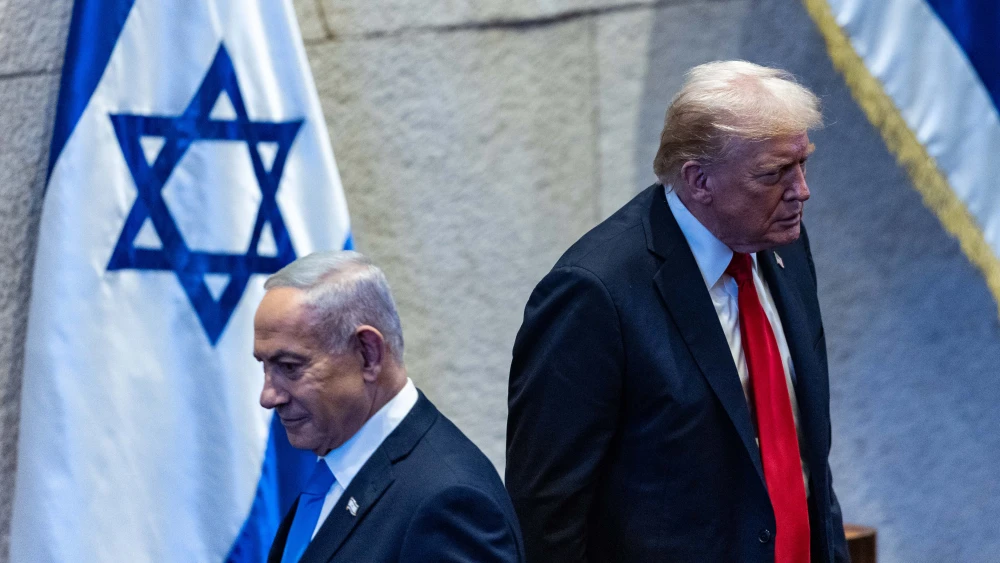

In the weeks since the guns went silent over Iran, a particular claim has taken hold across the political spectrum: that Israel dragged the United States into a war it didn’t need and that Washington’s involvement was a product of special-interest pressure rather than strategic logic.
These are serious accusations, and Zionists the world over have every right—indeed, an obligation—to engage with them seriously, rather than dismiss them.
The U.S.-Israel relationship is not and has never been a simple transaction in which the Jewish lobby extracts favors from a compliant American government. It is a layered strategic apparatus, built over decades, in which each component—diplomatic assurances, arms transfers, intelligence-sharing, public commitments—serves a specific function within a broader architecture of American foreign-policy interests. Understanding how Israel fits into that architecture is the precondition for defending it intelligently.
A 2016 RAND study found that U.S. overseas security commitments generate trade and GDP benefits that conservatively outweigh their costs by a factor of three or more. Security commitments are not expenditures. They are investments. The U.S.-Israel relationship is best understood as such an investment.
Consider a somewhat similar aspect of the American foreign-policy apparatus: The United States stations roughly 28,500 troops on the Korean Peninsula because those troops function as a “tripwire,” a commitment device. Yet no serious strategist believes that Washington keeps troops in Korea because a Korean lobby pressures Congress.
The U.S.-Israel relationship operates on a similar logic, though with an important distinction. Unlike the Korean situation, Jerusalem fields an independent military capable of acting without American approval. This is precisely the double edge at the heart of the relationship; what makes Israel a meaningful partner is the same autonomy that makes the partnership difficult to manage at times.
In a region pregnant with belligerents like the Middle East, having an ally largely receptive to American strategic interests is a particularly salient foreign policy asset. That asset has a price: reassurance. As political scientist Ariel Ilan Roth argued in a 2009 essay in International Studies Perspectives, an important function of American support for Israel is “restraint-inducing reassurance.” Put simply, Washington moderates Israeli behavior to serve broader American interests.
The 1967 Six-Day War is a cautionary example. When the United States failed to honor its 1957 assurances regarding freedom of navigation through the Straits of Tiran, and France embargoed arms, Israel felt abandoned. With no credible external guarantor and what its leadership genuinely believed was an existential threat bearing down, the Jewish state concluded it had no choice but to act. It launched a war that tripled its territory and pushed Egypt and Syria further into the Soviet orbit.
The 1973 Yom Kippur War shows the benefits of successful reassurance. Then-Israeli Prime Minister Golda Meir rejected preemption in October 1973 at real military cost. U.S. resupply then enabled Israel’s ultimate victory. Israeli restraint served American interests, and American investment made Israeli restraint possible.
The current moment is one in which all that history comes to bear.
We must articulate clearly what great powers actually do in dangerous neighborhoods.
Iran has long framed the U.S.-Israel relationship as a unified target, a posture rooted in revolutionary ideology that no amount of American distancing from Israel is likely to alter.
Indeed, as diplomat and scholar Dennis Ross documents in Doomed to Succeed, every administration that tried to improve its regional standing by distancing itself from Israel found it produced no strategic benefit. When the United States joined the operation against Iran, it was not because Israel dragged it in, but because American assets and credibility were already in Iranian crosshairs and thus at risk regardless of Israeli action.
American involvement in securing freedom of navigation through the Strait of Hormuz likewise reflects an independent U.S. interest. The 2022 National Security Strategy explicitly commits Washington to preventing any power from jeopardizing navigation through the Strait, a commitment rooted in decades of American strategic doctrine, not deference to any ally. That this has been framed primarily as something done on Israel’s behalf is not incidental. It is precisely the kind of conspiracy theory this article warns against.
None of this means that U.S. foreign policy toward Israel is above criticism. The tension around reassuring Israel that its survival is not in doubt while preserving the ability to express genuine disapproval of specific policies is real and not sui generis. American support has not always produced restraint. Sometimes it has provided cover. Acknowledging that complexity, however, is precisely what the narrative that reduces the relationship to lobbying and ethnic favoritism prevents.
Nonetheless, that narrative is not entirely baseless, which is precisely what makes it so enduring. Domestic politics should not be completely discounted. Interest groups, evangelical constituencies and defense cooperation all shape outcomes. The mistake is to flatten a 70-year strategic partnership to those factors alone. When the dominant framing reduces U.S.-Israel ties primarily to Jewish lobbying and ethnic favoritism, it flatters antisemites and impoverishes analysis. Israel’s location in one of the world’s most volatile regions makes this partnership more visible than others. That visibility, however, does not justify the disproportionate and undue scrutiny the relationship attracts.
The claims heard regarding the Iran operation—charges of manipulation, as well as the insistence that America is fighting someone else’s war—are not new. They are the oldest distortions in the playbook updated for the current news cycle. The answer to them is not to retreat from the U.S.-Israel relationship or apologize for defending it. The answer is to be more rigorous than our critics, name the complexity they refuse to countenance and articulate clearly what great powers actually do in dangerous neighborhoods.
That is not just an intellectual exercise. It is what serious advocacy requires.