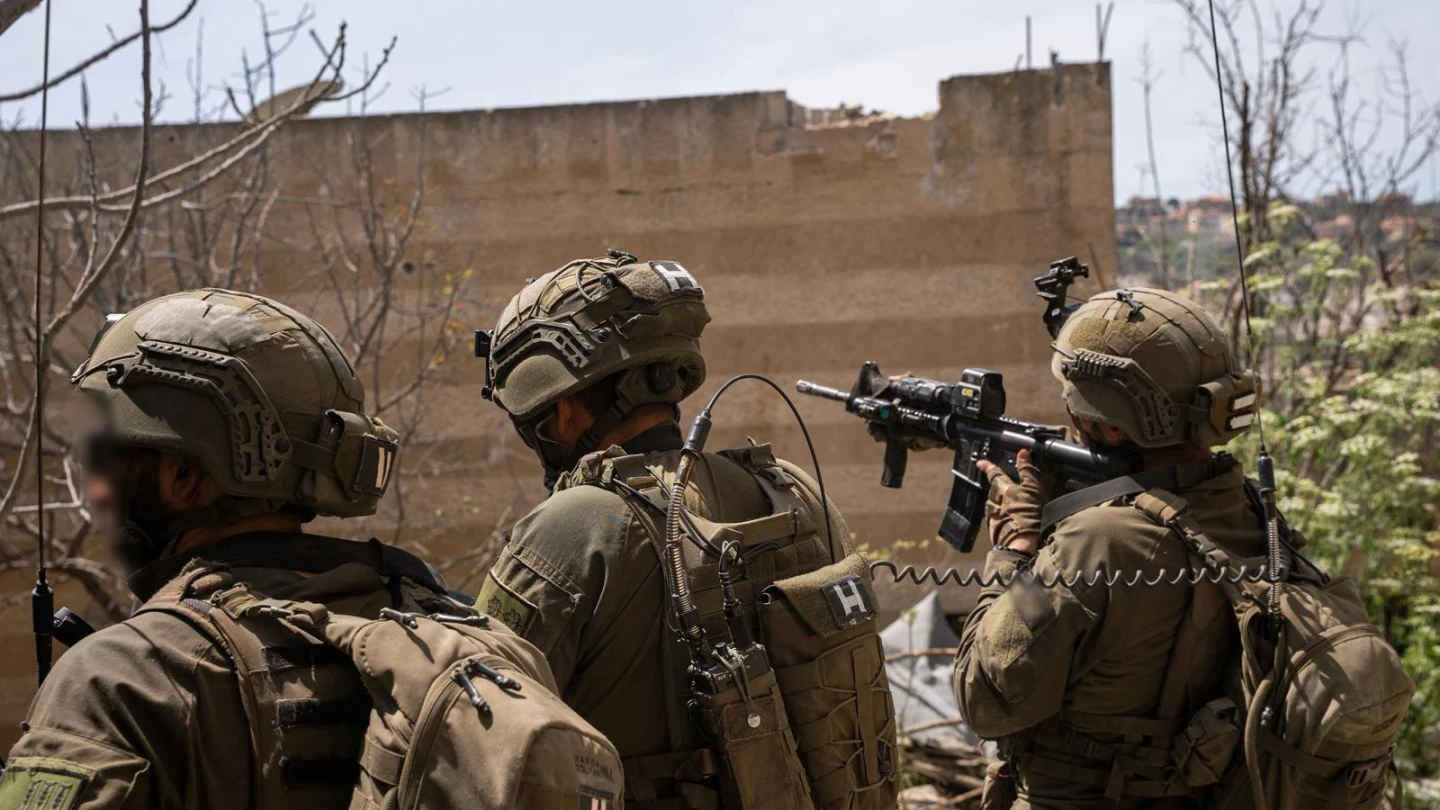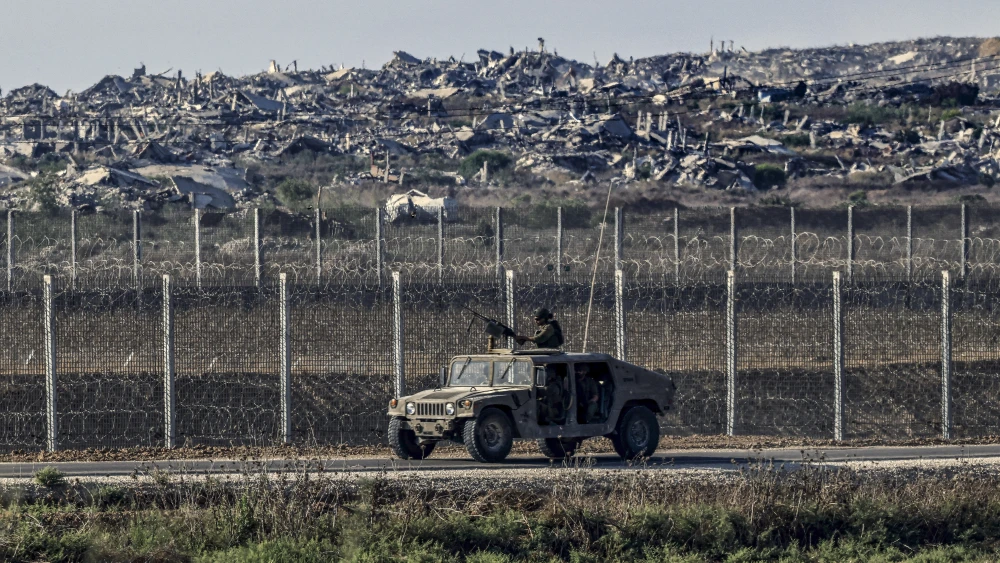

A few hundred concrete blocks painted yellow now sit at the center of a debate that will shape—no exaggeration—the entire Middle East. On the day the hostages came home 10 months ago, the Israel Defense Forces held 52% of the Gaza Strip. Since then, it has expanded to 70%. Gazans wake up to find the Yellow Line buffer zone closer than it was, sometimes forcing them to evacuate again to stay out of the line of fire.
Israel touts its expanding control of the Strip, though, in reality, there’s no advance of forces or new positions, only the widening of our troops’ firing line against approaching threats. The gap between the original lines and the current ones is what the fight over Gaza’s future now turns on. In principle, Israel doesn’t believe Hamas will disarm (or surrender its weapons to be melted down—a new American idea). It has no interest in a photo-op with U.S. President Donald Trump as long as it isn’t asked to withdraw.
The Americans tell Israel: 400 feet between you and them—what’s that? Move the concrete blocks back a little, and we’ll use it to force Hamas into the next stage. Worst case, a few hours of crane work and you’re back where you started. In Jerusalem, they resist, fearing a return to the withdrawals-first pattern that paved the whole road to Oct. 7. And in the background, there’s another political worry: With less than three months to the election, any withdrawal or agreement hurts Likud and the coalition. Itamar Ben-Gvir will bite from the right; Avigdor Lieberman, Naftali Bennett and Gadi Eisenkot from the left.
The Americans were caught off guard when Israel dug in against a withdrawal they considered purely tactical. Israel reminded them of the electoral calendar and of the fact that Israeli Prime Minister Benjamin Netanyahu has no great desire to concede now and collect the reward, if ever, only when it’s already too late. So, the thinking goes, let’s turn to the opposition leaders and have them publicly back the deal struck at the White House. For some reason, Lieberman, Bennett, Eisenkot and Yair Golan have yet to step in front of the cameras to call for an Israeli withdrawal and embrace Netanyahu. Surprising.
A round of primaries was held in the United States this week, and in a striking number of them, Gaza was front and center. Israel has a supreme interest in putting the issue to rest and beginning to recover in global public opinion; not, heaven forbid, by leaving Hamas in place, but through temporary tactical maneuvering that lets the Americans and their regional allies keep isolating the terrorists that still, barely, control the ruins of the city.
Eyes on him
“I will fight tooth and nail, if necessary,” Netanyahu said when former President Joe Biden moved towards a weapons embargo on him. But what, exactly, will the United States fight with? Even without an embargo, its own arsenals are approaching the red line fast. The commander of United States European Command warned the Pentagon that there aren’t enough resources to defend against the coming confrontation with Iran while protecting both Israel and American forces—they will have to choose.
Reuters reported that the U.S. Army has nearly exhausted its entire stock of precision missiles. In Israel, it was reported that the bunker-buster bombs of the kind dropped on Fordow last year are also nearly gone after a single night of strikes, making an attack on Pickaxe Mountain difficult.
The whole world is now watching Trump.
And all this after just a few weeks of fighting a failing Middle Eastern dictatorship, torn from within and teetering on economic collapse. What happens if Russia stages a provocation somewhere else in Europe? Or if China decides to push forces toward Taiwan? The state of the U.S. military brings to mind the IDF on the eve of Oct. 7: An imposing image that, in practice, delivered failure after failure, draw after draw. Its only clear victory since the end of the Cold War was over Saddam Hussein, a quarter of a century ago.
The whole world is now watching Trump. Will he end the war with Iran still controlling the Strait of Hormuz, the regime still standing and its army merely licking its wounds?
Two absurdities.
The first: The American, and especially Republican, trauma of a ground operation and a bloody quagmire is the very thing that has kept the Iranians alive. Almost any ground operation—to seize uranium, take Kharg Island or capture senior officials—would likely have triggered a dramatic upheaval of the regime.
The second: It is precisely the fear of a dramatic collapse in American standing that stops Trump from ending this conflict the way Washington ended Afghanistan, Iraq and Vietnam. Walter Russell Mead proposed years ago that the United States finish off Iran—the small, weak, estranged son of the Sino-Russian-Korean axis, and the only one that doesn’t yet have nuclear weapons. The message, he wrote shortly after Oct. 7, would land well in every capital that loves evil, even if the message is that the United States can no longer win.
Sail away
Like divided border cities during the Cold War, the twilight zone in Israeli politics known as the “Unity Bloc,” the “Third Bloc,” the “National Right” or whatever else you want to call it, is where the foreign powers are scheming.
Because, with all due respect to the campaign so far, the election will be decided by one question: Who, if anyone, can squeeze four or five seats out of this rather unpromising lemon. Take this week’s Channel 12 poll: If Hili Tropper and Yoaz Hendel clear the electoral threshold, they carry the Eisenkot bloc to 60 seats—within reach of a stable, four-year government. But if those four seats instead go to Gilad Erdan and Yuli Edelstein, or to Eyal Winter—none of whom rule out Netanyahu—then Eisenkot has no majority to govern, even with Arab abstention. Ten thousand votes shifting one way or the other, and the outcome is entirely different.
To general surprise, Eisenkot is looking more competent these days. The ideal scenario, from his point of view, is one in which right-wing voters move directly to a party that will recommend him to form the government and effectively join it—all to keep another election off the table. Tropper, alert to the danger of being lumped in with the Yair Golan-Yair Lapid camp, has lately been explaining that, while his final stop is Eisenkot, he won’t rule out pairing with another party just before the lists close and riding it to the unity government terminal.
Netanyahu, for his part, rules out only two things: He doesn’t trust Winter, and he won’t talk to Erdan. Channel 14 credits the former Likud minister with a soft spot for Yair Lapid and Yair Golan.
This isn’t some elaborate plot to peel him away from Netanyahu; it’s the reason that Erdan never went looking for a future inside Likud to begin with. In Likud, they’d be delighted to see Benny Gantz clear the threshold, rightly suspecting he’d sooner hand the premiership to Tali Gotliv than to Eisenkot, who abandoned him and left him to drown.
If the Bennett-Eisenkot fight was the semifinal, what’s happening now is the Oceania qualifiers on the road to the World Cup: a crowd of small teams chasing half a ticket to the tournament. The Erdan-Edelstein party launch was designed to drag everyone underwater by force. Once they’re all swallowing water and thrashing, just before the last of them blacks out, the strongest will break to the surface. Gantz is betting his money will pull the others toward him; Tropper, that the polls will. Erdan’s weapon is having no way out; he’s burned his bridges in Likud. Tropper has a safe harbor to return to; Gantz has a pension after long years in the game, but Erdan will tell everyone: I’m here to the end, and whoever wants to survive is welcome to join me.
Originally published by Israel Hayom.