



Sixty days of negotiations under the memorandum of understanding reached between the United States and Iran is a long time. There will be a moment of reckoning, and the final word has not yet been spoken.
But Israel is now trying to find a new balance in the uncomfortable world into which U.S. President Donald Trump has pushed it—a world that Vice President JD Vance described with his characteristic detachment from anything not American: “Certainly Israel will have a seat at the table in the new Middle East.”
The new understandings with Iran—because it is still absurd to call it an agreement or peace—is like a fog settling over a weary and wounded country. It is an affront to so many who fought, to the reservists, and to the memory of soldiers who believed they were fighting for a genuine solution to the Iranian problem, the great nuclear and terrorist threat hanging over Israel. For now, that will not be the outcome.
Israel is absent from the table where this non-agreement has been crafted, even as Iranian officials proudly parade it before the world in anticipation of its formal signing. Their satisfaction is obvious, and for precisely the same reasons that Israelis ask how Trump, after so much shared effort and sacrifice, arrived at such a meager conclusion.
History may well record that this was how a president abandoned the struggle against the world’s most dangerous regime—a state founded on oppression and the murder of its own people, and internationally on the construction of an empire of terrorist proxies: Hezbollah, Hamas, the Houthis, the Iraqi Hezbollah factions and countless Shi’ite militias, backed by the great autocratic powers of China and Russia, to which Iran supplies drones, the very same kind Hezbollah launches against Israel.
How extraordinary that Trump should walk away from the battle for democracy and from the defense of the Jewish people at a moment when antisemitism is resurging across the globe.
Throughout this long war for survival, Israel placed its trust and admiration in the man who moved the American embassy to Jerusalem and who appeared finally to understand the siege under which Israel has lived since its birth—and especially since Oct. 7, 2023.
Israeli Prime Minister Benjamin Netanyahu and Trump undoubtedly cultivated a personal bond. Today, it feels like a relationship—and a shared set of values—coming undone.
The joint campaign that reached all the way to Tehran was extraordinary. The destruction of Iran’s nuclear infrastructure and ballistic missile capabilities intended to dominate Israel and threaten the wider region remains an indelible achievement.
But now Israel watches as its closest friend prepares to hand billions of dollars to the Islamic Revolutionary Guard Corps. It sees the nuclear issue endlessly discussed but still unresolved, and Lebanon left hanging in uncertainty.
People in northern Israel are deeply worried. They know all too well what Hezbollah missiles and drones have done to their lives since 2023: homes abandoned, schools closed, jobs lost, families uprooted, people killed and wounded, communities devastated.
Netanyahu has remained silent while his political opponents, in the midst of an election campaign, descend upon him from every direction.
Yair Golan calls him “weak, sick and without influence.” Yair Lapid declares that “even Trump understands you care only about your own interests.” Benny Gantz and Gadi Eisenkot join the chorus.
Attacking Netanyahu has once again become a national pastime, particularly among those who could never tolerate his determination to fight “with fingernails and teeth,” as he once described his refusal to yield when then-President Joe Biden tried to block operations in Gaza—and now when Trump rebuked him for continuing to strike Dahiyeh in response to Hezbollah attacks.
For his part, Netanyahu vowed on Monday night to prevent Iran from acquiring a nuclear weapon “with or without an agreement.”
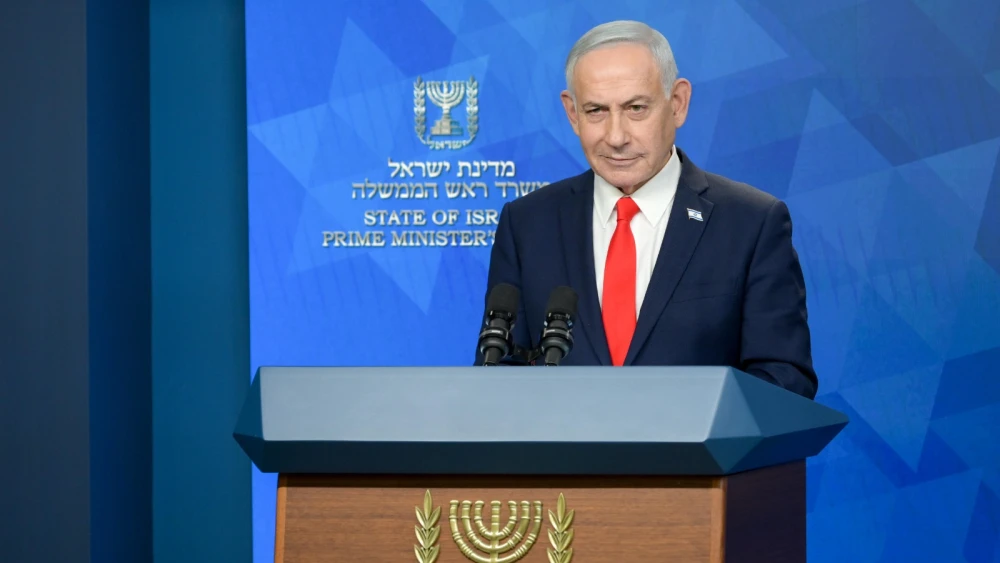
“Iran will not have nuclear weapons. As long as I am prime minister of Israel, this will not happen,” the premier told reporters in his first press conference since Trump concluded his peace deal with the Islamic regime on Sunday.
Asked about reported disagreements with the Trump administration, Netanyahu said, “He is the U.S. president, I’m the Israeli prime minister—we often see eye to eye and there are also instances where we see less eye to eye.”
Still, Netanyahu acknowledged that the “historic” joint U.S.-Israeli operation against Tehran “saved the State of Israel from the threat of nuclear annihilation.”
The wound is fresh and it is difficult to know what course to take, given that the United States remains the indispensable pillar of the Western alliance.
Clearly, Netanyahu could never have renounced American support when Israel embarked on the long war forced upon it after Oct. 7. But now every strategic choice must be reconsidered in an atmosphere where any independent move risks damaging relations with Washington.
His central mission—to free Israel and the wider world from the Iranian nuclear threat—has once again been thrown into doubt. The ayatollahs promise much, as Iran always does while consistently deceiving.
Yet those promises ring hollow in the face of 440 kilograms of uranium enriched to 60%, another 150 kilograms enriched to 20%, and tons of additional nuclear material still awaiting processing. If the centrifuges remain in Iran and are eventually restored with the funds now flowing back to the regime, they can once again produce weapons of mass destruction, even if on a longer timetable than before the war.
As for Lebanon, Israel cannot accept a peace that merely gives Hezbollah another opportunity to dig tunnels, accumulate weapons and money, and prepare for a Lebanese version of Oct. 7.
Trump’s chosen course reflects domestic American realities: high fuel prices, mounting political pressure ahead of the midterm elections, the burden of a distant conflict and the prospect of American coffins returning home draped in flags.
Over time, it also became evident that the enemy would never truly make peace. Trump is not a man who thinks in terms of the coming of the Mahdi, which Ayatollah Ruhollah Khomeini identified in 1979 as the horizon of a final war against the infidels.
Today’s Iran is far less the heir of the Persian Empire than the sword of revolutionary Islam, seeking first Shi’ite domination over Sunni Islam and ultimately global religious victory. It cares little about casualties, destruction or hunger, least of all among its own people, whom it routinely eliminates whenever they fail to conform to the dictates of the Islamic Republic.
Netanyahu understood this reality well when he addressed the U.S. Congress in 2015 to oppose then-President Barack Obama’s nuclear agreement with Iran. Today, the lies are the same, but Netanyahu cannot travel to Congress to speak against Trump’s peace initiative.
He can only continue fighting—under siege politically at home until the next elections—and once again confront the loneliness that has so often defined Israel’s struggle against its gravest dangers.



