
On June 22, 1948, a Tuesday, a ship with some 200 tons of military equipment in its hold, mainly half-tracks and dynamite, approached the Tel Aviv shoreline. It had set sail from Europe, despite the U.N. truce declared and in force since June 11, which included an arms embargo.
It was unloaded only after evening darkness had set in. Its name was the Inaco, and it was commanded by the Palmach.
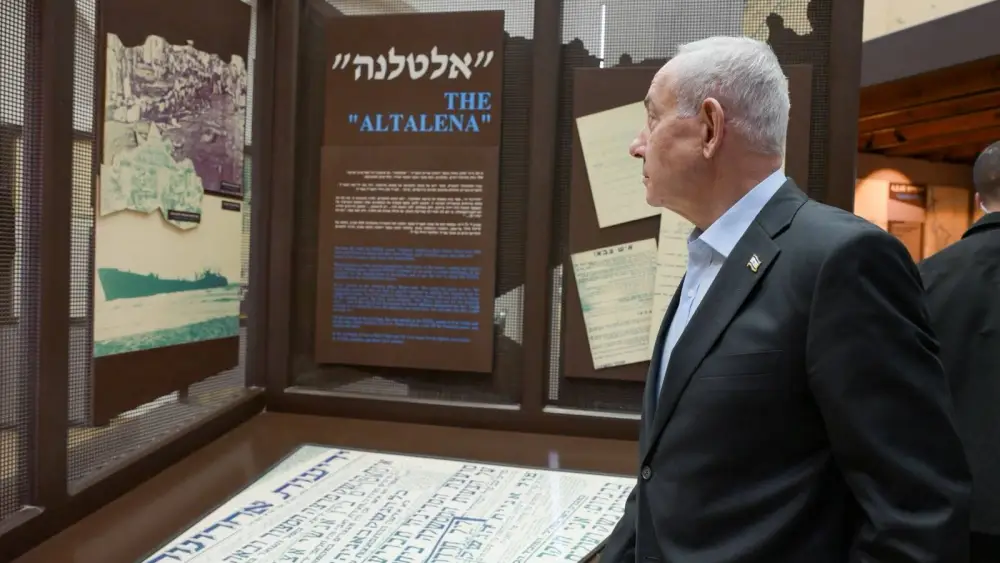
The delay was caused by an intense firefight some 4 kilometers to the north, just off the beachfront at Frischman Street where the Altalena had run aground. That incident followed an earlier shoot-out at the Kfar Vitkin shoreline (today, Bet Yannai beach) on June 20, where the ship, according to the agreement reached, had begun to unload its weaponry shipment.
The Palmach ship had no trouble bringing in its arms. The Altalena, the Irgun ship, despite understandings reached with the newly established Defense Ministry, commanded by the Irgun’s Diaspora Division, found itself under fire twice.
The Altalena had made its way to Tel Aviv, and during the evening, it had been chased by Israel Navy corvettes and fired upon. David Ben-Gurion had even sought to have the ship bombed from the air as well.
After the hostilities were over—leaving 19 dead, 16 of them members of the Irgun, including Jews and non-Jewish volunteers, as well as three soldiers in the Israel Defense Forces, and dozens wounded—the ship remained as a ghost presence just 200 meters or so off the coast.
The Herut Movement, led by Menachem Begin, who had twice narrowly avoided bullets fired by Jews that could have killed him, conducted a memorial ceremony a year later on the beach opposite the burnt-out hull.
People were swimming out to the boat; some climbed up and dove off it, despite unfound ordnance perhaps still on board. It was an ugly thing to be sitting there. The government announced on July 22, 1949, that the boat would be dragged off the sandbar and towed out to sea. At some undisclosed location, it would soon be sunk and, with it, Ben-Gurion hoped, memories of the event.
But that was not to be—not in the intervening years and not today.
We now know where the ship is after some 15 years of searching for it. However, not everyone is satisfied with it being found. Others are unhappy with the timing of it being located during an election campaign.

The events surrounding the Altalena are particularly seared into our national consciousness as a result of Jews shedding the blood of Jews. They are also remembered because, with hindsight, it is not hard to pinpoint the errors and missteps of both sides that eventually led to deaths and injuries, in addition to the loss of a huge amount of military supplies that could have turned the tide in the 1948 War of Independence, even in only specific battles.
Even now, eight decades later, the facts and the intentions are disputed. A major claim that the Irgun attempted to surprise the new State of Israel with an attempted putsch is blatantly false.
By March 1948, the ship was well known to Haganah agents of the Mossad L’Aliyah. At one point, given the expense of keeping the Altalena in port (rental fees, maintenance, etc.), the Haganah was offered to purchase it from the Irgun. Some even investigated the ship’s worthiness at Marseille; a Capt. Monroe Fein was reported as showing them around.
On May 16, 1948, Begin convened a meeting of Haganah representatives with several Irgun members who had flown in from Paris the previous day. Included in the discussion were Levy Eshkol (then Shkolnik), Yisrael Galili and David Hacohen. The latest developments concerning the Altalena were detailed and, again, in the spirit of cooperation, the Haganah was offered shipping space for its arms. Ben-Gurion even noted down the summary in his diary.
On June 1, Begin and Galili met to finalize an agreement whereby Etzel members would be absorbed into the IDF. A Haganah agent in France wired Tel Aviv on June 11 that the Etzel was loading their vessel and that a list of the passengers on board was given to the Israeli consul in Paris for their visa requirements.
At another meeting, conducted on June 16, Begin again convened Galili, Eshkol and HaCohen to deliberate whether, in view of the new ceasefire, the government wanted the vessel to come in. An arrival location was agreed upon: Kfar Vitkin, a Mapai moshav. It would have been an odd choice from where to stage a putsch.
The Irgun was not at all secretive. Defense ministry officials were updated on Saturday night, June 19, that the Altalena had reached the area off of Tel Aviv and would be proceeding to the Kfar Vitkin off-load area.
What must be seared into our national consciousness are not only the events of that sorry chapter.
The talks broke down on the beach at Kfar Vitkin over the division of the arms, and Begin was given 10 minutes to stand down his men. A gunfight erupted—not only because of a disagreement over percentages of arms to be distributed but also because of 25 years of animosity, distrust and slander.
The Revisionist Zionist movement and the Histadrut Labor Zionists had been locked in a bitter feud since the early 1920s. Major arguments centered on issues of defense against Arab violence; how to oppose British Mandate policies; and the economic structure of the Yishuv. Along those lines, Jabotinsky was construed as a “fascist” and Ben-Gurion a “Bolshevik dictator.”
Members of the Betar youth movement were denied immigration permits, employment and settlement opportunities. In 1944-45, the Saison period saw the Haganah hand Irgunists over to the British.
The Altalena was but another link in the inter-party rivalry and mutual dislike.
What must be seared into our national consciousness are not only the events of that sorry chapter. The recall of the motives of those involved at the time, as well as the grudges that blinded them, is what needs to be mulled over, so that such prejudices don’t rear their heads again.
One more point: Altalena was Jabotinsky’s nom de plume. If the ship is to be raised, then Jabotinsky’s legacy should also be brought out of the depths as a worthy heritage project, to be read, debated and serve as texts for study in Israel’s schools.