Everyone knows about the Jewish-Muslim tussle over claims to rule Jerusalem, with its Palestinian lie that Jerusalem has no role in Judaism, and also the pro-Israel rebuttal that the Koran does not mention Jerusalem.
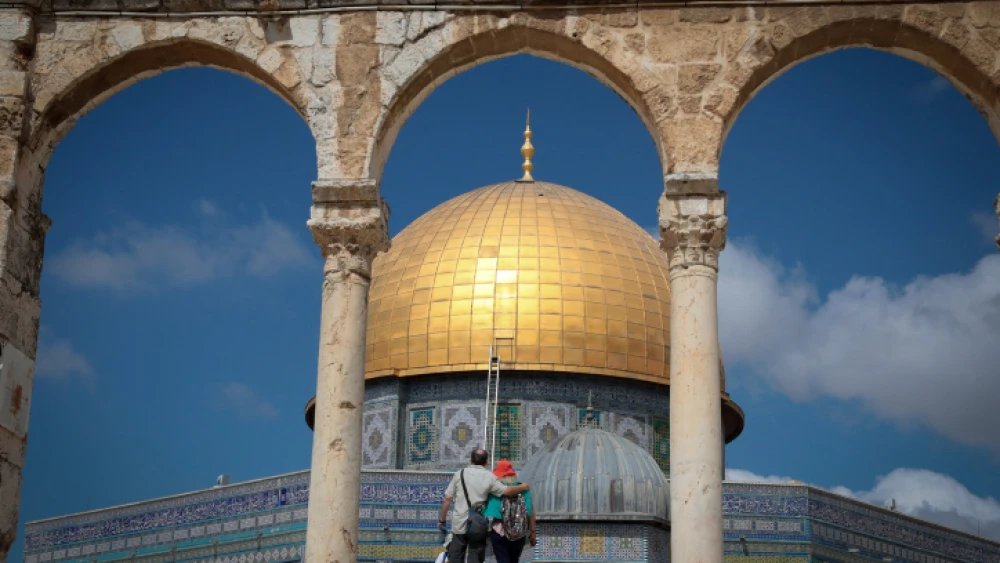
But there’s another heated, if less public, battle over Jerusalem (Arabic: al-Quds): not about the right to rule the city, but regarding authority over the Temple Mount (Arabic: al-Haram ash-Sharif), the holy esplanade containing two antique and holy edifices, the Dome of the Rock (built in 691 C.E.) and Al-Aqsa Mosque (705 C.E.).
Palestinian Authority: Controlling the Temple Mount is absolutely central to the P.A.'s mission. It may lack the economic and military resources of a state, but it wields two unique powers: day-to-day management (thanks to Israeli deference) and wide international support for its claim to rule eastern Jerusalem.
The P.A. zealously sustains these powers by intimidating Israel with its calls for Muslim outrage and leftist anti-Zionism. As the effective ruler atop the Temple Mount, it is the status quo power resisting any change.
Jordan: Amman enjoys many formal privileges but has minuscule sway on the ground. The 1994 Jordan-Israel peace treaty states that “Israel respects the present special role” of Jordan in “Muslim Holy shrines in Jerusalem” and grants “high priority to the Jordanian historic role in these shrines.”
One scholar mistakenly translates this into a supposed custodianship, “with its attendant duties of maintaining, protecting, and regulating access to the shrines.” Indeed, Israel colludes with relatively friendly Jordanian kings to hide their impotence because that pretend “special role” is, in the words of Nadav Shragai, “The central anchor that bolsters their monarchical rule, granting it legitimacy in the face of Islamic extremist elements in Jordan. A weakened presence on the mount, Jordan fears, will necessarily also undermine stability in the kingdom to the point of presenting an existential threat.”
Saudi Arabia: The Saudis lack influence but acutely aspire to some power to enhance their international standing. John Jenkins, a former U.K. ambassador to Riyadh, explains why: “Iran has always challenged them on the legitimacy of their custodianship of Mecca and Medina. If they were to add a third shrine to their list, it could enhance their claims to be the absolute [religious] leaders of the Islamic world.” The Israelis could hand Riyadh such power, simultaneously sweetening a peace treaty and lessening Palestinian control.
Turkey: The Ottoman Empire ruled Jerusalem for four centuries (1516-1917), after which Turkish authorities abruptly lost interest in the city. President Recep Tayyip Erdoğan recently renewed claims to its holy places, culminating in an October 2020 statement that “this city that we had to leave in tears during the First World War ... is our city, a city from us.”
Ankara has backed those words with tens of millions of dollars to promote Jerusalem’s Turkish heritage, win support for Turkey’s claims over the Temple Mount, and challenge Israeli rule. Allied with Hamas, the Turks do not cooperate with the Jewish state, which in turn wants to limit its role.
Morocco: Chairing the Organization of Islamic Cooperation’s Al-Quds Committee and hosting its headquarters since the committee’s founding in 1975 gives Moroccan kings a certain influence over the Temple Mount—despite a distance of 4,000 kilometers (2,485 miles).
The committee also has a subsidiary, Bayt Mal Al Quds Agency, which funds Islamic interests in Jerusalem by donating prayer rugs, building houses, helping with renovations, etc. Symbolically, Morrocan Foreign Minister Nasser Bourita prayed at Al-Aqsa in March 2018 to send “a strong message of support for the Palestinian cause.”
Generally, Moroccan kings ally on Temple Mount issues with Saudi kings to diminish Jordanian kings. Winning its goodwill presumably had a role in Rabat’s December 2020 decision to normalize relations with Israel.
Israel: Israel faces two hostile actors on the Temple Mount—the P.A., and Turkey/Hamas—and three actors quasi-willing to work with it—Jordan, Saudi Arabia and Morocco. Until now, Israeli leaders have lacked the imagination to exploit this rivalry, with its great potential psychological impact. One idea: encourage Emirati rulers to join the other three kings to undermine P.A. legitimacy. Another: revive Ehud Olmert’s initiative to sponsor a committee overseeing Jerusalem’s Islamic sanctities.
The ball is in Israel’s court.
Daniel Pipes (DanielPipes.org, @DanielPipes) is president of the Middle East Forum.
This article first appeared in Israel Hayom.