
Lovers of poetry are a rare, often eccentric breed. And poetry in the Torah is a rare occurrence.
What is it about poetry that makes it so appealing to connoisseurs and dilettantes alike? Surely, it is not clarity. If anything, verse is the aural thicket in which ideas both sublime and devastating seek refuge. Often, its message is inaccessible to the point of incoherence. Yet as opaque as a poem may be, the very sound of its chosen words, the way different articulations are strung together, creates an abstract beauty of its own, irrespective of our capacity to engage the idea—if indeed, there is any idea—embedded in the lines.
The adoring crowds who flocked to hear an inebriated Dylan Thomas declaim his verses came for the music—the music of his words and the music of his voice. Often, this was enough, because it is doubtful whether much of what he recited made any sense, certainly on first hearing. Thomas’s ability to string a necklace of words was sublime. No one came for the message. The sound was the message.
Having grown up in the yeshivah world, I can safely say that interest in poetry among devout Ashkenazi Jews is near zero. I speak not only of secular poetry or the transcendental poetry of others. The late antique and medieval piyyutim that are such an important part of the High Holiday liturgy are inscrutable to nearly all the daveners.
Among the vast majority of Torah-obsessed and Talmud-addicted men, there is simply no inclination to compose new piyyutim. Here and there, one may find the individual who actually pays attention to the words and comprehends the meaning of the verses. Even in these cases, they are more likely to seek the meaning rather than the melody, to which a tin ear is the Orthodox norm.
Things are markedly different among Sephardim, who never abandoned their love of Hebrew and the piyyutim. In fact, to some extent, they continue to compose piyyutim. Moroccans, especially, are committed to the art of paytanut. One is mesmerized by the devotion of Syrian Jews to their piyyutim as they gather year after year—young and old alike—from midnight to dawn on Friday nights during the weeks between Parshat Shemot and Beshalach to chant their magnificent poetry of exodus and redemption.
Alas, for religious Ashkenazim, the closest thing to poetry is an ox goring a cow.
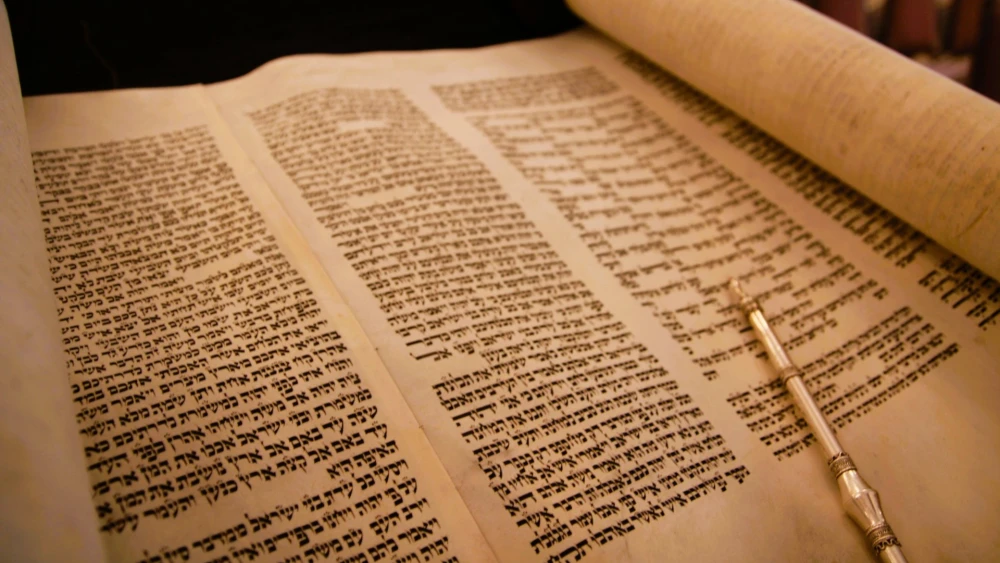
This brings us to the poetry of the Torah portion Ha’azinu.
It is highly doubtful that a critical mass of ancient Israelites had an ear for poetry, let alone the ability to decode the largely horrific message encoded in Moses’s final and mostly hortatory verses. Indeed, it is somewhat startling that the speech-impaired Moses, who demonstrated no penchant for poetry during his entire 120 years, could suddenly, on his deathbed, rival King David, Eliezer Kallir, William Shakespeare and T.S. Elliot, let alone camouflage his parting admonition in this epic declamation.
The opening verses are, in fact, a statement to the effect that poetry is beyond the human masses: “Listen, O heavens, and I shall speak; and let the earth hear my mouth’s utterances” (Deuteronomy 32:1). The poet makes it clear that his words are not for the unwashed masses, at least not in the literal meaning of the text. Rather, “My lesson shall fall like rain, my utterances flow like dew, like droplets on leaves of grass and showers upon the herb” (Deuteronomy 32:2).
If anything, these introductory phrases explain what poetry is. The bard writes not for pedestrian ears, but for heaven and earth, hoping that in the fullness of time, the music of his words will come to irrigate, nourish and sustain.
In the poetry of Ha’azinu, Moses is simply repeating the dire and embittered predictions he offered in Parashat Vayelekh: that the Israelites will eventually rebel and be subjected to the most horrific punishment and exile.
Perhaps he, too, was hoping that the music of his words, rather than the darkness of their meaning, would irrigate, nourish and sustain the Children of Israel with the passage of time.