


Two lawsuits filed in California this week seek to recover paintings, which they say were stolen by the Nazis, from museums.
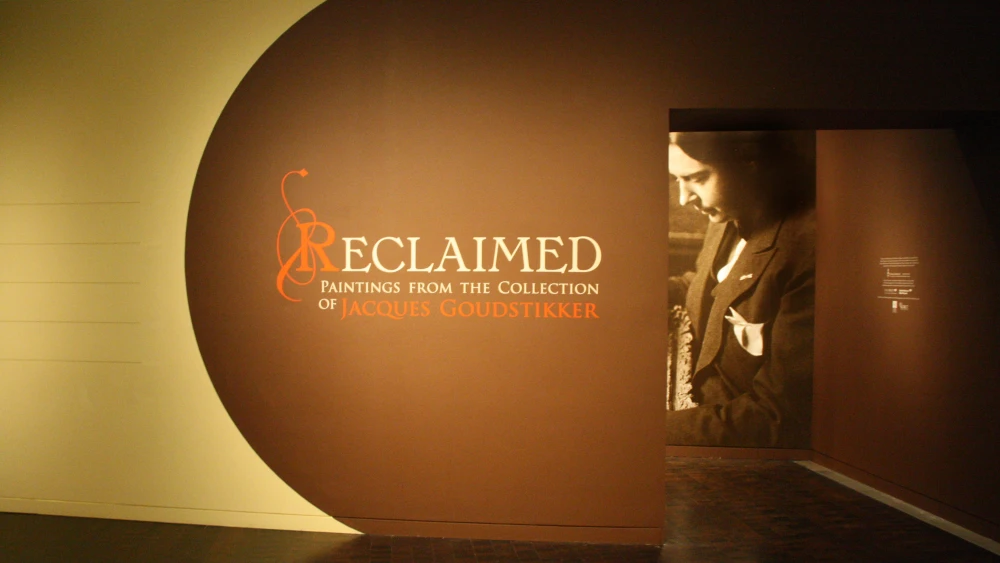
The Jewish Federation Los Angeles filed one of the suits against the Norton Simon Museum in Pasadena, Calif. According to the suit, the Nazis stole two oil paintings by renowned German Renaissance artist Lucas Cranach the Elder from the family of Dutch Jewish collector Jacques Goudstikker after it fled the Nazis in the Netherlands.
The Goudstikkers were unable to recover the paintings due to the difficulty of receiving postwar restitution from the Dutch government, the suit stated.
In the 1960s, the Dutch government gave the paintings to George Stroganoff-Scherbatoff, a member of a Russian noble family, who subsequently sold the Cranachs to the Norton Simon Museum five years later, the suit stated. (JNS sought comment from the museum.)
Marei von Saher, the only surviving Goudstikker heir, sued the museum in 2007 in the U.S. District Court for the Central District of California but lost in 2018 after the Ninth Circuit Court of Appeals ruled that the court could not overturn the Dutch government’s decision to bestow the Cranachs to Stroganoff-Scherbatoff.
The Federation is bringing the suit under California’s AB 2867, a law enacted in 2024 allowing state residents to recover property stolen as a result of political prosecution. The suit also invokes the recent federal law, the Holocaust Expropriated Art Recovery Act, which prevents a foreign government’s actions from being used as a defense against recovering Nazi-looted artwork.
Von Saher assigned her claim to the Cranachs to the Federation, which will donate the majority of the proceeds to Holocaust survivors who are living in poverty. Cranach paintings have sold for millions of dollars each, and some for hundreds of thousands, in recent sales at major auction houses.
“We are seeking to reverse a great injustice perpetrated by the Nazi theft of a Jewish family’s property, and securing the resources that will enable us to provide for the many needs of thousands of impoverished Holocaust survivors in the greater Los Angeles area so they can live in dignity for the remainder of their lives,” stated Rabbi Noah Farkas, president and CEO of the Federation.
The other suit, filed in the U.S. District Court for the Central District of California, alleges that the Auschwitz-Birkenau State Museum in Poland wrongly holds a series of watercolor paintings.
According to the suit, Dina Gottliebova Babbitt, a Holocaust survivor from Czechoslovakia, was imprisoned in Auschwitz, where the Nazis noticed her artistic ability. Dr. Josef Mengele forced Babbitt to paint people upon whom he experimented, and those paintings are held at the state museum, per the suit.
Mengele kept the paintings, which were never returned to Babbitt after the death camp was liberated in 1945, the suit stated. The museum has acknowledged that Babbitt is the creator of the works, but it maintains that it should keep the paintings. It said that the only person who had a legal claim to the works was Mengele, according to the suit.
Babbitt’s prior efforts to get the museum to return the paintings failed. She died in 2009. Her daughters, Michele Babbitt Kane and Karin Wendy Babbitt, filed the suit.
Paweł Sawicki, deputy spokesman for the Auschwitz museum, told JNS that “we fully understand the emotional approach of Dina Gottliebova’s family to the works she made on the orders of Josef Mengele in circumstances that certainly affected her life, but in carrying out our statutory responsibility, we express the deep conviction that the watercolors should remain at the memorial.”
“Since its creation in 1947, the museum has been struggling to collect and secure all the post-camp remains, striving to preserve them as a testimony to the crimes committed by Nazi Germany in this place where they are inextricably linked,” he said.
“The camp death certificates, prisoners’ registration cards and other documents created by Nazi bureaucracy, as well as different kinds of drawings created in the camp by prisoners, whether at the request of the SS or illegally, are unique documents and material evidence that weighs in favor of the place of their creation,” he told JNS.
“Our statutory responsibility is to gather and preserve all crime evidence and objects related to the history of Auschwitz,” Sawicki said. “While fully respecting the rights of people who created some of the documents here, we are of the opinion that any loss in the collections of the memorial will constitute irreparable harm.”



