



I recently came across a quote from Socrates: “The difficulty, my friends, is not in avoiding death, but in avoiding unrighteousness.”
Socrates was not sitting safely in a study when he said this. He was on trial, accused by Athens of impiety and corrupting the youth. He was found guilty and sentenced to death. Yet his concern was not simply whether he would survive, but whether he had acted righteously.
I immediately thought of Rosh Hashanah. As the piyyut says, “Today is the birth of the world. Today all the creatures of the world stand in judgment.”
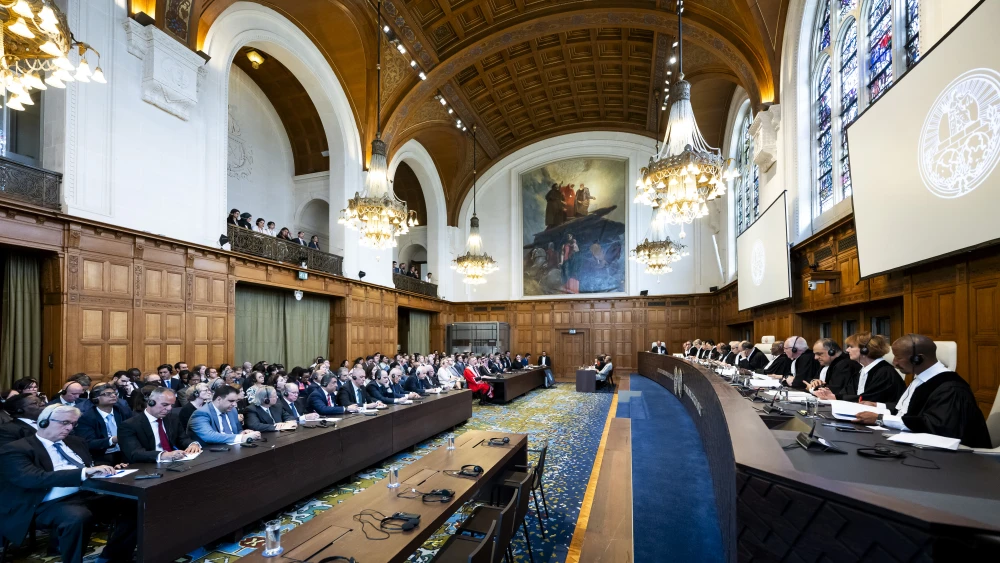
Those words have particular resonance this year because Israel itself seems to be on trial. Not merely an Israeli government, prime minister or military operation; increasingly, Israel and Zionism are in the dock. The story of Jewish return is recast as colonialism and Jewish sovereignty as something requiring apology. The accusation has moved beyond whether Israel has done wrong to something far more fundamental: Israel itself is the wrong.
That distinction matters. Israel should be criticized. Governments should be held accountable and military decisions examined. That is what democracies do. But there is an enormous difference between asking whether Israel has acted justly and asking whether Israel has the right to exist.
The Holocaust left humanity with a question we still have not adequately answered: How could it happen? How could an educated society descend into barbarism? How could doctors, lawyers and civil servants participate? How could propaganda transform neighbors into enemies? How could governments close their borders to desperate Jews? How could so many look away?
There is another question: Why were the Jews so powerless?
Israel is, in part, the Jewish answer. The existence of Israel declares that Jewish survival will never again depend upon somebody else to protect us. Jews once again possess sovereignty and the means to defend Jewish life.
Then came Oct. 7. Jews were murdered in their homes, young people slaughtered at a music festival and people dragged into Gaza as hostages. “Never Again” was suddenly no longer a slogan. It became a question: Does it mean waiting for the world to save us, or does it mean that after 2,000 years we finally possess the power to defend ourselves?
Israel defended itself, and found itself on trial.
This does not mean every Israeli action has been correct or every criticism antisemitic. War creates terrible moral choices, and democracies must examine how they exercise power. But for many, the conversation has moved from how Israel fights to whether Israel should exist.
Rosh Hashanah asks: Where did we fail to transmit the beauty of our story? Where have our actions contradicted our values? How did we allow others to define Zionism?
Here, Socrates becomes relevant. The possibility that his accusers were unjust did not relieve him of his obligation to pursue righteousness. Nor does it relieve us.
We can expose double standards, confront antisemitism and challenge the rewriting of Jewish history. We should. But Rosh Hashanah does not allow us to stop there, because while the world puts Israel on trial, Judaism puts all of us on trial: “Today all the creatures of the world stand in judgment.”
The countries and institutions judging Israel stand in judgment. Those who excuse terrorism stand in judgment. Those applying different moral standards to different conflicts stand in judgment. But so do we.
Rosh Hashanah is not an opportunity for me to compile a list of everybody else’s failures. It is about my failures. Can I become a better person? A better husband? A better father? A better child? A better grandfather, friend and neighbor? Where did I fail and what can I change?
That is teshuvah. And if individuals can do teshuvah, then surely nations can, too.
For almost 2,000 years, Jews could study the morality of power. Now we exercise it. We could study justice. Now we administer it. We could pray for the return to Zion. Now we are home.
The question is no longer whether or not we can build a Jewish state. We have done so. The question is what kind of Jewish state are we going to continue to build?
Can Israel become a better country? Can our politics become less poisonous? Can religious and secular Jews disagree without treating one another as enemies? Can we care for the vulnerable while encouraging responsibility? Can strength coexist with moral restraint? Can a confident Jewish identity respect the dignity of those who are not Jewish?
This is why I have become increasingly obsessed with the idea of the Good Society, a question that occupied the late Rabbi Lord Jonathan Sacks throughout his life. A Good Society cannot be outsourced to a government or created by markets alone. It requires responsibility, community, morality, trust and the understanding that we are accountable for one another.
This leads to perhaps the most uncomfortable question I want us to ask this Rosh Hashanah: Why have so many people become fed up with Israel and Zionism?
Some of it is antisemitism, ignorance and the extraordinary campaign to recast Jews as foreigners in their ancestral homeland. We should confront that without apology. But teshuvah requires another question: What part of this is ours? Because Zionism should be one of the most beautiful love stories of modern history.
If individuals can do teshuvah, then surely nations can.
A people scattered across the world for 2,000 years never stopped dreaming of home. Jews in Poland and Yemen, Morocco and Russia, Ethiopia and South Africa spoke different languages but prayed toward the same city: Next year in Jerusalem.
Then we came home. We revived an ancient language, built cities, farms, universities and hospitals, and absorbed Jews from across the world, rebuilding our society together. That is Zionism.
It should be a story of love, belonging, memory and return that connects Jews everywhere. Yet today, painfully, for far too many people—including far too many Jews—Zionism evokes anger and even disgust.
We can blame a hostile media, antisemitism, social media and failed education, often with justification. But Rosh Hashanah asks: Where did we fail to transmit the beauty of our story? Where have our actions contradicted our values? How did we allow others to define Zionism for us? How do we change this?
That is not surrendering to our critics. That is teshuvah.
Perhaps the best answer to those who portray Zionism as ugly is not another argument. It is to build something beautiful: A Jewish state strong enough to defend itself, confident enough to tell its story, honest enough to examine itself and ambitious enough to become better. A country that Jews throughout the world do not merely feel obliged to defend but want to love.
Socrates’ trial ended with a guilty verdict and the philosopher’s execution. Judaism, however, offers something different. Judgment can be followed by return. Failure need not be final.
As we enter 5787, this is where I want to return with my writing on the Good Society. We need to defend Israel’s right to exist and reclaim the Jewish story. But we must never become so consumed with defending our story that we lose the courage to examine it.
There are no perfect people and no perfect countries. A Good Society is not a perfect society. It is one confident enough to defend what is good and confront evil, humble enough to examine itself and courageous enough to become better.
We spent 2,000 years dreaming of coming home. We came home. Now comes the harder task: Building a society worthy of the dream. Perhaps that is teshuvah for a nation. And perhaps that is the Good Society we came home to build.



