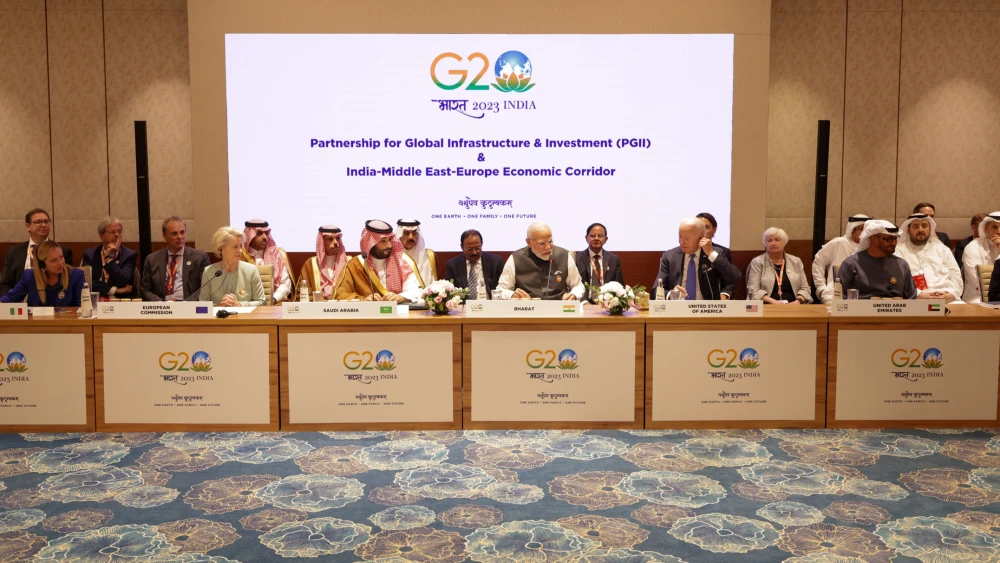

The IMEC (India-Middle East-Europe Economic Corridor) was introduced at the G20 summit in New Delhi in September 2023. Its framework links three layers of connectivity: trade, energy and data. It represented an auspicious move forward.
Then came the Hamas-led terrorist attacks in southern Israel on Oct. 7, and the ensuing war in the Middle East. It stalled IMEC’s progress as an intra-regional connectivity initiative, and Israel was sidelined as an active force within it.
Following “Operation Epic Fury” against the Iranian regime, IMEC has regained momentum among governments and in academia, as the Strait of Hormuz crisis has accelerated global efforts to develop alternative energy routes. IMEC seems like a perfect fit, and the buzz around it has gotten louder.
Now this buzz has entered the current Israeli election campaign.
Most Israeli parties see IMEC as a rare opportunity to change both Israel’s fortunes and global image, and to position the Jewish state as a major power in the Middle East. Through IMEC, Jerusalem could become a valuable partner to other countries, whether in Asia or Europe, that are seeking to connect via the Middle East. That, Israelis believe, will be an effective response to false narratives, as well as the boycott, divestment and sanctions movement.
Moreover, one party—Yesh Atid, part of the Beyachad list—endorses integrating Israel into major regional economic corridors, IMEC chief among them, and promises returns of hundreds of billions of dollars and a vision of Israel as a regional hub that “everything passes through.”
The fact that a major Israeli party now talks about connectivity infrastructure is genuinely good news. Yet a massive gap exists between populist promises during an election campaign and creating impact for Israel the day afterward.
The actual status of IMEC is less dramatic than “hundreds of billions of dollars.” To this day, there is no agreed-upon estimate of its potential impact on the Israeli economy. Some researchers argue that it will generate a maximum of two to three billion shekels. Others will not commit to a specific number, but point to potential benefits like job creation and the strategic gains of becoming a regional hub.
At the same time, some publications are creating panic among decision-makers by arguing that if Israel stays outside IMEC, it will be a disaster, as there are alternative routes in the making via unstable countries like Iraq, Syria and Turkey.
Moreover, whether due to pure populism or advisors misleading politicians, the reasons to commit to IMEC’s trade route remain unclear. There are major challenges: The corridor’s overland leg runs through Saudi Arabia, which means its entire premise depends on Saudi-Israel normalization or steps toward it, a process that has been stalled since Oct. 7. The corridor relies on financing structures across multiple governments that remain unresolved three years after IMEC was announced in 2023. Finally, IMEC depends on regional stability that no single Israeli election, government or minister can manufacture on their own. These issues don’t make IMEC worthless, but they do make it a long-term gamble.
To be sure, connectivity is crucial to the Israeli economy, and developing multiple trade routes is essential for redundancy. However, this distinction highlights the difference between a buzzword and concrete reality. IMEC is an appealing concept, but its feasibility and potential impact on the Israeli economy are questionable. After all, three years after the G20 announcement, IMEC has sparked significant diplomacy and commentary, yet it has produced only a minimal tangible outcome in terms of what it’s supposed to be about: connectivity.
There is also a major issue with relying on a trade corridor as Israel’s main economic-diplomatic asset. It simply won’t be such an asset. Connectivity encompasses more than just trade and railways. Israel’s true, defensible contribution to interregional connectivity and global partnerships is not about speeding up the movement of containers or trucks between Mumbai and Piraeus. It’s about technology. Israeli technologies can enhance value in various sectors relevant to connectivity initiatives worldwide, including energy, defense, cyber, AI, data, fintech, smart mobility and critical minerals processing.
Technology is an area where “hundreds of billions of dollars” is a realistic figure for something that Israel can develop independently, rather than relying on Riyadh and Washington to develop something around it. A corridor’s value depends on what passes through it. Israel’s influence stems from being essential to what passes through the corridor, not from claiming ownership of the infrastructure itself. By prioritizing technology, geographic constraints and geopolitical sensitivities become less significant, allowing business interests to set the tone and treating connectivity as an inclusive concept in its broadest sense.
Connectivity is a strategic priority and should be taken seriously enough to stop chasing trendy buzzwords. Whoever leads the next Israeli government owes the public a connectivity strategy built on Israel’s real advantages, not a campaign talking point.