



On Election Day 2026, U.S. President Donald Trump announced that American military aid to Israel will end this year. I have wanted to read that sentence for a long time.
Then Trump explained why. Israel doesn’t need the money, he said. And why should Republicans “suffer the slings from lunatics like an El-Sayed?”
The first reason is right. The second, regarding wildly anti-Israel Michigan senator-elect Dr. Abdul El-Sayed, should worry every friend of Israel.
Start with what’s right.
Most of the American aid to Israel never actually left America. Israel must spend 92% of the aid on American-made weapons, and every dollar of it by 2028. Those dollars built F-35s in Fort Worth and F-15s in St. Louis. They paid American machinists and engineers.
The money was never a gift to Jerusalem. It was a purchase order for American factories. Moreover, the strings ran one way. As former Israeli Ambassador to the United States Michael Oren said at a debate in New York last month: “We cannot sell to whom we want to sell. We have to buy what we’re told to buy.”
What the aid gave American industry in contracts, it cost Israel in standing. For four decades, the aid let Israel’s enemies describe the Jewish state as a dependent, a client and a line item.
A country that pays for its own weapons negotiates as a customer, not a ward.
But that is not the case Trump made. Israel’s argument for ending aid was about strength. The president’s argument was about cost: the political cost to his party.
Israel is not being promoted to partner; it is being managed as a liability.
Oren warned that Israel might have only a couple of months to make the transition on its own terms before Washington sets the terms instead. He was right about the clock. The terms arrived on Election Day, and they were Washington’s.
Seven years ago, when Reps. Ilhan Omar (D-Minn.) and Rashida Tlaib (D-Mich.) floated the possibility of cutting aid, Trump said he couldn’t believe the country was even having that conversation “because of two people that hate Israel.”
On Election Day, Trump named El-Sayed as his reason for doing it. El-Sayed ran on cutting off aid to a country he accuses of genocide. He won. And before he has even taken his oath, the president has adopted his policy.
The next morning, after Republicans lost both chambers, U.S. Vice President JD Vance listed “change our relationship to Israel” as one of the four ways to win back the voters who abandoned the Republicans.
Put those together, and the logic is plain: Israel is not being promoted to partner; it is being managed as a liability.
That should frighten us.
If cutting aid buys the president some quiet, what does he trade away the next time the critics get loud? Arms sales? The Security Council veto that has shielded Israel from one-sided resolutions for decades?
Once you accept that standing with Israel costs too much, every piece of the relationship has a price, and the people setting that price are the ones who want the relationship gone.
Remember who said it was about the money and make them explain what it’s about now.
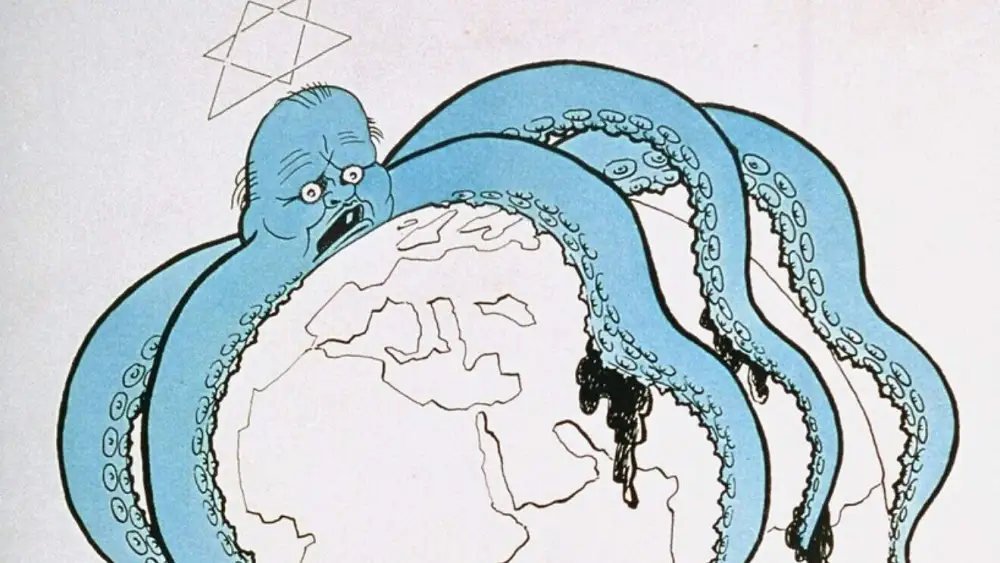
The critics who turned Israel into a liability are working from an old script. I know it well. I grew up in the USSR, where it was state policy. In 1967, my parents’ generation sat through workplace rallies condemning “the Israeli aggressors.” I was born after that war. The anti-Israel cartoons in the Soviet media were still running.
In one, Uncle Sam dropped a bag of dollars on a seesaw and launched an Israeli soldier over the desert: Israel as America’s puppet. In another, a 1971 Krokodil cover, a figure in a Star of David shirt ran off with the Statue of Liberty’s torch: Israel as America’s parasite.
The two contradicted each other, and it didn’t matter. Neither allowed Israel a will of its own.
That vocabulary didn’t die with the Soviet Union. It emigrated. “Your tax dollars fund genocide” is the seesaw cartoon with a hashtag. The parasite cartoon lives on in parts of the American right, where it is believed that Israel drags America into its wars. This is why the end of aid is a test.
Nonetheless, I welcome it wholeheartedly.
If money were the grievance, the grievance should end with the money. The “not one more dollar” chants at the marches should go quiet. The “genocide funding” signs should be retired. The candidates who ran on cutting aid should declare victory and move on to something else.
Of course, they won’t. When the bag of dollars disappears from the seesaw, they will simply reach for the other cartoon. Within months, the target will move: from aid to arms sales, from arms sales to “complicity,” from complicity to the existence of the state itself. That is what happens when a grievance was never about the stated grievance.
When it happens, remember who said it was about the money, and make them explain what it’s about now.
For American Jews, the way forward is twofold.
First, claim this policy on Israel’s terms, not the president’s. Israel asked for it before Trump announced it. Israeli Prime Minister Benjamin Netanyahu has spent the past year saying Israel wants to phase out military aid. He’s done something like it before: During his first term in the late 1990s, he told Congress that Israel no longer needed American economic aid. That aid wound down, and Israel’s economy grew without it.
So, when a colleague says, “Trump finally cut them off,” the answer is simple: No. Israel asked for this. Israel isn’t being cut loose. It is standing on its own two feet. Say that every time someone frames it otherwise, including friends.
Second, stop expecting either party to support Israel for us. Support built on a budget line can be removed with a budget line. Support built on Americans—and American Jews—who actually know what Israel is and why it exists can’t be canceled by a phone interview with Fox & Friends.
In the end, Trump made the right decision for the wrong reasons. I’ll gladly take the decision.


