REPORTER’S NOTEBOOK
PHILADELPHIA—Two days after a boycott against six Jewish- and Israeli-owned restaurants in Philadelphia and one day after arriving back from a week in Israel, I found myself pounding the pavement at night, walking from eatery to eatery in Center City, looking for scraps.
Not leftovers in the literal sense of the word. But when the party is over, some detritus tends to remain.
So does anger, rancor, melancholy, dread, introspection—feelings that go with being targeted on the streets.

That’s what happened to members of the local Jewish community on Nov. 8, one day before the 88th anniversary of Kristallnacht, “Night of the Broken Glass.”
On Nov. 9-10, 1938, Nazi Party soldiers and members vandalized, burned and destroyed as many as 1,400 synagogues and prayer rooms in Germany and Austria; looted and vandalized 7,500 Jewish-owned businesses; smashed other Jewish institutions, organizations and even homes; and murdered nearly 100 people. Some 30,000 Jewish men were arrested and deported to concentration camps.
That is not what occurred in Philly on Sunday. It didn’t because this is America in 2026, not Europe in the late 1930s. World War III is not on the immediate horizon.
Still, it was less than a week after a volatile midterm election that had Israel and the Jews on the ballot, and which saw the election of the first Muslim senator in the United States, a man who has repeatedly put the State of Israel in the crosshairs.
It didn’t occur because, as has been reported widely, as many as 2,000 people didn’t let it. The Jewish and pro-Israel community and its supporters came out in full force to patronize six targeted eateries: Huda, K’Far Café, Mac Mart, Dizengoff, Goldie and Schlesinger’s, each of which is Jewish- or Israeli-owned. (Goldie, a falafel restaurant, is kosher.)
The “Boycott Ride” was organized by Philly Bike On Your Left in collaboration with Boycott CookNSolo and Philly Solidarity Calendar. A flier promoting the antisemitic effort stated: “No business for Zionists” and “These Zionist establishments must go.”


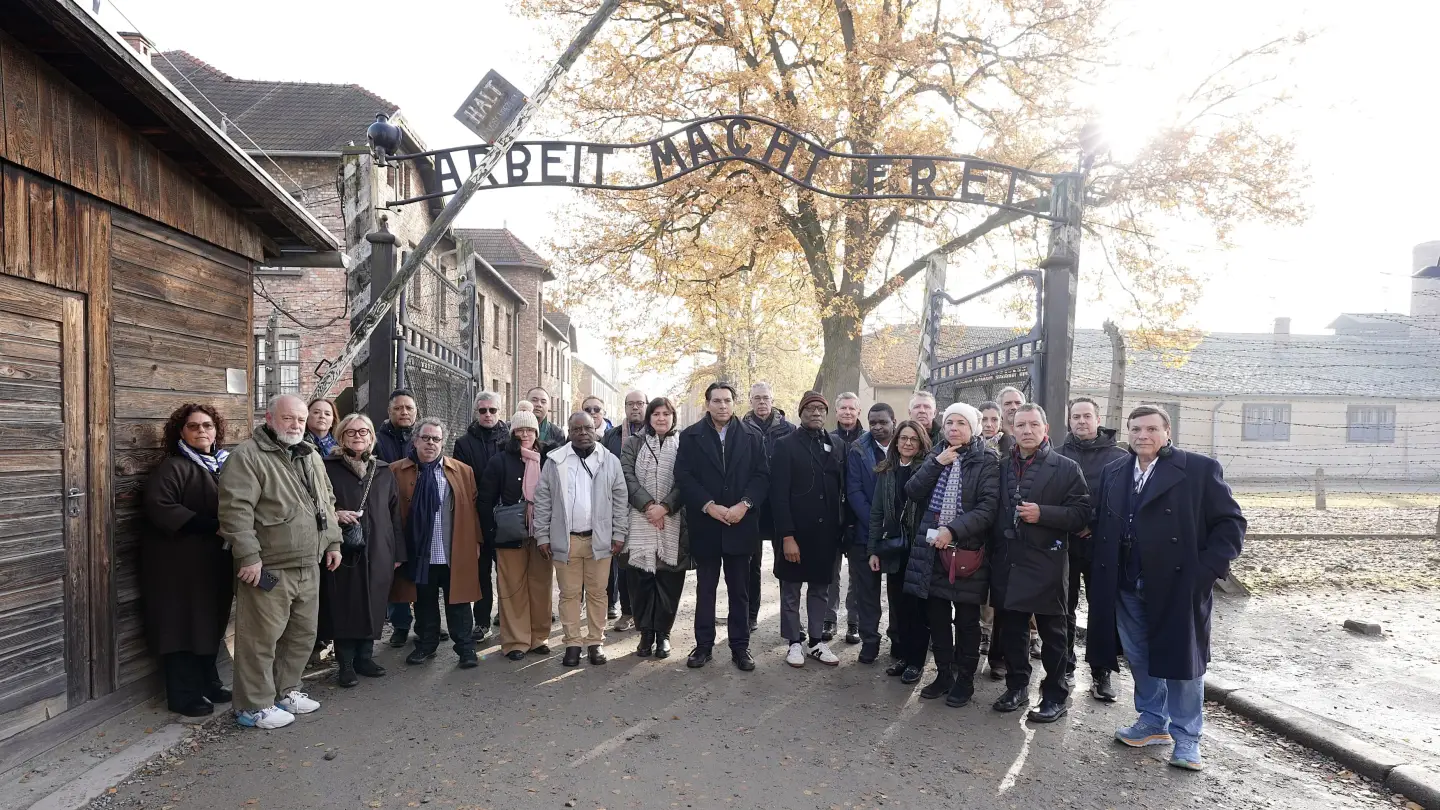
Notice of its ill intentions made it all the way to Israel, where I—a third-generation Philadelphian—got wind of the impending boycott while part of a press trip sponsored by the Or Ofir Foundation and the Israeli Ministry of Foreign Affairs. The program was titled “Standing Against Antisemitism: Voices, Stories and Action.”
The irony didn’t escape me.
And so, after a day of working and fighting jet lag in the waning hours of what I could only imagine was massive destruction and despair nearly 90 years ago this night, I enticed my husband and two of my sons to go out to eat (not a hard sell for teenagers). We headed to Dizengoff because three of the restaurants were already closed for the day. This place had the most room and later hours, and we’d never been there before.
We got a table immediately, which one server noted was unusual. Normally, there’s a wait, he said, even on weekdays. On Sunday, the line formed “before the place even opened,” he told us.

As we looked over the menu, two men sitting next to us were engaged in conversation. One asked the other if he had heard of a book called The Startup Nation. He described its contents, telling his fellow diner about desalinization, drip irrigation and Israeli defense measures.
Multiple works own this title, and I wasn’t sure which they were referring to. All I knew was that they were stewing—and chewing—over developments in the Middle East.


A different server said it was ridiculously busy on Sunday, and that the restaurant “came out on top,” both socially and financially.
That fact was confirmed earlier in the day by the owner of one of the other targeted places, Mac Mart. Marti Lieberman said they typically serve 30 to 50 meals a day, being a smaller model in a standalone kiosk. They’ve only been in this location for about a year, and “we’re still in that education phase,” she said.
“If I get 50 people a day, I’m happy. I had more than four times that on Sunday,” she said. “We were overwhelmed by the support.”
In fact, she sold so much food that she had to close the next day, Monday, to restock.
“It backfired—it backfired 100%,” she said. “It’s mind-blowing that this 105-square-foot mac-and-cheese place, smaller than a food truck, was brought into this. They found us and made assumptions.”
But at the end of the day, said the 37-year-old, “it helped my business. People donated money—it started pouring in—and we want to pay it forward. We are going to donate it to the hungry, to food efforts, foundations.”
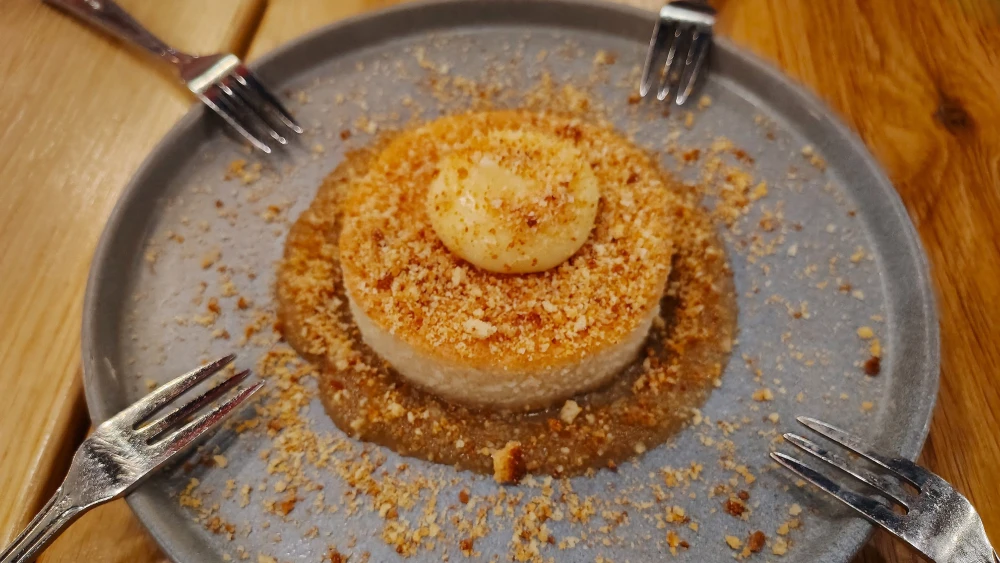
Back at Dizengoff, with the baba ganoush and labneh appetizers polished off, every speck of the tahina-ketchup scraped up by crispy fries, the sabich sandwich boxed to go home, and four forks surrounding an olive-oil cake with a dollop of vanilla cream and a circle of apple butter, I turned to members of the table right behind us.
Nancy Bergen, David Kalkstein and his son, Seth Kalkstein, were finishing their meal. They came to support the restaurant on Sunday but couldn’t get in. “The lines were around the corner,” said Bergen. Later, she learned that Dizengoff had run out of tomatoes and cucumbers, crucial ingredients for a classic Middle Eastern salad.
“The energy was through the roof,” she described. “Everybody was united against hatred of the Jewish people. It was such a bust for the boycotters.”

She mentioned that a similar event is planned for this Sunday, Nov. 15—a “ride of return” (a play on the Palestinian demographic “right of return” to areas before the establishment of modern-day Israel in May 1948), also timed to a “Ride for Israel” with a more positive message: that antisemitism and hatred have no place in Philly or anywhere else.
The elder Kalkstein, who’s originally from Tel Aviv, said, “They want to drive us out. That really got me.” He feels that antisemitism has never left—“that it’s always been there” and “that it rears its head every so often.”
His wife said the boycotters claim that their efforts are anti-Zionist, not anti-Jewish. She knows they’re not, adding that “we talk about this all the time. Every day, we are upset.”
Seth Kalkstein, a software engineer, said he has lost the majority of his non-Jewish friends over this in the past few years: “They want to globalize the intifada.”
He amended that and said he had a few left, though he didn’t sound convinced. I noticed he had crutches next to his chair and he responded: “Yep. I went on Sunday, crutches and all.”

Lieberman, at Mac Mart, which advertises “cheesey macs, snaz & more local goodies to go,” was more optimistic.
She’s worked 14 years in the business in a different part of the city, Rittenhouse Square, where the crowd gathered initially—anti-Israel protesters and pro-Israel supporters, with police trying to maintain order. Groups had formed days earlier from synagogues, community centers, neighborhoods and schools in the heavily Jewish suburbs and even exurbs to send a message.
She didn’t seem shaken. She seemed strengthened. “Good will always prevail,” she said. “This is living proof.”