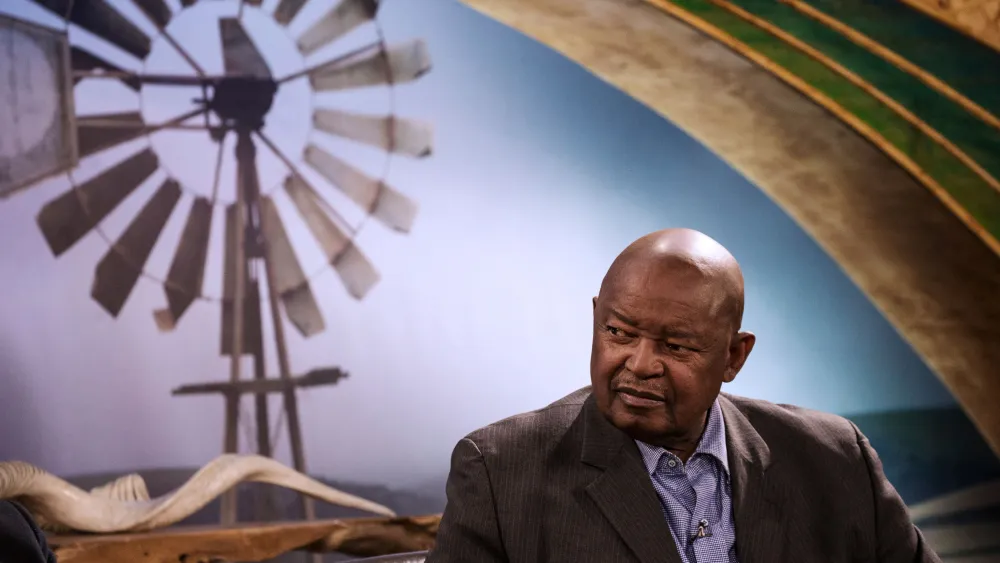

South Africa has lost many political figures over the decades, but few embodied the moral complexity and courage of Mosiuoa (“Terror”) Lekota.
For the Jewish community, his death on March 4 at the age of 77 marks not only the loss of a respected statesman, but the loss of a friend. He stood with us when it was easy, and more importantly, when it was not.
Lekota’s story is inseparable from the story of South Africa itself. Born in 1948, the very year apartheid became official state policy—and also the same year as the establishment of the modern-day State of Israel—he grew up under a system that denied millions of South Africans their most basic rights. As a young activist, he joined the Black Consciousness Movement and student organizations that challenged the apartheid regime, a path that would eventually cost him his freedom.
He spent years imprisoned for his activism, including time on Robben Island, alongside Nelson Mandela and other leaders of the liberation struggle. Those years of sacrifice were not merely symbolic. They forged a generation of leaders who would go on to build South Africa’s democratic future.
Lekota was among them.
After the fall of apartheid, he became one of the most prominent figures in the African National Congress, serving as the first premier of the Free State, and later, as South Africa’s minister of defense under President Thabo Mbeki. Even after leaving the ANC in 2008 to help found the Congress of the People (COPE), his political voice remained rooted in the ideals of constitutional democracy, accountability and principled leadership.
But for South Africa’s Jewish community, Lekota represented something even more profound. He was a loyal friend.
Jewish leaders recall that he met frequently with the community, attended Jewish events and engaged openly on issues affecting both South African Jews and Israel. Importantly, he did so during periods when it was politically fashionable for many in public life to distance themselves from the Jewish community.
Lekota did the opposite. He chose engagement over slogans, dialogue over hostility and truth over ideology.
That commitment was evident even in the most difficult moments. In the wake of the Oct. 7 massacre in Israel, when tensions were high and many public figures chose silence, Lekota attended the commemoration event held by the South African Zionist Federation to honor the victims of the attacks. His presence was not performative. It was a quiet but powerful expression of solidarity at a time when it mattered most.
That moral clarity also extended to his views on Israel itself.
Having visited the country himself, Lekota rejected the increasingly common claim that Israel is an apartheid state. He pointed out something that anyone familiar with apartheid South Africa would immediately recognize: the systems are fundamentally different.
“In Israel,” he observed, “you won’t find the same divisions between Jews and non-Jews that we used to witness during apartheid.” He noted that Israelis of different backgrounds share public transport, schools, and public life in ways that were unthinkable under apartheid rule.
This was not a casual comment. It came from a man who had lived apartheid, fought against it and suffered imprisonment because of it. When someone with that history speaks about what apartheid truly looks like, the world should listen.
Yet today, the apartheid label has become a political weapon frequently invoked by activists and governments seeking to delegitimize Israel.
Lekota’s voice exposed the weakness of that narrative. He understood that the term “apartheid” is not a rhetorical device but a specific historical system—one that millions of South Africans endured firsthand. To casually apply it elsewhere without accuracy is not only intellectually dishonest; it trivializes the lived experience of those who fought against the real thing.
In that sense, Lekota’s position carried a weight that slogans never could. He was not defending Israel because of ideology; he was defending the truth. And perhaps that is the most fitting way to remember him.
Lekota belonged to a generation of South African leaders forged in struggle—leaders who understood that freedom required moral courage, not just political rhetoric.
He stood for dialogue when others chose division. He chose engagement when others retreated into hostility. And he remained steadfast in his belief that South Africa’s strength lies in its diversity of communities, histories, and perspectives. For the South African Jewish community, his friendship will not be forgotten. Nor will his willingness to speak honestly about Israel at a time when doing so required courage.
In an era when historical language is increasingly weaponized for political ends, Lekota reminded us of something simple but powerful: Truth still matters.
And sometimes, the people best positioned to defend that truth are those who lived through history themselves.
Mosiuoa Lekota was one of those people.