


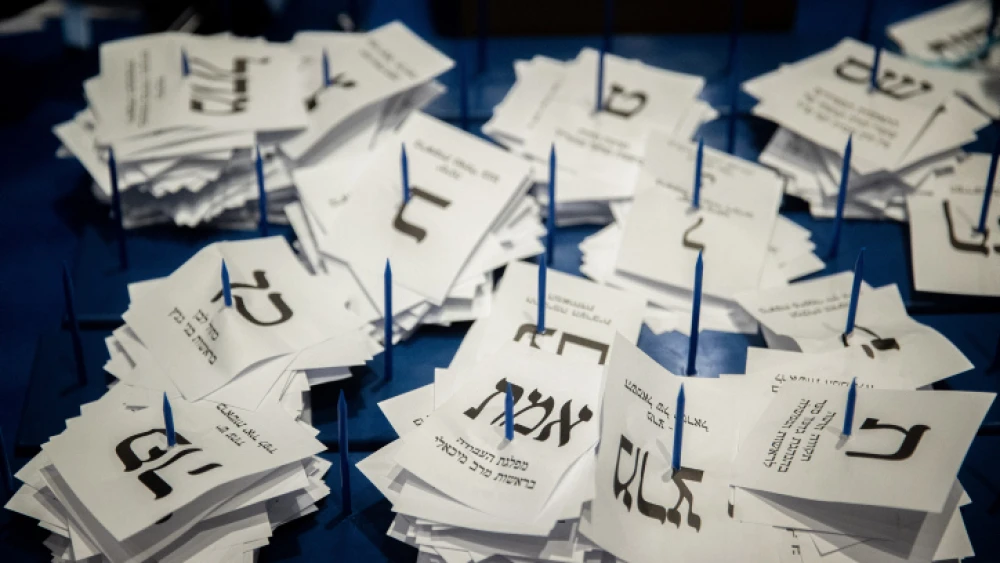
Israel’s election deadlock threatens to further paralyze its political system as, according to polls, neither the right nor the left has a majority, and a sixth round of elections is already around the corner.
The thought of the billions of shekels that go down the drain with each election round—funds that could have been put to much better use, such as education, health and welfare—is mind-boggling.
After four years of elections, Israelis want a stable government.
According to a recent report, 46% of Benjamin Netanyahu’s supporters would accept him establishing a government with the opposing factions, the so-called “anyone but Bibi” camp. And 60% of that camp said they would accept a government that includes Netanyahu.
The conclusion, in my opinion, is clear: Israelis want unity. Moreover, this is not wishful thinking, but a very possible scenario. Strategist Aviv Bushinsky said that after the Nov. 1 vote, “none of the leaders are likely to keep their election promises,” such as refusing to form a coalition with a particular opponent.
Bushinsky stressed that Netanyahu’s approach to Prime Minister Yair Lapid is not as aggressive as that toward Defense Minister Benny Gantz and his associates. He pointed to Netanyahu’s recently published memoir, in which he speaks against Gantz and former Prime Minister Ehud Barak, but not so much against Lapid. The prime minister himself said in an interview that he would not oppose sitting in a government with Netanyahu, but would not do so if Netanyahu is found guilty in his criminal trial.
According to reports, Netanyahu has even complimented Lapid in closed talks, and said that unlike former premier Naftali Bennett, who “tried to copy him and failed,” Lapid is smart and knows what he’s doing.
As such, it won’t come as a surprise if, on election night, Netanyahu’s first phone call will not be to far-right leader Itamar Ben Gvir or head of the haredi Shas party Aryeh Deri, but to Lapid. The prime minister is unlikely to hang up in protest. He will probably listen to the proposal of a rotation agreement in which Lapid will be prime minister for two years while Netanyahu takes care of his legal affairs. If acquitted, he will take over from Lapid when the two years are up. If convicted, another Likud MK, who wins the party primaries, will become prime minister.
The opportunity to join such a unity government will also be offered to the ultra-Orthodox on the right, Gantz and Avigdor Lieberman on the center and Labor on the left, with the Religious Zionist Party and the Arab factions left out.
Nechama Duek is a journalist and political commentator.
This article was originally published by Israel Hayom.



