


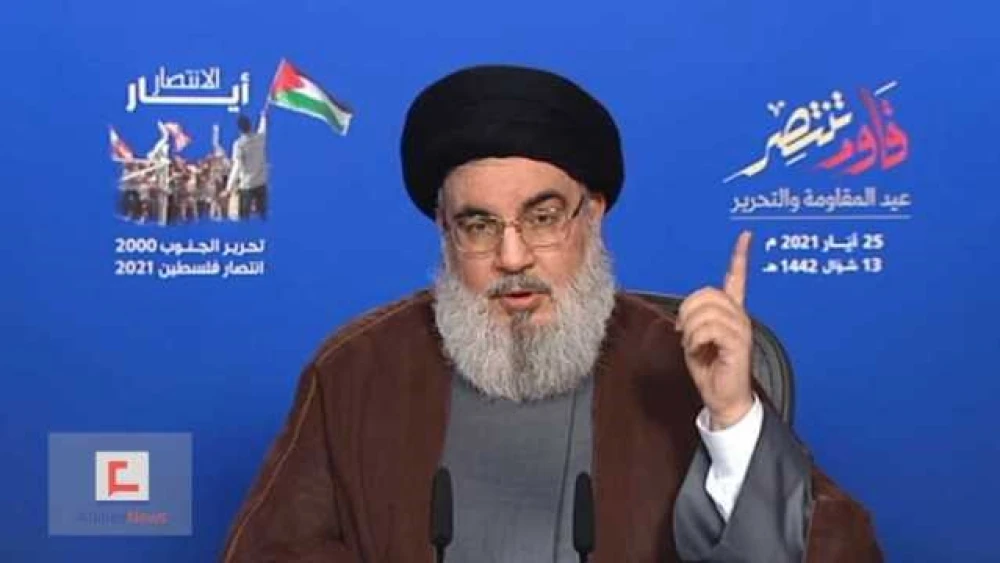
In an interview with adoring interviewer Ghassan Ben Jeddou on Lebanon’s Al-Mayadeen TV, Hezbollah leader Hassan Nasrallah escalated his threats against Israel over drilling activities in disputed waters.
The head of the terrorist organization warned that Israel would not be allowed to drill at the Karish gas field unless it agreed to a maritime border with Lebanon. He also warned that if Israel begins drilling, the matter could escalate into a conflict as early as September. He did not rule out the possibility of an all-out war.
There are two ways to interpret Nasrallah’s warnings. First, as mere swagger, intended to pressure Israel into accepting Lebanon’s demands on the demarcation of the maritime border. Nasrallah could claim credit for such an accomplishment and proclaim that only his threats could have forced Israel to fold.
This ties in well with the fact that a major part of the interview focused on pushing back against criticism of Hezbollah and its leader. Such criticism is increasing by the day in a Lebanon that is on the verge of collapse. In particular, many Lebanese see Hezbollah as a terrorist organization that does not consider the good of the country its number-one priority. They believe that, instead of helping to end the country’s current political crisis and rehabilitate the economy, Hezbollah intends to start a war with Israel. In his interview, Nasrallah insisted that he is a Lebanese patriot.
However, there is another possibility that should not be overlooked, which is that Nasrallah is preparing for a confrontation with Israel over the gas field and the maritime border. If so, Nasrallah believes, this will be a limited military conflict that will only strengthen his position, and will not escalate into an all-out war he does not want.
Why is Nasrallah interested in a limited conflict? In the interview, he said that U.S. President Joe Biden does not want another war in the Middle East, and Israel will probably obey Washington.
But it is also possible that he has other reasons for such an assessment, as Israel is in the middle of a political crisis. The country is led by the new and inexperienced Prime Minister Yair Lapid. The IDF is preoccupied with appointing a new chief of staff, who will only assume his role in January. In short, if Nasrallah does end up hitting the Karish gas field, there is no one to declare war.
If he really believes this, Nasrallah should realize that he may be repeating the same miscalculations that got him in trouble in the 2006 Lebanon war. At the end of that war, he admitted that had he known in advance how Israel would react, he would never have started it. He should know that this time he is playing with fire again.
Oded Granot is a senior Middle East and Arab world commentator.
This article was originally published by Israel Hayom.


