For Rabbi Chaim Steinmetz, of Congregation Kehilath Jeshurun, a Modern Orthodox synagogue on Manhattan’s Upper East Side, observing Rosh Hashanah this year without acknowledging the events of Sept. 11, 2001, would be unthinkable.
“Yes, Rosh Hashanah is a sacred day,” he told JNS. “But nothing could be more sacred than remembering the victims of 9/11, showing gratitude to the heroes of 9/11 and vowing to uproot the evil of terror.”
This year, Rosh Hashanah will begin on the 25th anniversary of the attacks, in which terrorists killed 2,753 people in New York.
“We will absolutely remember 9/11 on Rosh Hashanah,” Steinmetz told JNS. “It is simply too large an event to overlook, and everyone will be thinking about it that day.”
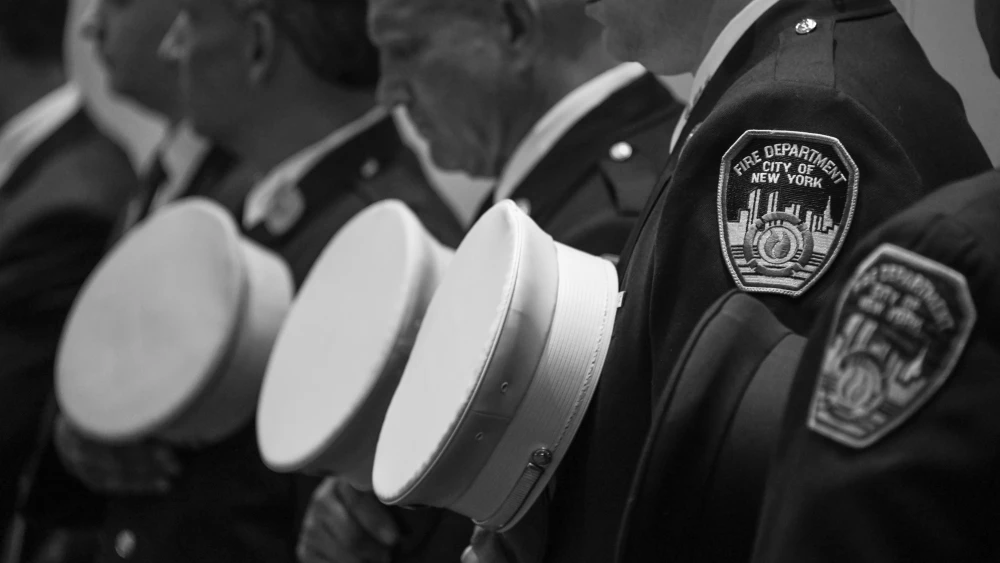
Steinmetz plans to hold the synagogue’s annual 9/11 remembrance on the Shabbat before Rosh Hashanah, when it will honor members of the New York City Police and Fire Departments. Members of the departments will be called up during each of the holiday’s services, and the congregation will honor them.
“We cannot forget the evil of the perpetrators, who murdered thousands in cold blood,” the rabbi told JNS. “The terrorists who perpetrated this attack are nearly ideologically identical to Hamas and Hezbollah.”
“Gratitude is one of Judaism’s foundational values, and very much belongs on Rosh Hashanah,” Steinmetz said. “We will never forget the nearly 3,000 victims of this terror attack, many of whom were members of the Jewish community.”
He added that “above all, we will never forget the heroes who ran into the buildings when everyone else was running out.”
‘Always part of our collective identity’
At Temple Emanu-El, a Reform synagogue on the Upper East Side, Rabbi Joshua Davidson, senior rabbinic chair, plans to incorporate a commemoration of 9/11 into services on the eve of Rosh Hashanah, which falls on Sept. 11.
“Being a synagogue in New York City, many of whose members were here at that time—and all of our members think back on that day with deep emotion—one can’t not, I think, incorporate it,” Davidson told JNS.
“It will certainly be a part of my message, my sermon that night,” he said.
Commemorating the events of that day is not at odds with the seriousness of Rosh Hashanah, according to Davidson.
“People come to the High Holidays with all kinds of things on their minds,” he said. “For some, it’s how to address the challenges of the world at large. For most, it’s how to address the challenges present in their own lives.”
Though internal reflection is of the utmost importance on the holiday, remembering “communal struggles” can be a similarly beneficial and reflective experience, according to the rabbi.
“Rosh Hashanah is Yom Hazikaron—the Day of Remembrance in Hebrew—it’s about God’s remembering covenant with us,” Davidson told JNS. “But remembrance also involves our own remembering where we’ve come from and those events that have shaped us into who we are and the community that we are.”
“It may not be the same for every city, but for New Yorkers, 9/11 is an event that will always be part of our collective identity,” he said.
The convergence of the High Holiday and the somber anniversary can also remind Jews of their communal responsibilities to one another, according to Davidson.
“The way the country responded in the immediate aftermath of the tragedy—how we came together, no matter our political or ideological affiliation—can teach us something about healing the divisions that exist within the country today and within the Jewish community,” he said.