The head of the women’s burial unit of the Israel Defense Forces’ Rabbinate has stated: “We have a mission: 100% verified identification.”
When we think about the heroes of Oct. 7, we tend not to think about 42-year-old women. Nor do we think about lawyers with zero medical or military training.
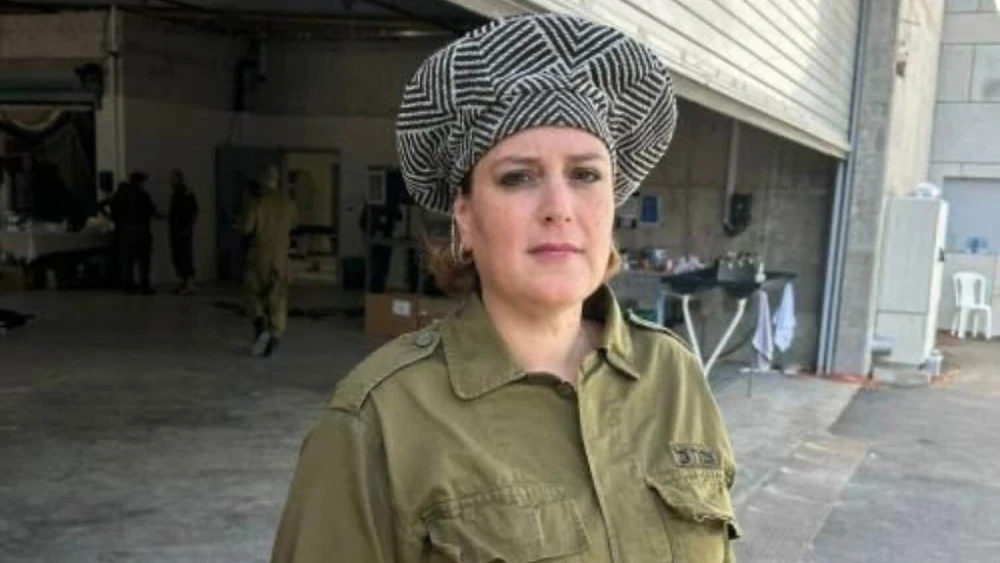
But Efrat Nursi is all of the above, and she is part of an unsung group of heroes whose holy work extended long past Oct. 8 or Oct. 9—the IDF Rabbinate’s chevra kadisha, or burial society. In Jewish tradition, the dignity of the deceased is a supreme value, and the IDF Rabbinate is assigned the sacred, yet difficult task of purifying fallen soldiers in preparation for burial.
Hundreds of fallen have been brought to Shura Base, home to the IDF Rabbinate, which is committed to 100% accuracy in identifying victims in line with the policies set forth by IDF Chief Rabbi Eyal Krim. Soldiers in the rabbinate’s identification and burial unit undergo extensive training, including on cutting-edge technologies, to be able to fulfill that mission.
If a female soldier dies while enlisted, she is given identical care as male victims. Since female soldiers’ deaths were few and far between, though, volunteer women from the female victims’ local burial society were called upon when the need arose.
In the last 15 years, more women have been entering army combat units, thus raising the risk of more female deaths. Recognizing this new reality, a designated unit of women was established to assist in the identification process and burial preparation for female fallen soldiers, a chevra kadisha operating under the IDF Rabbinate.
In 2010, Sharon Laufer, originally of Teaneck, N.J., recruited the first group of eight female volunteers. Each volunteer undergoes specialized training identical to that of the male volunteers.
In an eerily prescient move, the IDF Rabbinate decided to formally draft these volunteers in July 2023 as reserve-duty soldiers—with uniforms and all—enabling the IDF to issue them emergency draft orders in times of war.
Less than three months later, their expertise was needed beyond anyone’s worst nightmares.
A total of 306 soldiers were killed in Hamas’s invasion into communities in southern Israel, including dozens of female soldiers who literally protected the surrounding settlements with their bodies.
Nursi described the chaos of the first hours of the war: “They called us in on the Sabbath morning (Oct. 7), and we arrived along with a team of men to start preparations for the burial of the many fallen soldiers, both male and female.” She emphasizes that “when a fallen female soldier arrives, only women handle the body. The medical team might include a male professional, such as a dentist, but as far as the tahara (purification process) is concerned, there can never be a situation where a man handles a fallen woman.”
Nursi noted that soldiers who die sanctifying God’s name in battle don’t require the typical purification, as Jewish tradition teaches that “they’re already pure and holy.” As such, the main work is preparation for burial.
In her regular life, Nursi is a 42-year-old lawyer, volunteering in the chevra kadisha in her town. Today, she is the head of the IDF Rabbinate’s women’s chevra kadisha.
“We end up handling women we are connected to personally—neighbors, friends of friends. Because I have a sense of mission, I manage to deal with the difficult sights,” she explains. “I manage to disconnect because I know why I’m there. I tell myself, ‘There’s another family whose doubts we’ve removed.’ ”
When asked how the terrible condition of some of the bodies complicated the identification process, Nursi prefers not to answer the question directly. “The identification task was very difficult because of the barbaric behavior of the terrorists,” she says. “Our aim was to complete it as quickly as possible but with 100% certainty.”
“I don’t want to go into details, to preserve the honor of our holy female soldiers. But I’ll say that when I used to purify women who died tragically in car accidents, it doesn’t compare in any way to what we saw then.” The cases were so complex that women of the IDF Rabbinate’s chevra kadisha were working to identify Oct. 7 victims for many months, well into 2024.
I ask Efrat how she’s doing, but she replies that the question shouldn’t be directed at her.
“We don’t need help,” she says, “only the families who have lost their dearest and the wounded who need prayers.” Other members of her team demur, illustrating the lasting effects on their mental well-being from handling mutilated and burnt victims, many of whom were subject to rape or sexual violence as well.
“You know how you enter this event, but you have no idea how you’ll come out of it,” says a fellow comrade. “Things arise unexpectedly when you return home. You open the refrigerator and smell the refrigerator of the bodies; you see your son lying down and remember the sights from Shura Base.”
In October 2023, the women’s unit was working nonstop, seven days a week.
“I personally was here all through the Sabbath,” says Nursi. “We received instructions from the chief military rabbi that elements of the identification work continue on Saturday (even for those who are Sabbath-observant). We work in shifts to try to ease the burden on the families as much as possible. That’s our mission, to treat them in the most respectful way possible.”
What emotions does she experience as we approach the second anniversary? “It’s difficult,” she replies. “I think about the families of the fallen, and it’s very difficult. I’ve been given this privilege to return something to those who sacrificed on our behalf. But mostly, it’s hard to say, because I don’t feel like it’s behind me. I’m still in it. The war is ongoing. I served for nearly two years; there were constantly new cases to take care of. Two years … it’s simply insane.
“When they called us on Oct. 7 and even in the weeks afterward, no one imagined that we’d be here so long. When they first mentioned we’d be in the reserves during Chanukah, we were like, ‘What?’ We’re not going to be here on Chanukah.
“A couple months later, when someone mentioned Passover, we were like ‘What?’ We’re not going to be here Passover. Yet there we were again, on Simchat Torah (the Jewish holiday on which Hamas’s attack took place) last year and beyond.”
“Any thoughts on how to move forward from here?” I ask. Efrat offers a prayer: “God willing, may we have strength, see light, and may I have no more work.”
But as long as, tragically, Nursi does have work, I pray that we appreciate how fortunate we are to have an army that aligns with Jewish values. That we appreciate those, such as Nursi and Laufer, who give of their soul to ensure dignity for the martyred. And I pray that we be worthy of their sacrifice.