


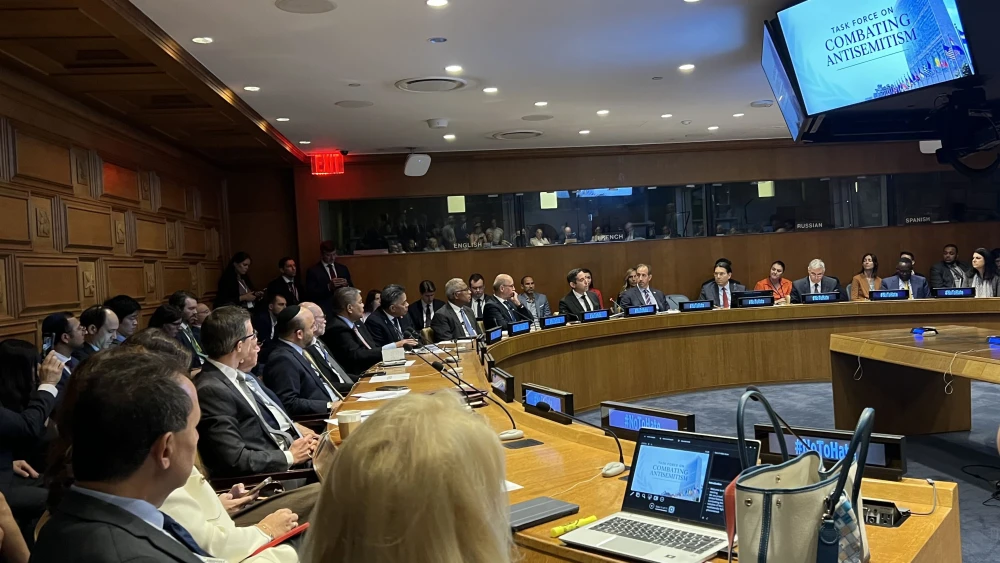
Danny Danon, Israeli ambassador to the United Nations, was motivated to launch a U.N. Task Force on Combating Antisemitism due to growing concern about Jew-hatred worldwide and a disconnect between governments expressing concern publicly and following that up with action.
“Nobody will make a commitment, but we see the gap between the declaration and the action,” Danon told JNS after he launched the task force during an event in Turtle Bay on Wednesday. “That’s exactly what we were trying to do—to close that gap.”
The Jewish state has been working on the initiative for several months and wanted other countries to help shape the panel’s eventual recommendations. “It’s a team effort,” Danon told JNS.
Representatives of dozens of countries, including the United Kingdom, Australia, Argentina and Slovakia, attended the task force launch and its first meeting, according to the Israeli mission to the global body. JNS also attended.
Danon shared a video collage of antisemitic attacks and news reports documenting anti-Jewish hatred around the world. Attendees faced each other at a round table, with the phrase “no to hate” displayed in front of each participant.

“The words ‘Never Again’ were not meant to be a slogan,” he told journalists during a U.N. Security Council stakeout announcing the panel. “They were meant to be a commitment.”
The Israeli envoy said that there has been a 136% increase in Jew-hatred across the seven countries with the largest Jewish populations outside Israel since before Oct. 7.
“Today, we issue a warning,” he said. “This has become an international problem. This demands an international response.”
At the meeting, Danon said that antisemitism has taken increasingly visible forms across the world, including online, on college campuses and within international institutions.
The United Nations must confront Jew-hatred not only in the international arena but “right here within the walls” of the organization, he said.
The coalition of U.N. member states is intended to identify emerging threats, develop policies and tools to combat them and coordinate diplomatic action, according to Danon.
“That’s why we coordinate government efforts, provide guidance and learn from each other,” he said at the meeting.
The task force will develop and issue concrete recommendations and “measurable” results rather than symbolic statements, according to the Israeli envoy. He added that the panel will address Jew-hatred within the United Nations and that rising antisemitism is “not only outside in the street but also inside.”

At the task force meeting, Katharina von Schnurbein, European Union coordinator on combating antisemitism, told attendees that “it is fully unacceptable that Jews in many regions of the world look across their shoulder in public or even hide their identity.”
“There can be no excuse for antisemitism,” she said. “It cannot be tolerated anytime or any place.”
Mark Goldfeder, an Orthodox rabbi and director of the National Jewish Advocacy Center, called on governments and international institutions to move beyond decrying Jew-hatred and to focus on enforcement.
“Condemnation can be filed away, but the subpoena can’t,” he told attendees. “The difference between the two is the burden of proof.”
“Count your prosecutions, not just your statements,” Goldfeder said.
Goldfeder told JNS that “the honest answer to ‘why now’ is that we have run out of road on words.”
“Every government in that room has condemned antisemitism, most of them more than once, and last year 20 Jews were murdered anyway, the most in more than 30 years,” he said. “So a task force is only worth launching if it exists for the step after the condemnation, and as the ambassador explained, he wants action.”
Jeff Bartos, U.S. representative to the United Nations for management and reform, described antisemitism as a global “pandemic” and criticized what he said is longstanding U.N. institutional bias against Israel.


The U.N. has a choice,” Bartos told attendees. “It’s time for choosing.”
Confronting antisemitism is necessary for the long-term viability of the global body, Bartos said.
Danon said that words alone would not address the problem of Jew-hatred.
“Words, declarations and statements are not enough to fight the rising antisemitism on the streets, in synagogues, in universities and even here at the United Nations,” he said. “It’s time for action.”


