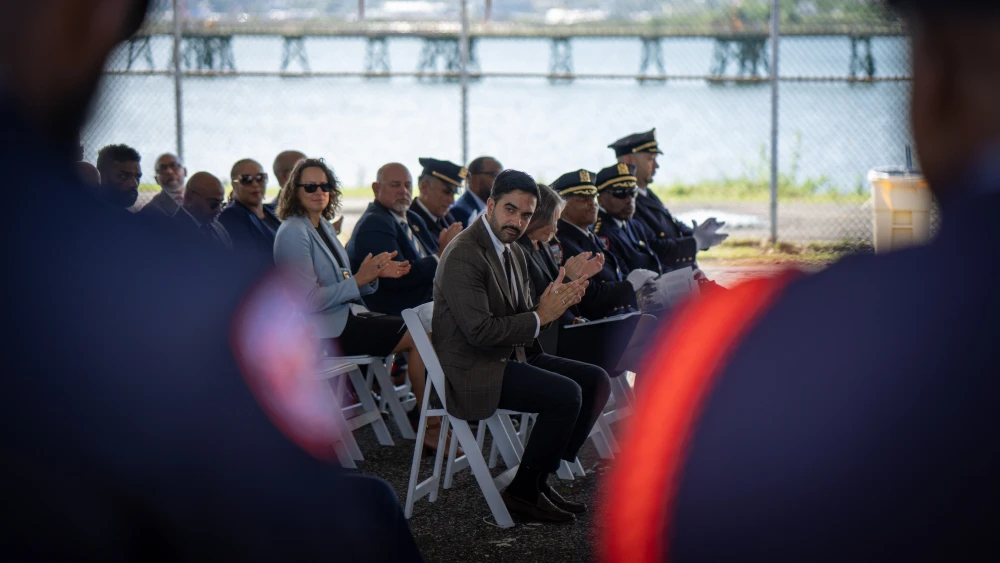

New Yorkers are debating whether or not it is appropriate for Mayor Zohran Mamdani to attend the ceremonies commemorating the 25th anniversary of the terrorist attacks on America on Sept. 11, 2001. But, like the one about his boycott of the city’s annual “Israel Day” parade, most of the arguments miss the point.
The presence of a politician who has cheered on other Islamist terrorists in his career may be unwelcome to many of the families of the victims, and to other New Yorkers and Americans. But just as there was no way to force him to honor Israel by attending the annual parade in New York City, as mayor, he cannot be stopped from being at the 9/11 ceremony. So those there while the names are read aloud of the 2,977 people killed at the World Trade Center, the Pentagon in Washington and on a field in Shanksville, Pa., by Al-Qaeda terrorists will have to endure his presence.
Overshadowed by Afghanistan and Iraq
What matters about this kerfuffle goes beyond anger about the radical mayor’s ability to insinuate himself into the ceremony. If anything, the fact that New York City is now governed by someone who, though condemning terrorism, views America and the West from a perspective not dissimilar to that of those who committed the 9/11 attacks, is something that ought to be considered entirely relevant to the discussion of such a significant anniversary.
The horror of the assault on America 25 years ago is something those under 30 don’t remember. Even for many of us who do recall where we were that awful morning when we first heard the news of what was happening in Lower Manhattan, the memories of 9/11 are now bound up more with subsequent events.
The long, bloody and ultimately disastrous wars that the United States fought in Afghanistan and Iraq have become the primary focus for any discussion of the aftermath of 9/11 or what it meant. Indeed, the anger about those failures dominates the historical memory of George W. Bush’s presidency. Bush’s mistaken belief that he could remake the Middle East by exporting Western democracy to nations that were neither prepared for such a transition or even wanted it led many Americans to accept a distorted view of what led to those conflicts.
The idea that Americans can turn their backs on the world—and so avoid wasting so much blood and treasure on forlorn efforts to impose our values on other peoples—is deeply rooted in the country’s historical traditions. The United States has always viewed its defense as defined by oceans and continents, and therefore felt safe ignoring the rest of the world. Foreign wars, not to mention Bush’s failed experiments in nation-building, are almost always unpopular and easily depicted as imposed on the country against its will by those pursuing agendas other than American security.
Indeed, President Donald Trump’s rise and takeover of the Republican Party was part of this sea change in U.S. politics, though that would have been unimaginable on Sept. 12, 2001. It was largely based on a belief that Bush and the rest of the party establishment were more focused on futile foreign wars while pursuing domestic policies that worsened the lives of working-class Americans.
It wasn’t a ‘war on terrorism’
Much was wrong with Bush’s policies at home and abroad. But he was right about one thing.
The lesson of 9/11 was that in the 21st century, it was no longer possible for Americans to live in splendid isolation from foreign threats, especially those originating in the Middle East. Most Americans may not have been interested in an Islamist belief centered on a perpetual war on the West; however, those pursuing that hateful cause were and are very interested in such a prospect. Bush might have been wrong about the wisdom of investing so much into the conflicts in Afghanistan and Iraq. And by toppling the despotic Saddam Hussein in Baghdad, he wound up strengthening an even more dangerous threat to the West in neighboring Iran.
Bush foolishly named the conflict a “war on terror,” even though the enemy was a global Islamist movement, and terrorism was just the foe’s preferred tactic. Whatever name was used, it wasn’t a product of mistaken intelligence about Saddam’s weapons of mass destruction programs or a doomed crusade for democracy in the Muslim and Arab worlds. It was a Western recognition that a great many Muslims and Arabs were already waging a war on them before 9/11, and that rather than going back to sleep, Americans needed to do something about it.
Desperate for international support, especially from Arab nations with governments that were as afraid of the Islamists as Washington, Bush bent over backwards to avoid accurate descriptions of what was at stake. He was equally worried that he might fuel prejudice against innocent American Muslims. His laughable repeated insistence that Islam was a religion of peace did far more harm than good—and not just because the idea that there was a post-9/11 anti-Muslim backlash was a myth without any empirical evidence to back it up.
The war in which the 9/11 attacks were a historical milestone was not against “terrorism.” It was and remains a clash of civilizations in which Islamists are not merely destructive radicals, but a global force that seeks the destruction of Western civilization and American constitutional democracy. Yet most Western leaders then and now have continued to refuse to acknowledge this basic truth.
America’s post-9/11 counter-attack against Islamism was not limited to the failed wars in Afghanistan and Iraq. Al-Qaeda was, if not entirely wiped out, still severely damaged. But President Barack Obama’s obsession with winding down Bush’s wars caused him to misread what was happening in the Middle East. The “Arab Spring” of 2010 and 2011 was not—contrary to the understanding of the Obama administration and its mainstream media cheerleaders—a drive for democracy. It was rooted in a desire to replace brutal authoritarians with equally brutal Islamists. And his push for appeasement of Iran was based on a misreading of Iran’s goals. It didn’t want to “get right with the world,” as Obama said. It was an Islamist terror regime that had been at war with America since 1979.
Misunderstanding Islamism and its allies
The Islamist foe of the West that made itself felt on 9/11 may not call itself by the same name used by those terrorists. But in its various current guises, whether among Sunni Muslims who supported ISIS as well as Hamas and the Muslim Brotherhood or its Shi’ite versions embodied by the Iranian government and its Hezbollah auxiliaries, it remains just as much at war with America as it was a quarter-of-a-century ago.
Part of the confusion felt by many Americans is their mistaken belief that the war waged on Israel by Iran and its allies is somehow unconnected to the forces that assaulted them on 9/11. That is largely the result of misleading Islamist propaganda that has both demonized Israel via the spread of blood libels about “genocide” and tapped into toxic Marxist ideas that enabled them to falsely depict the Jews and their state as “white” oppressors.
Leftist orthodoxies embodied in critical race theory, intersectionality and settler-colonialism that have come to dominate academia, the arts and the media in recent years have played a large role in mainstreaming and normalizing the antisemitism that lies behind these lies. But these beliefs have also obscured the direct link between efforts to destroy the State of Israel and the Islamist conviction that the West must also be overthrown.
And that’s why the ascent of Mamdani, coupled with the rest of the “progressive” movement that seems on the cusp of taking over the Democratic Party, remains relevant to any discussion of the legacy of 9/11.
Hasan Piker speaks for many
Popular leftist Muslim streamer Hasan Piker spoke for many who shared his hate for Israel and the West when he said that “America deserved 9/11.”
Mamdani and Michigan Democratic Senatorial candidate Dr. Abdul El-Sayed, who campaigned with Piker, may say they disagree with him about 9/11, yet they do so because it is politically expedient. Still, the entire mindset of the Democratic Socialists of America and their political allies views the United States as an imperial, colonialist and racist power that must be defeated. Indeed, that is the whole point of the settler-colonialist belief system that wishes to undermine American exceptionalism and traditional conceptions of Western civilization as much as it desires Israel’s extinction.
The uncomfortable truth about the intersectional left-wing movement supporting people like Mamdani and El-Sayed is that whether they fully comprehend it or not, they share much of the worldview of those who were behind 9/11. The same ideas that mobilized the 2001 U.N. Conference against racism in Durban, South Africa, which sought the international isolation of Israel, are connected to the notion that the West is inherently evil.
This is now also being echoed to some extent on the political right.
Since 9/11, a number of high-profile political commentators and podcasters on the right have succumbed to the siren song of isolationism. Unsurprisingly, among the leading exponents of that false view of America’s place in the world, people like former Fox News host Tucker Carlson have become open apologists for Iran, Qatar and the Muslim Brotherhood’s American supporters. Many of his followers, and those of even more extreme voices like conspiracy theorist Candace Owens and neo-Nazi groyper Nick Fuentes, may prefer to blame all the ills of the world on the traditional scapegoat of the West: the Jews. But they and those on the left who echo such views fail to realize that they have all become the dupes of those who share the goals and belief systems of the 9/11 terrorists.
This—and not the fact that, as The Wall Street Journal reported, Mamdani gave the pen he signed the annual 9/11 city proclamation to his chief legal counsel Ramzi Kassem, who previously represented Al-Qaeda terrorist clients—is why we should be outraged about him being there at the 25th-anniversary ceremonies.
The thing we should be worried about is not who shows up at 9/11 ceremonies. It’s that a considerable portion of the American public has now fallen under the sway of those who also hate America and the West for some of the same reasons that motivated the murders of nearly 3,000 Americans. This is why, although it took place a long time ago and has been overshadowed by subsequent events, that assault on America and the worldview of those who launched it is very much part of our contemporary politics.
Americans need to wake up to the fact that, contrary to the way 9/11 is remembered by much of the media and the political establishment, that dark day was part of a generational “forever” war that can’t be wished away by politicians on the right or the left.
The conflict is between two civilizations that cannot coexist peaceably. The red-green alliance of Marxists and Islamists may want to obscure this truth, as do some of their antisemitic allies on the right. But as much as we might wish it not to be so, Americans need to keep fighting the war against Islamism, and its apologists and rationalizers. Doing so will require judgment as to where to stand their ground and where not to, as Bush’s failures illustrated. Yet if they don’t, sooner or later, their enemies will remind them why the violence that was aimed at them on 9/11 isn’t a historical memory, but a current reality.
Jonathan S. Tobin is editor-in-chief of JNS. Follow him: @jonathans_tobin.